
Start with the key idea
Choose a tutor by checking subject and curriculum fit, how they use the learner’s actual work, what the child will do in a session, how progress is reported and the practical terms. Compare observable teaching rather than promises of guaranteed marks.
1. Define the help you are buying
Start with a specific need: understanding a current fraction topic, expressing reading answers with evidence, or rebuilding a missed prerequisite. “Improve everything” is too broad to judge in a short trial. Bring a recent work sample and the school’s actual topic list.
Distinguish first teaching, homework support, revision and exam preparation. A tutor may be strong at one and less suited to another. Ask how the first few sessions will respond to the need you described rather than accepting a generic course tour.
Ask the child what feels difficult and what they hope will change. Their response is one piece of evidence, not the sole diagnosis. A useful starting point combines their account, actual work and teacher guidance where available.
2. Check the exact course and teaching level
Name the grade or year, country, curriculum, subject and current book or syllabus code. Two learners both called Grade 8 can be studying different sequences. Ask the tutor to explain how they will confirm the scope before teaching.

For exam preparation, ask which current specification and assessment structure they use. Request a demonstration with an appropriate example, not a claim that the provider covers every board. A subject qualification alone does not prove familiarity with a particular marking requirement.
If the tutor is unsure, a clear plan to check the specification is better than invented certainty. BananaLearn enquiries should include these details so fit can be discussed; this guide does not claim that every course or examination route is currently available.
3. Watch the child’s thinking during the trial
A useful trial includes a task the learner can attempt, time to explain their thinking, and a response from the tutor. Notice whether the tutor asks a focused question, provides a model when needed and checks a fresh attempt afterwards.
The tutor should not manufacture success by giving every step immediately. Nor should they leave a learner guessing indefinitely. Ask how they decide when to offer help and how they record the difference between independent and supported work.
A polished slide deck is useful only if it helps the teaching. Listen for clear explanations, accurate examples and a pace the child can follow. A trial is a small sample, so use it to form questions rather than treating it as proof of long-term results.
4. Ask what progress evidence will look like
Request a concrete example of feedback: the idea practised, one task the learner could complete, a remaining difficulty and the next step. “Great lesson” is pleasant but gives little information about learning.
Ask how the tutor revisits earlier topics and checks a new example without copying. Marks, confidence and attendance can be useful observations, but none alone proves that a concept is independently understood. Keep support levels visible.
Agree a review point and what you will discuss then. A reasonable review asks whether the planned help is working and whether the plan should change. Avoid guaranteed grade increases or a fixed speed of improvement without credible evidence and clear conditions.
5. Clarify the practical terms before committing
Ask who teaches, the session duration, time zone, cancellation and rescheduling rules, how missed lessons are handled, and whether the tutor may change. Get the current written offer from the provider. Do not assume an hourly price means a sixty-minute lesson.
Check device requirements, audio, the writing method and whether the child can see and respond to the materials. Desktop or tablet can make diagrams and working easier to manage, but suitability depends on the actual setup. Test the intended device during a trial.
Ask how recordings, messaging and the child’s work are handled, and who can access them. Use the provider’s current privacy information rather than relying on an informal promise. A parent should know the communication route and boundaries.
6. Compare two options with the same evidence
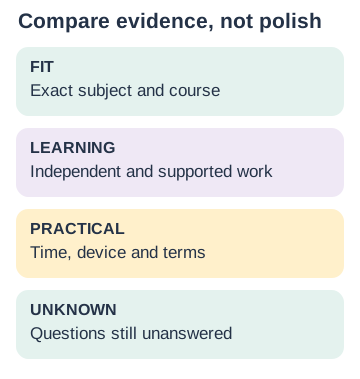
Use a simple table with need, curriculum fit, teaching response, learner participation, progress evidence and practical terms. Write observed facts or unanswered questions in each row. Leave unknowns blank rather than giving a high score because the presenter was confident.
After the trial, ask the child to explain one thing they learned and one point still unclear. Compare that with the tutor’s feedback. Their answers may reveal a mismatch worth discussing before a larger commitment.
Choose the option that fits the learner’s need and the family’s workable schedule. If neither can explain the next step clearly, keep looking or ask the school what support would be most useful. More sessions are not automatically the right response to an unclear plan.
5 worked examples with reasoning
1. A provider says it covers every curriculum.
- Ask for the exact subject, level and syllabus currently needed.
- Request an example of how it checks the scope.
- Treat unsupported breadth as a question, not proof of fit.
2. A trial contains only tutor explanation.
- Ask for a fresh learner attempt.
- Observe how the tutor responds to the reasoning.
- Separate a clear presentation from evidence of learner use.
3. Feedback says “excellent progress”.
- Ask what the child could do independently.
- Request a remaining target and a concrete next task.
- Use the detail at the agreed review point.
4. Two offers use different billing units.
- Write the number of sessions and minutes per session.
- Check the total price and current rescheduling conditions.
- Compare like with like rather than the headline number.
5. A child likes the tutor but cannot explain the lesson idea.
- Keep rapport as a positive observation.
- Ask the tutor how understanding was checked.
- Use another appropriate task before drawing a conclusion.
Save the guide or print the practice
Download to save or share
Complete guide with answers (PDF) · Worksheet without answers (PDF) · Worksheet and answer key (PDF)
Try each situation before reading the suggested response. These are learning decisions, not a diagnosis or a score of parenting.
14 practice questions with explanations
Try each situation before reading the suggested response. These are learning decisions, not a diagnosis or a score of parenting.
Write an answer and your reason before opening the explanation. Check the reasoning as well as the final answer.
- Need
Improve the brief “Help my child with Maths”.
Answer and reasoning
For example: Explain ratio word problems from the current school unit.
A specific need makes teaching fit easier to assess.
- Scope
Which course information should you supply?
Answer and reasoning
Grade, curriculum, subject and current topic or syllabus code.
Labels alone may hide different sequences.
- Trial
What should follow a worked explanation?
Answer and reasoning
A suitable fresh learner attempt.
It checks use rather than copying.
- Support
What should feedback say about hints?
Answer and reasoning
Whether the answer was independent or supported.
Correctness alone can conceal support.
- Evidence
Does attendance alone prove progress?
Answer and reasoning
No.
It shows participation, not understanding.
- Claims
How should a guaranteed-mark claim be treated?
Answer and reasoning
Ask for evidence and exact conditions; do not treat it as assured learning.
Outcomes depend on more than the promise.
- Terms
Why confirm minutes per session?
Answer and reasoning
An hourly-looking price may use another session length.
Compare the actual service purchased.
- Schedule
What time-zone detail matters?
Answer and reasoning
The learner’s and tutor’s local time, including daylight-saving changes where relevant.
A recurring time can shift between countries.
- Device
What should be tested on the intended device?
Answer and reasoning
Audio, readable material and a usable way to show working.
A successful login alone does not prove lesson usability.
- Privacy
What should you ask about recordings?
Answer and reasoning
Whether they are made, who can access them and how they are handled.
Use the current written policy.
- Review
What makes a review point useful?
Answer and reasoning
Compare actual learner work with the agreed target and decide the next step.
A review should inform a decision.
- Unknown
How should an unanswered comparison-table item be recorded?
Answer and reasoning
Unknown or a follow-up question.
Do not replace missing evidence with an optimistic score.
- Child voice
What can you ask the child after the trial?
Answer and reasoning
Explain one learned idea and one point still unclear.
This gives a more useful response than only asking whether it was fun.
- Decision
Must you buy more sessions when the plan is unclear?
Answer and reasoning
No.
Clarify the need and teaching approach before expanding the commitment.
Use the ideas without looking at the notes
Make a one-task record: the question, the learner’s first response, the support offered, what happened next and one fresh follow-up. Use the evidence to choose the next step rather than assigning a label.
Common questions
Should I choose only by price?
Compare price alongside exact session terms, teaching fit and evidence of learner participation.
Does a fun trial prove that a tutor is effective?
Enjoyment matters, but also inspect explanations and a fresh learner attempt.
Should a tutor guarantee marks?
Treat guarantees cautiously and ask for evidence and conditions; a learning plan should show concrete next steps.
Can a tutor help without knowing the exact school book?
Sometimes, but they should establish the required topic and scope before claiming course alignment.
Connect your learning
Ask about one-to-one learning support if your child needs help explaining these ideas.
About this guide
Original explanations, examples, diagrams and practice by BananaLearn. The grade label indicates the intended learning level; this is not an official textbook extract or exam paper.