
Start with the key idea
Confirm the exact IB programme, subject, level and current school task. Ask a tutor to demonstrate how they check understanding, respect assessment rules and report independent progress. This guide helps families evaluate suitability; it does not claim that BananaLearn is an IB World School or offers every IB course.
1. Name the programme before discussing a package
IB offers distinct programmes, including the Primary Years Programme, Middle Years Programme, Diploma Programme and Career-related Programme. Ask the family or school to identify the actual programme rather than inferring it from the child’s age alone. Then record the subject, year or stage and current unit.
For Diploma Programme mathematics, the official IB subject information distinguishes analysis and approaches from applications and interpretation, with standard-level and higher-level options. Those details matter when checking tutor fit. A tutor’s experience in one course does not by itself establish suitability for another.
Make a one-paragraph brief: “My child is studying this programme and subject, using these school materials, and needs help with this particular task.” If the family is unsure of the course name, ask the school before accepting a confident generic plan.
2. Separate concept teaching, revision and assessed work
Identify the problem the tutoring is meant to solve. A learner may need help understanding a mathematical relationship, explaining a scientific claim, organising an independent revision plan or interpreting teacher feedback. These needs call for different teaching choices.

Ask what the tutor will do in the first session and what the learner will do. “We will cover the syllabus” is less informative than a plan to inspect a sample, teach a missing idea and check a new application. Ask how school guidance will shape the work without turning the tutor into the author of the student’s assignment.
When an assessment is involved, ask the school what outside support is permitted. A tutor can explain a general skill using a separate example, but should not complete the learner’s assessed response or disguise adult-written work as the student’s own. School and IB rules should guide the boundary for the actual task.
3. Look for reasoning during the trial
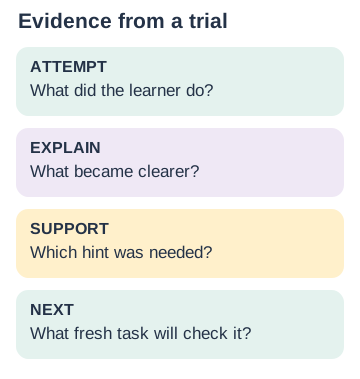
Bring a suitable independent sample and ask the tutor to respond to the learner’s thinking. A useful trial gives the student time to attempt, explain uncertainty and try a fresh example after feedback. Watching a polished solution alone does not show whether the tutor can identify and address the learner’s difficulty.
For an original simple illustration, suppose a student uses a graph but cannot explain what its slope represents in context. A tutor could ask what changes on each axis, compare two points and connect the numerical rate to units. This is a general teaching example, not a claim that one task represents the level or full content of an IB course.
Afterwards, ask the student what became clearer and ask the tutor what still needs work. The answers should connect to the observed task. A small trial cannot prove long-term results, but it can reveal whether the teaching process is responsive and understandable.
4. Check assessment knowledge without buying promises
Ask which current school guidance and official subject documents the tutor uses, and how they confirm the applicable version. For examination preparation, ask how the tutor chooses practice and explains the difference between an answer, its reasoning and the required presentation. Do not invent a universal IB marking rule from a single sample. Ask the school to confirm the learner’s teaching-start cohort and examination year when selecting a syllabus version, especially during a curriculum transition.
If a tutor claims examiner experience, ask for a clear, verifiable description without requesting confidential assessment material. A title or badge should not replace a demonstration of teaching. Likewise, a promised grade increase should be examined for evidence and conditions rather than accepted as a guaranteed outcome.
Keep source boundaries clear. Use resources the learner is authorised to access. A useful tutor can create an original analogous task; access to leaked questions, restricted mark schemes or another student’s completed assessment is not a legitimate advantage.
5. Agree what progress evidence will look like
Ask for feedback in four parts: the task attempted, what the learner did independently, support that was needed and the next step. This makes a report such as “good progress” concrete enough to review. Include the student’s own explanation when it helps clarify the difficulty.
For example: “The student identified the two graph coordinates independently, needed a reminder to compare vertical and horizontal change, then explained a new rate with units.” This is more informative than reporting only that five questions were completed. The example describes a general skill rather than an IB grade judgement.
Agree a review point and use a fresh task or later explanation. Marks, confidence and attendance can be useful observations, but do not treat one as a complete measure of learning. If the support is not helping, review the fit, task level and method before adding more lessons.
6. Compare providers against the same brief
Use the same course details and sample when comparing tutors. Record observed strengths, unanswered questions, practical terms and any unsupported claims. Do not turn unknown information into a high score simply because the conversation was reassuring.
Check session duration, time zones, cancellation rules, communication boundaries and how student work is handled. A parent should know the approved contact route and the provider’s actual privacy arrangements. An international service description does not automatically establish coverage of this specific IB course.
Choose a provider only after the teaching and practical fit have been confirmed. If enquiring with BananaLearn, supply the exact programme and subject requirements for a suitability discussion. This informational page is not a statement of IB affiliation, authorisation or guaranteed course availability.
Our IB tutor comparison brief
Use the same brief for each provider. Keep unknowns visible. Do not convert a broad IB claim into proof of programme fit, authorisation or guaranteed results.
Programme, subject and level where relevant: ____________________
Current school task and permitted-support boundary: ____________________
Provider: ______ Exact course fit confirmed: yes / no / unknown
Trial: independent action / support / fresh attempt: ____________________
Progress report promised and review point: ____________________
Schedule, class length, terms and remaining questions: ____________________
Save the full guide to keep this record with the explanations. The separate worksheet contains the practice and decision questions; use its answer version to check your reasoning.
5 worked examples with reasoning
1. A parent asks for “IB tuition” without naming the programme.
- Ask for the programme, subject and current stage.
- Request the school task or course information.
- Evaluate the proposed tutor against that specific brief.
2. A DP maths request omits the course and level.
- Confirm analysis and approaches or applications and interpretation.
- Confirm standard level or higher level with the school.
- Ask the tutor to explain their fit with that exact course.
3. A tutor offers to rewrite an assessed submission.
- Check the school’s permitted-support rules.
- Keep the submitted thinking and writing the student’s own.
- Use a separate teaching example instead of outsourcing the assessment.
4. Trial feedback says “excellent learner”.
- Ask what the student did independently.
- Ask which support was needed and what comes next.
- Compare the response with the actual trial work.
5. A provider claims all IB courses are covered.
- Request specific evidence for the required programme and subject.
- Record any unanswered scope questions.
- Do not treat broad wording as confirmation of availability.
Save the guide or print the practice
Download to save or share
Complete guide with answers (PDF) · Worksheet without answers (PDF) · Worksheet and answer key (PDF)
Try each situation before reading the suggested response. Give a reason and adapt the decision to the learner and school requirements.
14 practice questions with explanations
Try each situation before reading the suggested response. Give a reason and adapt the decision to the learner and school requirements.
Write an answer and your reason before opening the explanation. Check the reasoning as well as the final answer.
- Programme
What should be established before choosing subject practice?
Answer and reasoning
The actual programme and current school course.
IB is not one identical syllabus for all learners.
- DP maths
Which two details beyond “DP maths” should be confirmed?
Answer and reasoning
The mathematics course and its SL or HL level.
Course and level affect suitability.
- Brief
Improve “needs better grades”.
Answer and reasoning
For example: needs help explaining a graph’s rate with units in the current unit.
A concrete need makes teaching choices reviewable.
- Trial
What should follow a tutor’s model?
Answer and reasoning
A suitable fresh learner attempt.
Watching alone does not show independent use.
- Integrity
May a tutor write a student’s assessed response for submission?
Answer and reasoning
No.
The learner’s submitted work must remain their own under applicable rules.
- Boundary
Who should clarify permitted help on a school assessment?
Answer and reasoning
The school or responsible teacher.
Do not guess from a general online example.
- Resources
What is a legitimate alternative to restricted assessment material?
Answer and reasoning
An original analogous practice task.
It can teach the skill without using unauthorised material.
- Feedback
Name two details missing from “great progress”.
Answer and reasoning
Independent work and support still needed.
These make the claim specific.
- Evidence
Does completing many questions prove conceptual understanding?
Answer and reasoning
Not by itself.
Ask for explanation and a fresh application.
- Claims
How should a guaranteed-grade promise be treated?
Answer and reasoning
Ask for evidence, conditions and limitations.
A promise is not an observed learning outcome.
- Fit
Can experience with one IB course establish every other course?
Answer and reasoning
No.
Check the exact programme, subject and level.
- Terms
What practical unit should a price comparison include?
Answer and reasoning
The actual duration and number of classes.
Headline prices can use different units.
- Privacy
What should be confirmed before sharing student work?
Answer and reasoning
The approved channel and handling arrangements.
Use the provider’s actual policy.
- Decision
What should be done with an unanswered course-fit question?
Answer and reasoning
Keep it marked unknown and resolve it before committing.
Confidence of presentation does not fill an evidence gap.
Use the ideas without looking at the notes
Confirm the programme, course and level. Keep the school’s support rules visible. Observe a real learner attempt, ask for independent-progress feedback and resolve practical terms. Leave unverified availability or affiliation claims marked unknown.
Common questions
Does this page mean BananaLearn is IB authorised?
No. It is an independent parent information guide and makes no IB affiliation claim.
Should a tutor complete an internal assessment?
No. Ask the school about permitted support and keep the assessed work the learner’s own.
Can a trial prove a final grade outcome?
No. It can provide evidence about teaching fit and immediate learning, not guarantee long-term results.
What should I send with a tutoring enquiry?
The programme, subject, level where applicable, school materials, current need and workable schedule.
Connect your learning
Ask about one-to-one learning support if your child needs help explaining these ideas.
About this guide
Original explanations, examples, diagrams and practice by BananaLearn. The grade label indicates the intended learning level; this is not an official textbook extract or exam paper.