
Start with the key idea
Confirm the receiving school’s curriculum, placement process and requirements before preparing the child. Make a short learning handover that separates topics taught, independent work and support used. Admission and transfer requirements depend on the school and emirate.
1. Identify the school, curriculum and year group first
Start with the receiving school, not a general description of education in the UAE. Ask which curriculum the school follows, what year or grade placement is being considered, when its academic year begins and which books or course documents the child will use. A CBSE-to-CBSE move and a move to a British, American or IB programme raise different questions.
Write the answers in one record: school, emirate, curriculum, proposed grade, planned start date and admissions contact. Ask the school to confirm placement and document requirements directly. Do not translate a year-group label into an age or grade by assumption.
For example, two schools may teach the same broad maths topic at different points in the year. A child arriving mid-term may need a short bridge for the current unit while continuing the knowledge already learned. That is a sequencing problem to investigate, not evidence that the child needs to restart the whole year.
2. Build a two-page learning handover
Use the school’s topic list or the current textbook contents as a starting point. Next to each relevant topic, record one of three useful descriptions: can explain independently, can complete with a reminder, or not yet studied. Add a dated example rather than a claim such as excellent at maths.
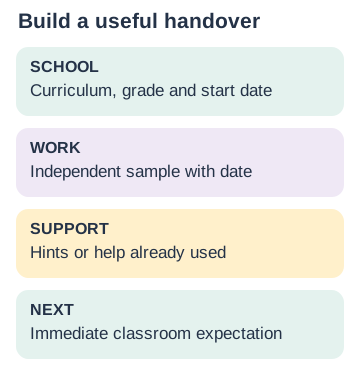
Include one maths solution with working, a short piece of independent writing and a recent reading response. Keep the originals intact; if an adult helped, record the help. A beautifully rewritten answer hides the information a new teacher needs.
Separate academic information from administration. Reports, transfer documents and language or translation requirements belong in the admissions checklist; classroom examples belong in the learning handover. Share sensitive records only through the school’s approved route, not through a public worksheet or group chat.
3. Choose a narrow bridge rather than a complete repeat
Ask what the new class is working on during the arrival week. Compare the prerequisite knowledge with the child’s examples. If the new unit uses decimals and the child can add whole numbers but not align tenths, a few place-value tasks may be more useful than a full revision book.
Try one accessible task without pressure, ask the child to explain, and then teach the missing step. Finish with a different example. For instance, after aligning 2.4 + 0.35 as 2.40 + 0.35 = 2.75, use 1.6 + 0.28 = 1.88 to check the idea again.
Keep what already works. If the child has a sound method that differs from the new teacher’s presentation, ask whether both methods are accepted and how working should be shown. Avoid telling the child a correct method is wrong merely because the layout is unfamiliar.
4. Prepare for instructions and classroom routines
Ask about the language of instruction, homework platform, equipment, assessment routines and whom the child can approach for help. A pupil may understand a concept but miss an instruction such as justify, estimate or show your working. Practise interpreting one actual instruction rather than memorising a long vocabulary list.
Create a small personal glossary only when a real mismatch appears. Write the new term, the familiar term if there is one, and a worked example. Numerator means the number above the fraction bar; an example such as 3/5 makes the explanation more useful than a translation alone.
Discuss a simple help-seeking sentence: “I understand the first step, but I am not sure what this instruction asks.” Adults can rehearse the sentence with the child without pretending that a difficult transition is solved by confidence alone. Ask the school how new pupils are introduced and supported.
5. Review the first weeks using evidence
Before arrival, agree a manageable routine that leaves room for settling in. During the first week, gather the actual assignments and identify what feels unfamiliar. After a few suitable attempts, look for patterns: missing topic knowledge, unfamiliar language, different expectations or practical access problems.
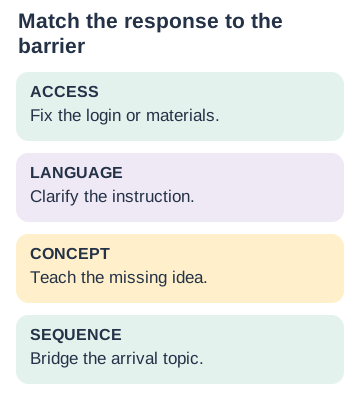
A child who cannot open the homework platform needs an access fix. A child who can explain the maths orally but cannot decode the question needs a different response from one who does not understand the concept. Bring those distinctions to a teacher conversation.
Keep a brief record of one success, one difficulty and one question for the teacher. Do not turn every evening into a diagnostic session. If the child is persistently distressed or the schoolwork remains inaccessible, contact the school promptly and discuss appropriate support.
6. Verify admissions requirements with the right authority
The UAE government provides general information on switching schools, while emirate authorities and individual schools provide more specific guidance. Dubai’s KHDA guidance should not be treated as a universal rule for every emirate. Check the receiving school’s current instructions before arranging certificates or translations.
Make a document checklist with the exact item requested, issuing organisation, format, deadline and confirmation of receipt. If the school requests a transfer certificate or authenticated report, ask which process applies to this specific transfer. This guide is a learning preparation tool, not an admissions guarantee.
Keep the plan useful even while placement is pending: organise existing work, continue reading and practise a few known skills. Avoid buying a full new course or promising a curriculum-specific tutoring plan until the school, year group and current topics are confirmed.
Our school-move handover record
Use this as an index to the school’s actual requirements and a few work samples. Keep administrative documents in the approved private channel, not attached to a public worksheet.
Receiving school/emirate: ______ Curriculum/grade: ______
Start date and admissions contact: ____________________
Document requested / format / deadline / receipt: ____________________
Current topic and dated independent sample: ____________________
Support used on that sample: ____________________
New class expectation and short bridge: ____________________
First-week access check and teacher question: ____________________
Save the full guide to keep this record with the explanations. The separate worksheet contains the practice and decision questions; use its answer version to check your reasoning.
5 worked examples with reasoning
1. The new school asks whether fractions have been covered.
- Show a dated independent fraction example, not only a chapter tick.
- Record whether the child explained it without a model.
- Ask which fraction skills the new class will use next.
2. A child solves 2.4 + 0.35 as 2.75 but uses a different written layout.
- Check the mathematical reasoning first.
- Ask the teacher how working should be presented.
- Adapt notation without discarding a correct understanding.
3. A parent applies a Dubai document rule to a school in another emirate.
- Identify the receiving school and its authority.
- Request the current checklist for this transfer.
- Do not assume the Dubai process applies.
4. Homework is missing for three evenings because the login fails.
- Test access and contact the school’s support route.
- Ask for the assignment through an approved alternative.
- Do not interpret a technical obstacle as poor motivation.
5. The new class has started a topic the child has not studied.
- Ask for the immediate prerequisite and a representative task.
- Teach a short bridge and check a fresh example.
- Agree with the teacher how to catch up while remaining in current lessons.
Save the guide or print the practice
Download to save or share
Complete guide with answers (PDF) · Worksheet without answers (PDF) · Worksheet and answer key (PDF)
Try each situation before reading the suggested response. Give a reason and adapt the decision to the learner and school requirements.
14 practice questions with explanations
Try each situation before reading the suggested response. Give a reason and adapt the decision to the learner and school requirements.
Write an answer and your reason before opening the explanation. Check the reasoning as well as the final answer.
- Identity
What should be confirmed before buying new textbooks?
Answer and reasoning
The receiving school, curriculum, grade and book or course list.
A country name alone does not establish the course.
- Placement
Can a parent assume the year group from a familiar grade number?
Answer and reasoning
No; confirm placement with the school.
Labels and admissions rules may differ.
- Evidence
Improve “fractions completed”.
Answer and reasoning
For example: compares 3/4 and 2/3 independently using twelfths.
A visible skill is more informative than completion.
- Honesty
How should a corrected adult-assisted sample be labelled?
Answer and reasoning
Record the assistance and retain the original attempt.
The teacher needs to distinguish support from independence.
- Maths
Calculate 1.6 + 0.28.
Answer and reasoning
1.88.
Write 1.60 + 0.28 with place values aligned.
- Bridge
What follows teaching one missing step?
Answer and reasoning
A different suitable example.
A copied correction does not establish transfer.
- Authority
Does KHDA guidance govern every UAE school?
Answer and reasoning
No.
Check the school and relevant emirate authority.
- Documents
What belongs beside a requested certificate on a checklist?
Answer and reasoning
Format, issuing body, deadline and receipt status.
These details make follow-up practical.
- Language
What makes a vocabulary note useful?
Answer and reasoning
A meaning plus an example from the child’s task.
Definitions alone may not show how the term is used.
- Routine
Name an access issue to check before judging homework habits.
Answer and reasoning
For example, the homework platform login.
A practical barrier needs a practical fix.
- Method
Must a different correct method be discarded?
Answer and reasoning
Not automatically.
Check the school’s presentation requirements while preserving understanding.
- Privacy
Where should sensitive school records be shared?
Answer and reasoning
Through the school’s approved private channel.
Avoid public or broad group sharing.
- Review
Name three useful items for the first teacher conversation.
Answer and reasoning
One success, one specific difficulty and one question.
Concrete evidence focuses the discussion.
- Plan
What can continue while admission is pending?
Answer and reasoning
Reading and suitable practice of known skills.
Avoid assuming an unconfirmed course sequence.
Use the ideas without looking at the notes
Record the receiving school, curriculum, grade and start date. Attach three honest work samples. Confirm document requirements directly. Agree one immediate learning bridge, one practical access check and a date to review the first assignments with the teacher.
Common questions
Is this an official admissions checklist?
No. Use the receiving school and relevant authority for current requirements.
Should we repeat the entire previous year?
Not automatically. Compare current expectations with specific work and target the missing prerequisites.
Will a CBSE-to-CBSE move have no learning gaps?
Not necessarily. Topic order, expectations and timing can still differ.
Can BananaLearn confirm curriculum coverage before seeing the course?
Share the school, grade, topics and materials so teaching suitability can be confirmed before committing.
Connect your learning
Ask about one-to-one learning support if your child needs help explaining these ideas.
About this guide
Original explanations, examples, diagrams and practice by BananaLearn. The grade label indicates the intended learning level; this is not an official textbook extract or exam paper.