Start with the meaning
Suggested starting level: Grade 7. School sequences vary. The linked NCERT Exemplar is a topic reference, not a claim that these questions match the latest textbook edition. These are original notes and practice, not official NCERT solutions. Start with finding a percentage of an amount, multiplying decimals or fractions, and converting months to parts of a year.
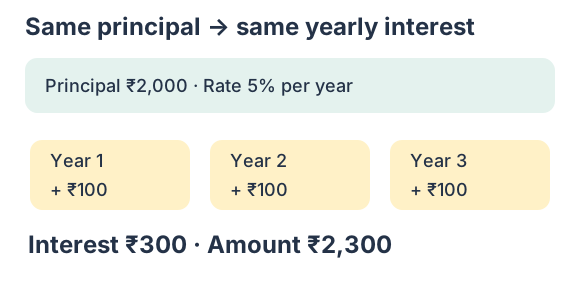
Principal, rate, time, interest and amount
The principal, P, is the starting sum used in the calculation. The rate, R, tells you the percentage charged or earned per stated time period. Time, T, tells you how many of those periods pass. Interest, I, is the extra money; amount, A, is principal plus interest.
For these classroom questions, the principal stays unchanged, the stated rate is fixed and there are no fees or repayments during the period. A real loan or savings product may work differently. Read the mathematical assumptions before choosing a formula.
Why is the formula I = P × R × T ÷ 100?
For one year at R% per year, the interest is R% of P: P × R ÷ 100. Simple interest is calculated on that same original principal each year. Multiplying the one-year interest by T years gives I = P × R × T ÷ 100.
With P = ₹2,000 and R = 5, one year gives ₹100. Three years give 3 × ₹100 = ₹300. The divisor 100 comes from the meaning of percent, not from a separate rule about money. In the formula R is 5 for 5%, not 0.05; do not divide by 100 twice.
Use the same time unit as the rate
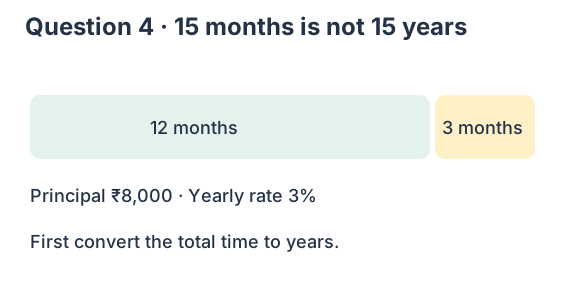
If the rate says “per annum” or “per year”, express T in years. Six months is 6 ÷ 12 = 0.5 year; nine months is 9 ÷ 12 = 0.75 year. For 1 year 6 months, use 1.5 years.
A monthly rate requires time in months. Do not mix a yearly rate with a month count of 6. If a problem uses days, it must state or establish the year-length convention. This guide uses whole years and months so that no 360/365-day assumption is hidden.
Interest is different from the amount
After finding I, add the principal only if the question asks for the amount: A = P + I. With a principal of ₹2,000 and interest of ₹300, the amount is ₹2,300. If principal and amount are given, subtract to find interest: I = A − P.
Use the labels in your working. “₹300 interest” and “₹2,300 amount” answer different questions. If you report the principal plus interest when asked for interest alone, the arithmetic can be correct but the answer is still wrong.
Work backwards to find a missing value
Write the known values and the unknown, then use the same relationship. If I = PRT ÷ 100, multiplying by 100 gives 100I = PRT. To find R, divide by P × T; to find P, divide by R × T; to find T, divide by P × R.
You do not need to memorise three unrelated rules. For ₹240 interest on ₹3,000 over 2 years, each year contributes ₹120. Since ₹120 is 4% of ₹3,000, the annual rate is 4%. Always substitute your answer back to check it.
Simple interest versus compound interest
With simple interest, each period uses the original principal. With compound interest, later periods can earn or charge interest on earlier interest too. Therefore the two methods generally produce different totals after more than one period.
For ₹1,000 at 10% yearly, simple interest for two years is ₹100 + ₹100 = ₹200. With yearly compounding, year two uses ₹1,100 and adds ₹110, making ₹210 interest. Use this comparison to understand the distinction; do not use a compound calculation in a simple-interest question.
Worked examples, step by step
Example 1: Find simple interest and amount on ₹3,000 at 4% per year for 2 years.
- One-year interest = 3,000 × 4 ÷ 100 = ₹120.
- For 2 years, I = 120 × 2 = ₹240.
- A = 3,000 + 240 = ₹3,240. The annual interest stays ₹120.
Example 2: Find simple interest on ₹4,800 at 5% per year for 9 months.
- Time must be in years: T = 9 ÷ 12 = 0.75.
- One-year interest = 4,800 × 5 ÷ 100 = ₹240.
- Nine months is three quarters of a year: I = 240 × 0.75 = ₹180.
Example 3: ₹2,500 becomes ₹2,800 after 3 years at simple interest. Find the yearly rate.
- First separate the interest: I = 2,800 − 2,500 = ₹300.
- Interest per year = 300 ÷ 3 = ₹100.
- Rate = 100 ÷ 2,500 × 100 = 4% per year. Check: 2,500 × 4 × 3 ÷ 100 = 300.
Example 4: What principal earns ₹360 at 6% per year for 2 years?
- Over 2 years, simple interest is 12% of the principal.
- If 12% is ₹360, then 1% is ₹30 and 100% is ₹3,000.
- Check: 3,000 × 6 × 2 ÷ 100 = ₹360.
Example 5: How long does ₹6,000 take to earn ₹900 at 5% per year?
- One-year interest = 6,000 × 5 ÷ 100 = ₹300.
- Time = 900 ÷ 300 = 3 years.
- Substitute T = 3 in the original formula: I = ₹900. This is the time to earn ₹900 interest, not to reach ₹900 total.
Common mistakes and useful repairs
Putting 9 months in the formula as T = 9 years
Convert 9 months to 9/12 year when the rate is yearly. Write the unit beside T.
Using the amount as the principal
Start with the original sum. If only amount and interest are known, subtract to recover the principal.
Adding interest to the principal each year in a simple-interest problem
That changes the model. Calculate each period’s simple interest from the unchanged original principal.
Dividing by 100 twice
Use either P × 5 × T ÷ 100 or P × 0.05 × T for a 5% rate. Both work; mixing them does not.
Try before revealing
Quick understanding check
Read the check answers
0.5. Six months is 6/12 = 0.5 year.
₹1,680. Amount means principal plus interest: 1,500 + 180 = 1,680.
Class 7 simple interest — practice sheet
Work on paper before opening an answer. Print this question sheet with or without a separate worked key; no account is needed.
Name: ____________________ Date: __________
Find simple interest on ₹2,000 at 6% per year for 1 year.
Show answer and reasoning
₹120. 2,000 × 6 × 1 ÷ 100 = 120.
Find simple interest and amount on ₹5,000 at 4% per year for 3 years.
Show answer and reasoning
Interest ₹600; amount ₹5,600. Yearly interest is ₹200. Three years give ₹600; add the principal for the amount.
Find simple interest on ₹3,600 at 8% per year for 6 months.
Show answer and reasoning
₹144. T = 0.5 year. 3,600 × 8 × 0.5 ÷ 100 = 144.
Find simple interest on ₹8,000 at 3% per year for 15 months.
Show answer and reasoning
₹300. 15/12 = 1.25 years. Yearly interest ₹240 × 1.25 = ₹300.
A principal of ₹4,000 becomes ₹4,640. Find the interest.
Show answer and reasoning
₹640. Interest = amount − principal = 4,640 − 4,000.
₹3,000 earns ₹450 simple interest in 3 years. Find the yearly rate.
Show answer and reasoning
5% per year. Yearly interest = ₹150; 150 ÷ 3,000 × 100 = 5.
Find the principal if simple interest is ₹240 at 4% per year for 2 years.
Show answer and reasoning
₹3,000. Two years earn 8% of the principal. 240 ÷ 0.08 = 3,000.
At 6% per year, how long does ₹2,500 take to earn ₹450 simple interest?
Show answer and reasoning
3 years. Yearly interest is ₹150. 450 ÷ 150 = 3.
A child uses T = 8 for 8 months at a yearly rate. Explain the correction.
Show answer and reasoning
Use T = 8/12 = 2/3 year. The rate and time units must match. Eight would mean eight years.
At 5% simple interest per year, what is the difference between the interest on ₹4,000 for 2 years and for 3 years?
Show answer and reasoning
₹200. One extra year adds 5% of the unchanged principal: 4,000 × 5 ÷ 100 = 200.
Class 7 simple interest — worked answer key
₹120. 2,000 × 6 × 1 ÷ 100 = 120.
Interest ₹600; amount ₹5,600. Yearly interest is ₹200. Three years give ₹600; add the principal for the amount.
₹144. T = 0.5 year. 3,600 × 8 × 0.5 ÷ 100 = 144.
₹300. 15/12 = 1.25 years. Yearly interest ₹240 × 1.25 = ₹300.
₹640. Interest = amount − principal = 4,640 − 4,000.
5% per year. Yearly interest = ₹150; 150 ÷ 3,000 × 100 = 5.
₹3,000. Two years earn 8% of the principal. 240 ÷ 0.08 = 3,000.
3 years. Yearly interest is ₹150. 450 ÷ 150 = 3.
Use T = 8/12 = 2/3 year. The rate and time units must match. Eight would mean eight years.
₹200. One extra year adds 5% of the unchanged principal: 4,000 × 5 ÷ 100 = 200.
Choose the next practice step
Use the questions in this guide to practise this specific skill. If you need another explanation, compare the closest worked example with your own drawing before trying a fresh problem.
Help at home: Explain the yearly increment
Draw one box for the original principal, then an equal-sized interest box for each year. Ask why the extra boxes stay equal in simple interest. Only then replace the diagram with P, R and T.
If the formula is right but the answer is too large, check months versus years before repeating calculations. If interest and amount are confused, make your child label both separately.
Keep one example of your child’s own working. If the same confusion returns across fresh questions, share that attempt with their teacher and ask which next step fits their current learning.
Questions students and parents ask
What does per annum mean?
Per annum means per year. A rate of 5% per annum uses time measured in years in the standard simple-interest formula.
Can the time be a fraction?
Yes. Six months is half a year, and eighteen months is one and a half years. Fractional time is normal when the rate is annual.
Is the amount the same as interest?
No. Interest is the extra money; amount is principal plus interest in these problems.
Do I need a different formula for months?
You can use the same formula after replacing T with months/12 for an annual rate. State the conversion before calculating.
Are these bank rates or financial recommendations?
No. All rates and sums here are invented classroom examples used to teach the calculation.
Does this replace the current NCERT chapter?
No. It is an original topic guide referenced to the Class 7 Exemplar. Use the school’s actual book for its exact chapter sequence and assigned exercises.
About this resource
BananaLearn created these explanations, diagrams and practice questions. They are not reproduced textbook or past-exam questions. School sequences differ; use the prerequisites to choose a starting point. Read how we prepare learning guides.
Curriculum and teaching references used to check scope:
Bring the sticking point to a teacher
For 1-on-1 support, bring one question your child found difficult to a free 50-minute session. Tell us their grade, curriculum and time zone so we can discuss a suitable next step.
Request a free session