
Start with the key idea
Percentage change compares the change with the original amount: percentage change=(new −original)÷original×100%, for a nonzero positive original amount in these examples. An increase of r% uses multiplier 1+r/100; a decrease uses 1−r/100.
1. Label the original amount before calculating
If a price rises from ₹200 to ₹250, the increase is ₹50. The comparison is 50 out of the original 200, giving 25%. Dividing by 250 instead answers what fraction of the new price the increase represents.
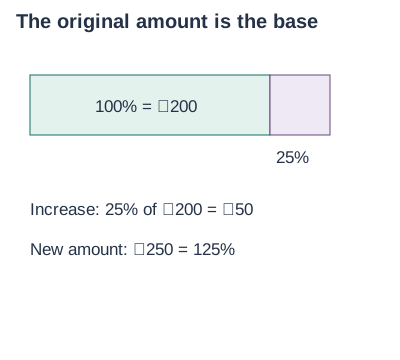
Write original, change and new in three labelled places. The relationship is original+change=new for an increase. Clear labels stop a learner from selecting a denominator merely because it is the larger number.
Imagine the original amount as one whole bar. The change is compared with that bar even after a new amount has been created. From ₹200 to ₹250, the extra ₹50 is a quarter of the original bar. Calling it twenty per cent would compare ₹50 with the new ₹250, which is a different question.
2. Find an increase or decrease directly
To increase ₹600 by 15%, find 15% of 600=90 and add it: ₹690. To decrease 600 by 15%, subtract 90 and obtain ₹510. Both changes use 600 as the base.
A decrease of 15% leaves 85% of the original. That is why a single multiplier 0.85 gives the same ₹510. An increase of 15% leaves 115%, represented by 1.15. Keep the multiplier separate from the percentage number 15.
A multiplier collects the original and change into one step. An increase of fifteen per cent means one whole original plus fifteen hundredths of it, or 1.15 originals. A decrease of fifteen per cent leaves eighty-five hundredths, or 0.85 originals. This is why multiplying by 0.15 finds only the change, not the final amount.
3. Work backwards using the final multiplier
After a 20% discount, an item costs ₹480. The final price is 80% of the original, so 0.8×original=480. Divide 480 by 0.8 to obtain ₹600. Taking 20% of 480 and adding it back would use the wrong base.
A reverse problem should be checked forwards. Twenty per cent of 600 is 120; 600−120=480. This quick check confirms both the original amount and the interpretation of the discount.
Compare two attempted reversals of a twenty per cent discount. Starting from ₹480, adding twenty per cent produces ₹576. Discounting ₹576 by twenty per cent gives ₹460.80, so it fails the forward check. Dividing by 0.8 gives ₹600, which returns exactly ₹480 after discount. The check identifies the valid inverse operation.
4. Apply successive changes in order
Starting with ₹100, a 20% increase gives ₹120. A 20% decrease now removes ₹24, leaving ₹96. The decrease is calculated from the current amount, not the original ₹100.
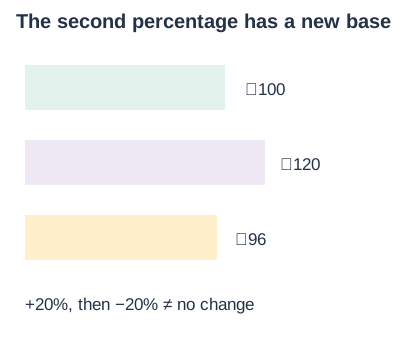
Multipliers make the result visible: 1.2×0.8=0.96. The final amount is 96% of the initial amount, so the overall change is a 4% decrease. Adding the signed percentages would miss the changing base.
The order of two percentage multipliers does not change their product in a simple repeated-price model, but the individual money changes can differ. A ten per cent rise then five per cent rise and the reverse order both multiply by 1.155. That does not justify adding the percentages; their combined effect is still fifteen and a half per cent.
5. Separate percentage points from percentage change
If a test score rises from 40% to 50%, it has risen 10 percentage points. Relative to the starting 40%, the percentage increase is 10÷40×100%=25%. Both statements can be correct, but they measure different comparisons.
Likewise, doubling a value is a 100% increase, not a 200% increase. The new value is 200% of the original, while the increase alone is 100% of it. State whether you are describing the change or the final value.
A decrease from fifty per cent to forty per cent is ten percentage points but a twenty per cent relative decrease, because ten is one fifth of fifty. Write both labels when explaining a rate comparison. Without the phrase “percentage points”, a reader can reasonably interpret the change as relative to the starting rate.
6. Check scale, signs and rounding
For a positive original amount, a modest increase should produce a slightly larger result. Multiplying by 15 instead of 1.15 makes the result far too large. Estimate with 10% before doing an exact calculation.
If a percentage is requested, keep sufficient digits until the final step, then round as instructed. An original amount of zero cannot be used as the denominator in this ordinary percentage-change formula; describe the absolute change instead.
Money questions sometimes require rounding to the nearest paise, while a classroom problem may request the nearest rupee. Follow the stated instruction rather than rounding every intermediate percentage. For a long sequence, early rounding can change the final total. Keep the unrounded value for calculation and round only the reported answer unless the transaction itself rounds at each step.
5 worked examples with reasoning
1. A price rises from ₹80 to ₹100. Find the percentage increase.
- Change=₹20.
- 20÷80×100%=25%.
- Use the original 80 as the base.
2. Decrease ₹750 by 12%.
- 12%=0.12; change=₹90.
- 750−90=₹660.
- Equivalently 750×0.88=660.
3. A 20% discount leaves ₹640. Find the original price.
- The final price is 80% of the original.
- Original=640÷0.8=₹800.
- Check 20% of 800=160; 800−160=640.
4. Increase 200 by 10%, then by 5%.
- 200×1.10=220.
- 220×1.05=231.
- Overall rise 31 out of 200=15.5%, not 15%.
5. A proportion moves from 30% to 36%. Describe both changes.
- It rises 6 percentage points.
- Relative increase=6÷30×100%=20%.
- Label the two measures to avoid ambiguity.
Save the guide or print the practice
Download to save or share
Complete guide with answers (PDF) · Worksheet without answers (PDF) · Worksheet and answer key (PDF)
Try each task before opening its answer. Give an example or reason, not only a label.
14 practice questions with explanations
Try each task before opening its answer. Give an example or reason, not only a label.
Write an answer and your reason before opening the explanation. Check the reasoning as well as the final answer.
- Forward
Increase ₹400 by 10%.
Answer and reasoning
₹440.
400×1.10=440.
- Forward
Decrease ₹400 by 10%.
Answer and reasoning
₹360.
400×0.90=360.
- Rate
₹60 rises to ₹75. Percentage increase?
Answer and reasoning
25%.
15÷60×100=25.
- Rate
₹80 falls to ₹60. Percentage decrease?
Answer and reasoning
25%.
20÷80×100=25.
- Reverse
A 10% discount leaves ₹450. Original?
Answer and reasoning
₹500.
450÷0.9=500.
- Reverse
A 25% rise gives ₹250. Original?
Answer and reasoning
₹200.
250÷1.25=200.
- Successive
₹100 rises 10%, then falls 10%. What is the final amount?
Answer and reasoning
₹99.
100×1.1×0.9=99.
- Multiplier
What multiplier gives a 7% increase?
Answer and reasoning
1.07.
100%+7%=107%.
- Multiplier
What multiplier gives a 7% decrease?
Answer and reasoning
0.93.
100%−7%=93%.
- Double
What is the percentage increase when a positive value doubles?
Answer and reasoning
100%.
The increase equals the original.
- Points
20% rises to 25%. How many percentage points?
Answer and reasoning
5 points.
Subtract the two percentages.
- Relative
For the same 20% to 25% change, percentage increase?
Answer and reasoning
25%.
5÷20×100=25.
- Error
Can percentage change from 0 to 10 be calculated as 10÷0×100?
Answer and reasoning
No.
Division by zero is undefined.
- Check
Why does adding 20% to a discounted price not usually undo a 20% discount?
Answer and reasoning
The two 20% amounts use different bases.
Undo a 0.8 multiplier by dividing by 0.8.
Use the ideas without looking at the notes
Label original, change and new. Write the multiplier, check forwards after a reverse calculation and distinguish percentage points from relative percentage change.
Common questions
Which number is the denominator?
The original amount for ordinary percentage change.
Do equal rise and fall percentages cancel?
No, because the second change uses a new base.
How do I reverse a discount?
Divide the final price by the fraction of the original that remains.
Are percentage points the same as per cent increase?
No. One subtracts percentage values; the other compares the difference with the original percentage.
Can I calculate change from zero?
Not with this formula; report the absolute change and explain that the percentage denominator is zero.
Connect your learning
Ask about guided Maths learning if your child needs help explaining these ideas.
About this guide
Original explanations, examples, diagrams and practice by BananaLearn. The grade label indicates the intended learning level; this is not an official textbook extract or exam paper.