Start with the meaning
You should understand that percent means per hundred, use basic multiplication and division, and read simple decimal equivalents such as 25% = 0.25. No compound percentage change is required.
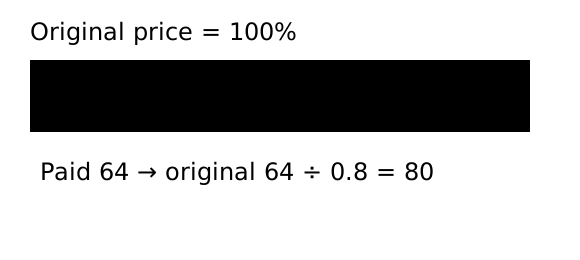
Name the 100% amount
In “15% of 200 students”, the whole is 200 students. Divide by 100 to find one percent, then multiply by 15. Or use a useful chunk: 10% is 20 students and 5% is ten.
Write “100% = ___” before a calculation when the story is unfamiliar. This is particularly helpful for reverse percentages, where the given amount is only part of the original whole.
Distinguish the part, rate and whole
To find a part, multiply the whole by the rate as a decimal. To find a rate, divide the part by the whole and multiply by 100%. To find a whole, divide the part by the rate as a decimal.
These are connected statements about the same relationship. A bar labelled with both amounts and percentages is often more informative than choosing a formula from memory.
Separate the discount from the price paid
For a 25% discount on 80 units of currency, the saving is 20. The price paid is 80 − 20 = 60, or 75% of the original.
Read the last sentence carefully. A question asking “How much is saved?” has a different answer from one asking “How much is paid?” The currency does not change the percentage method.
Check whether the answer is plausible
A percentage below 100% of a positive amount should be smaller than the whole. A score of 18 out of 24 is more than half but less than the full score, so its percentage must be between 50% and 100%.
A price after a discount is lower than the original. When you reconstruct an original price from a discounted price, your result should be larger than the amount paid.
Worked examples, step by step
Example 1: Find 15% of 240
- 10% of 240 is 24.
- 5% is half of 10%, so it is 12.
- 15% = 10% + 5%, giving 24 + 12 = 36.
Example 2: A student scores 18 out of 24. What percentage is that?
- The whole is the possible score, 24, not the score achieved.
- 18 ÷ 24 = 3/4 = 0.75.
- 0.75 × 100% = 75%.
Example 3: A price after a 20% discount is 64. Find the original price.
- The paid price represents 80% of the original.
- Find 1%: 64 ÷ 80 = 0.8. Then 100% = 80.
- Check: 20% of 80 is 16, and 80 − 16 = 64. Adding 20% of 64 would use the wrong whole.
Common mistakes and useful repairs
Using the wrong denominator for a score
In 12 out of 20, divide by 20, the whole. 20 ÷ 12 does not describe the fraction achieved.
Undoing a discount by adding the same percentage
A percentage of the reduced amount is based on a different whole. Reconstruct the percentage remaining, then divide to find 100%.
Try before revealing
Quick understanding check
Read the check answers
20. The possible total, 20, is the whole.
60. The discount is 20; the remaining price is 80 − 20 = 60.
Percentage word problems with step-by-step answers — practice sheet
Work on paper before opening an answer. Print this question sheet with or without a separate worked key; no account is needed.
Name: ____________________ Date: __________
Find 30% of 90.
Show answer and reasoning
27. 10% is 9; three lots give 27.
Find 12% of 250.
Show answer and reasoning
30. 10% is 25 and 2% is 5, giving 30.
A score is 21 out of 30. Express it as a percentage.
Show answer and reasoning
70%. 21/30 = 7/10 = 70/100.
An item costs 120 and is reduced by 25%. Find the saving and the price paid.
Show answer and reasoning
Saving 30; price paid 90. 25% is one quarter. 120 ÷ 4 = 30; subtract from 120.
40% of a group is 18 people. How many people are in the full group?
Show answer and reasoning
45 people. 10% is 18 ÷ 4 = 4.5; 100% is 45. Fractional intermediate values are acceptable.
A price is 72 after a 10% discount. Find the original.
Show answer and reasoning
80. 72 represents 90%. 72 ÷ 0.9 = 80.
A quantity increases from 50 to 60. Find the percentage increase.
Show answer and reasoning
20%. The increase is 10, measured against the original 50: 10/50 × 100% = 20%.
A child finds 20% of 60 as 12 when asked for the original price after a 20% discount. What is missing?
Show answer and reasoning
The given 60 is 80%, so the original is 75. 60 ÷ 0.8 = 75; check that 20% of 75 is 15 and 75 − 15 = 60.
Percentage word problems with step-by-step answers — worked answer key
27. 10% is 9; three lots give 27.
30. 10% is 25 and 2% is 5, giving 30.
70%. 21/30 = 7/10 = 70/100.
Saving 30; price paid 90. 25% is one quarter. 120 ÷ 4 = 30; subtract from 120.
45 people. 10% is 18 ÷ 4 = 4.5; 100% is 45. Fractional intermediate values are acceptable.
80. 72 represents 90%. 72 ÷ 0.9 = 80.
20%. The increase is 10, measured against the original 50: 10/50 × 100% = 20%.
The given 60 is 80%, so the original is 75. 60 ÷ 0.8 = 75; check that 20% of 75 is 15 and 75 − 15 = 60.
Choose the next practice step
When the original amount is missing
A price is 80 after a 20% discount. That 80 represents 80% of the original price, not 100%. Divide 80 by 0.8 to recover the original price of 100. Check: 20% of 100 is 20, and 100 − 20 = 80.
Learn how to find the original value with reverse percentages.
Use the questions in this guide to practise this specific skill. If you need another explanation, return to Finding a percentage of an amount before trying a fresh problem.
Help at home: Make the whole visible
Draw a bar for the original price and label it 100%. Shade the discount and label the unshaded amount as the percentage paid. Ask your child to point to each quantity before doing arithmetic.
If reverse percentages are confusing, return to a forward question first. Compare an original of 100 reduced to 80 with a different original of 80 reduced to 64. This shows why the base matters.
Keep one example of your child’s own working. If the same confusion returns across fresh questions, share that attempt with their teacher and ask which next step fits their current learning.
Questions students and parents ask
Can a percentage be greater than 100%?
Yes. 150% of an amount is one and a half times that amount. Not every context allows it: a score on a test without bonus marks cannot exceed the possible score.
Are these exam-specific questions?
No. They are original foundational problems. Check your examination syllabus for required formats and additional topics.
About this resource
BananaLearn created these explanations, diagrams and practice questions. They are not reproduced textbook or past-exam questions. School sequences differ; use the prerequisites to choose a starting point. Read how we prepare learning guides.
Curriculum and teaching references used to check scope:
Bring the sticking point to a teacher
For 1-on-1 support, bring one question your child found difficult to a free 50-minute session. Tell us their grade, curriculum and time zone so we can discuss a suitable next step.
Request a free session