What does it mean?
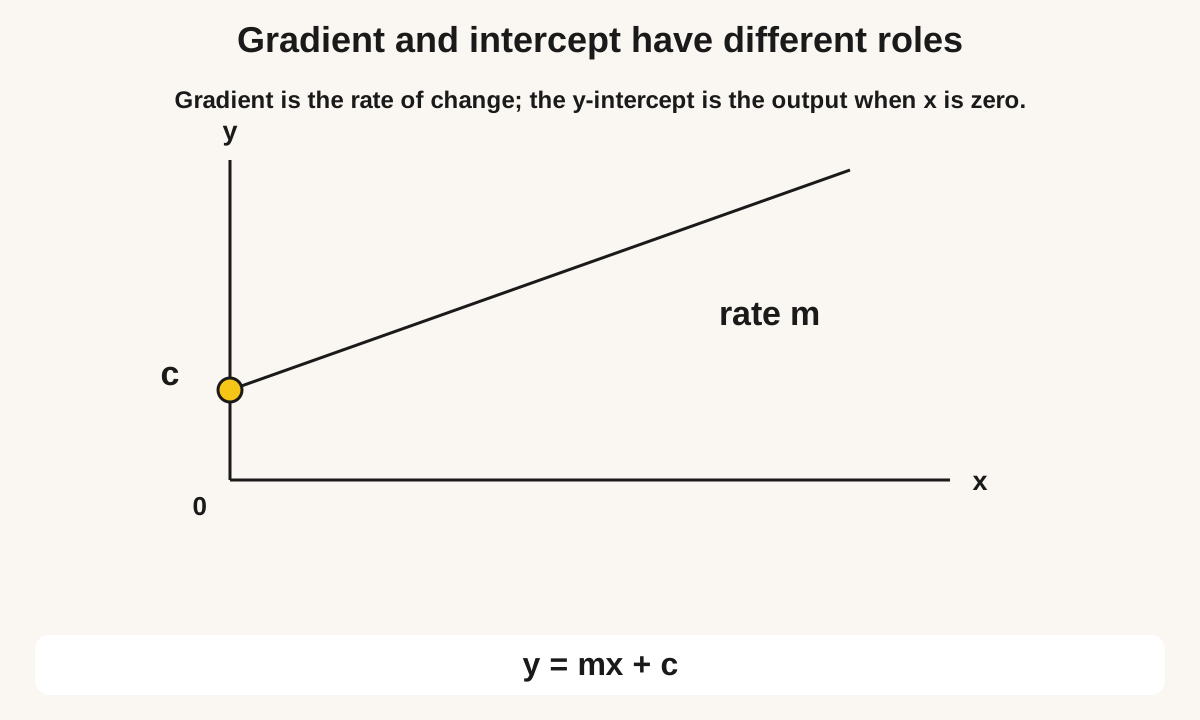
In y = mx + c, m controls how y changes and c gives y when x is zero. These are different roles. The line y = 2x + 5 has gradient 2 and meets the y-axis at (0, 5). Its intercept is not the y-value of every point on the line.
The equation y = mx + c describes a straight line. The number m is the gradient, already taught as rise over run. The number c is the y-intercept: when x = 0, y = c, so the graph meets the y-axis at (0, c). If c = 0, the line goes through the origin and y = mx is direct proportion. If c is not 0, the line is still straight and still has gradient m, but it is not direct proportion. The x-intercept is where y = 0. From ax + by = d you can read intercepts: x-intercept d/a and y-intercept d/b when those denominators are not 0.
Learning goal: Connect gradient and intercept to y = mx + c. The grade is a suggested starting point; school sequences vary. Use the first worked example to check readiness, and Pre-algebra if an earlier idea needs revisiting.
See the idea
Read each diagram with its labels, then follow the worked examples. Practice questions include their own measurements and information.
Enlarge diagram to read the labels
Swipe across the enlarged diagram to read every label.
Enlarge diagram to read the labels
Swipe across the enlarged diagram to read every label.
Choose a method and explain why it works
Identify m and c with their signs, calculate a few coordinate pairs and plot them. If two points are given, find the gradient first, then substitute one point to find c. To find an x-intercept, put y = 0 and solve. To find a y-intercept, put x = 0.
Notation: y = mx + c. y-intercept (0, c). x-intercept where y = 0.
Key rule and when to use it
In y = mx + c, m is gradient and (0, c) is the y-intercept. A direct-proportion line has c = 0.
Worked examples, step by step
Example 1: A line has gradient 2 and y-intercept 3. Write its equation and check with x = 0.
- m = 2 and c = 3, so y = 2x + 3.
- When x = 0, y = 3, so the graph meets the y-axis at (0, 3).
- Check another point: x = 1 gives y = 5, so (1, 5) lies on the line.
Answer: y = 2x + 3
Check: Starting at 3 and adding 2 for each extra x matches the table 0 → 3, 1 → 5.
Example 2: A line has x-intercept 4 and y-intercept 6. Write y = mx + c.
- The intercepts are given, not m and c directly. The y-intercept is 6, so c = 6 and the line meets (0, 6).
- It also meets (4, 0). Gradient m = (0 − 6)/(4 − 0) = −6/4 = −3/2.
- So y = −(3/2)x + 6. Check: x = 4 gives y = −6 + 6 = 0.
Answer: y = -1.5x + 6
Check: A negative gradient is expected because the line falls from (0, 6) to (4, 0).
Example 3: Find the line with gradient −2 through (3, 1).
- Start y = −2x + c.
- Substitute the point: 1 = −2 × 3 + c, so c = 7.
- The equation is y = −2x + 7. Check at x = 3: y = 1.
Common mistakes and important boundaries
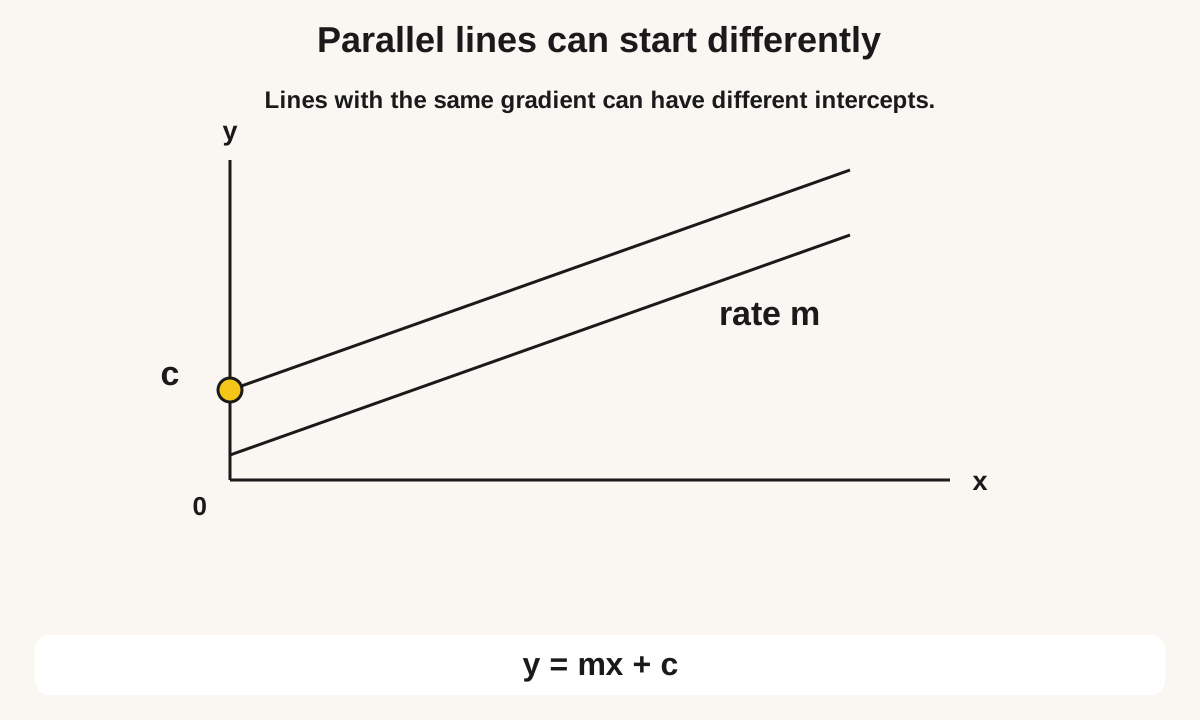
This form represents non-vertical straight lines. A vertical line such as x = 3 cannot be written y = mx + c with a finite gradient. Parallel distinct lines share a gradient but have different intercepts. Direct proportion is the special case c = 0, not every straight-line relationship.
A point to explain
A learner may treat the x-intercept as c, or assume every line is y = mx through the origin.
Compare an uncertain attempt with the closest worked example. Look at the meaning of each operation, unit and label before repeating the arithmetic.
Straight-Line Graphs: y = mx + c — practice
Work on paper first. Open each answer afterwards and compare the reasoning. Print the questions with or without the separate answer key; no account is required.
Name: ____________________ Date: __________
In y = 5x − 2, what is the y-intercept?
Answer and a way to check
−2
The y-intercept is the constant term: the value of y when x = 0.
A line has gradient 1 and y-intercept 4. Which equation matches?
Answer and a way to check
y = x + 4
Write y = (gradient)x + (y-intercept) in that order.
Write the equation of the line with gradient 3 and y-intercept −1.
Answer and a way to check
y = 3x - 1
Keep m as the coefficient of x. Keep c as the constant, including its sign.
The line is y = −2x + 8. What is the y-intercept?
Answer and a way to check
8
The y-intercept is the constant term, not the coefficient of x.
A line passes through (0, 5) and has gradient 4. Write its equation.
Answer and a way to check
y = 4x + 5
(0, 5) means c = 5. Then write y = mx + c with m = 4.
Explain why y = 2x + 5 is a straight line with gradient 2 but is not direct proportion.
Answer and a way to check
The gradient is 2, so it is straight. When x = 0, y = 5, so it does not go through the origin.
Name m from the coefficient of x. Then find y when x = 0.
A line meets the x-axis at (6, 0) and the y-axis at (0, 3). A student writes y = 6x + 3. What is the mistake?
Answer and a way to check
The intercept 3 is correct, but 6 is the x-intercept, not the gradient.
c is the y-intercept. Find m from the two intercept points, not by copying the x-intercept.
A tank starts with 12 litres and then gains 3 litres each minute. Write y = mx + c and find the volume after 5 minutes.
Answer and a way to check
y = 3x + 12; 27 litres
The 12 litres is the value when time is 0. The 3 litres per minute is the gradient. Then replace x with 5.
Straight-Line Graphs: y = mx + c — answer key
−2 The y-intercept is the constant term: the value of y when x = 0.
y = x + 4 Write y = (gradient)x + (y-intercept) in that order.
y = 3x - 1 Keep m as the coefficient of x. Keep c as the constant, including its sign.
8 The y-intercept is the constant term, not the coefficient of x.
y = 4x + 5 (0, 5) means c = 5. Then write y = mx + c with m = 4.
The gradient is 2, so it is straight. When x = 0, y = 5, so it does not go through the origin. Name m from the coefficient of x. Then find y when x = 0.
The intercept 3 is correct, but 6 is the x-intercept, not the gradient. c is the y-intercept. Find m from the two intercept points, not by copying the x-intercept.
y = 3x + 12; 27 litres The 12 litres is the value when time is 0. The 3 litres per minute is the gradient. Then replace x with 5.
Questions students and parents ask
Can a vertical line be written as y = mx + c?
No finite value of m gives a vertical line. Its equation has the form x = k, such as x = 4. The y = mx + c form covers non-vertical straight lines.
Is the x-intercept the gradient?
No. The x-intercept is an x-coordinate where y is zero. The gradient is a ratio of changes, so it must be calculated or identified separately.
Is this a complete set of textbook exercise solutions?
No. This guide adapts BananaLearn’s own teaching examples and practice. It is not official NCERT material or a promise of the exact chapter sequence in a particular board, country or textbook edition.
What if the examples are still difficult?
Revisit Pre-algebra. Try the first example with its model, then attempt one fresh question independently. A correct copied answer is not evidence that the method can be used without support.
Help at home
Have the learner explain what happens at x = 0 and what changes when x increases by one. Those two questions separate intercept from gradient.
Keep one example of the learner’s own working. A repeated difficulty across fresh questions can guide a discussion with their teacher; one short practice sheet does not establish a diagnosis or a full mastery profile.
Connect this idea to the next skill
About this guide
Based on BananaLearn’s Grade 8 course lesson “Gradient and Intercept”. The explanations have been adapted for independent reading; course diagrams are reused where they fit the idea, and missing classroom givens are made explicit in questions.
Need another way to understand it?
Bring one question your child found difficult to a free 50-minute session. Tell us their grade, curriculum and time zone so we can discuss a suitable next step.
Request a free session