1. Find the remainder on dividing x³−4x+7 by x−2.
- Use the divisor root 2.
- P(2)=8−8+7=7.
- The constant remainder is 7; no quotient is needed.
Maths · Algebra / Precalculus · suggested level; school sequences vary
Dividing a cubic just to find a single remainder can be a long route. Substitution works because the divisor becomes zero at one carefully chosen input.
Start here
When P(x) is divided by x−a, the remainder is P(a). Therefore x−a is a factor exactly when P(a)=0.
Original BananaLearn guide · 7 November 2026
On a narrow screen, swipe the diagram or open it full size.
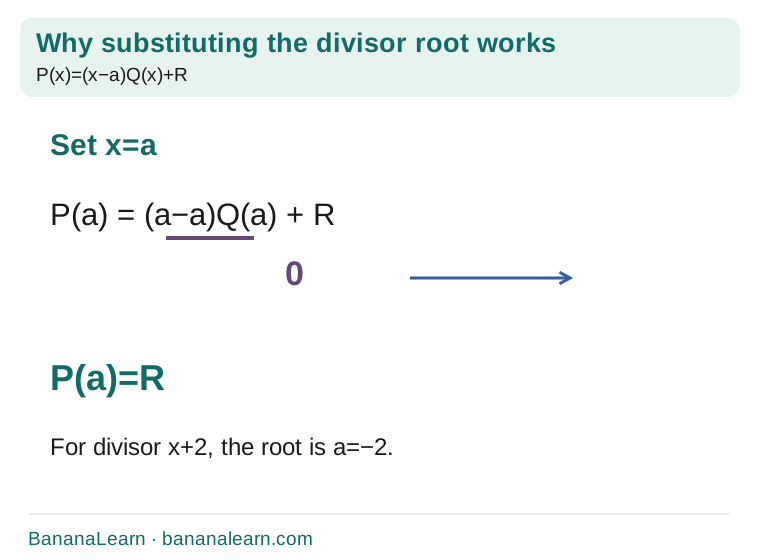
If P(x) is divided by x−a, write P(x)=(x−a)Q(x)+R. The remainder R is constant because its degree must be lower than the divisor’s degree, which is 1.
Set x=a. The product (a−a)Q(a) vanishes, leaving P(a)=R. This explains the remainder theorem rather than presenting substitution as a lucky shortcut.
For divisor x−4, substitute 4. For x+4=x−(−4), substitute −4. Keep negative inputs in brackets when evaluating powers. A sign error can make a factor test look convincing but wrong.
For x+2, the required value is P(−2), not P(2). The value that matters is the root of the divisor.
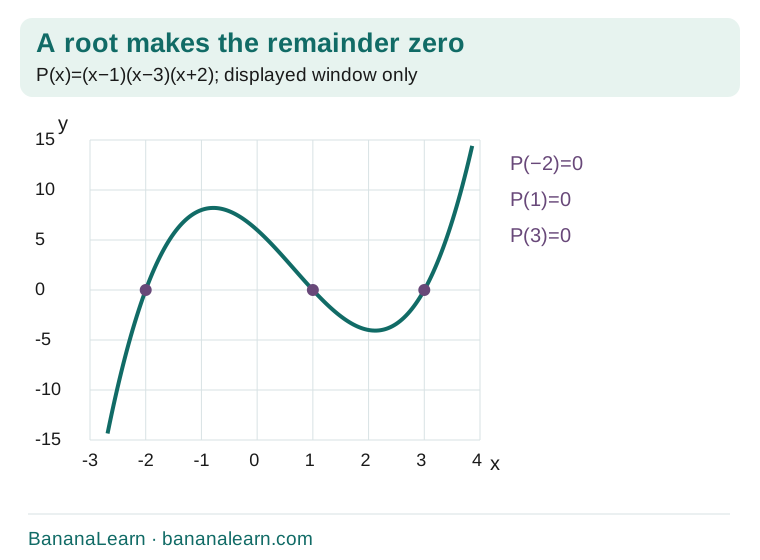
If P(a)=0, the division identity becomes P(x)=(x−a)Q(x), so x−a is a factor. Conversely, if x−a is a factor, substitution at a gives zero.
Finding one factor does not finish factorising a higher-degree polynomial. Divide out the factor or find the remaining quadratic, then check the full product.
On a narrow screen, swipe the diagram or open it full size.
For P(x)=2x³−3x²+4x−5, organise terms before substituting. At x=−1 the values are −2,−3,−4,−5, summing to −14. The even power is positive before its negative coefficient is applied.
If a term is missing, its coefficient is zero. That matters in long division or synthetic division. A direct substitution should still include every stated term.
If x−2 is a factor of x³+kx+6, substitute 2 to get 8+2k+6=0. Thus k=−7. Reinsert that value and check the zero before accepting it.
Two unknown coefficients usually need two independent conditions. One factor condition gives one equation and is not enough by itself to determine two unknowns uniquely.
For a non-zero constant m, the root of mx−n is n/m. In P(x)=(mx−n)Q(x)+R, substitution at n/m still leaves R=P(n/m).
For divisor 2x−1, use x=1/2. Do not multiply the remainder by 2 just because the divisor has a leading coefficient of 2. Polynomial coefficients here may be rational numbers.
A constant remainder is appropriate for division by a linear polynomial. Division by a quadratic can leave a linear remainder, so one substitution will not generally determine it.
A zero at a also does not tell you how many times the factor repeats. Repeated factors require further work. Keep a single factor test distinct from a complete root or multiplicity analysis.
After finding a factor, verify P(a)=0 and expand your proposed factorisation. When only a remainder is required, write the divisor root and the substituted expression so that the sign choice is visible.
This guide extends the idea of a polynomial zero. Learners who struggle with it may need substitution and bracket practice first, rather than more polynomial division.
See the reasoning
Try, explain, check
Try each task before opening its explanation. These are original BananaLearn questions, not official exam or past-paper questions. Where several answers can work, the explanation gives the criteria.
5
It makes x−5 equal zero.
−5
x+5=x−(−5).
11
P(2)=4+6+1.
−1
P(−2)=4−6+1.
Yes
P(3)=9−9=0.
Yes
P(−3)=9−9=0.
3
1+k−4=0.
5/4
P(1/2)=1/4+1.
Yes
Its remainder may have degree 1.
No
It proves at least one x−2 factor, not repetition.
0
The first factor vanishes.
No
It supplies only one equation unless additional information is given.
Copy these headings and fill them for one worked task, then for a fresh attempt. Use your own evidence rather than copying the model answer.
Explore BananaLearn’s games, learning features and one-to-one tutoring. Maths is our priority; English and Science tutoring are also available. Bring a recent example of schoolwork when checking teaching fit.
Original BananaLearn explanations, examples, illustrations and practice. Source facts checked 7 November 2026. Suggested levels are learning guides, not a claim that every board or textbook uses the same sequence.
How we prepare guides · Report a correction
Share the complete guide: https://bananalearn.com/learn/factor-and-remainder-theorem-examples.html