English · Suggested Grade 6–9
Constitution Day 2026: Preamble Ideas, Speech & Activity
26 November marks the Constitution’s adoption; 26 January marks its coming into effect. Keeping those two moments separate is the starting point for a clear Constitution Day speech.
Original explanations and practice by BananaLearn · Published 31 October 2026
On a small screen, swipe across the illustration to read every label.
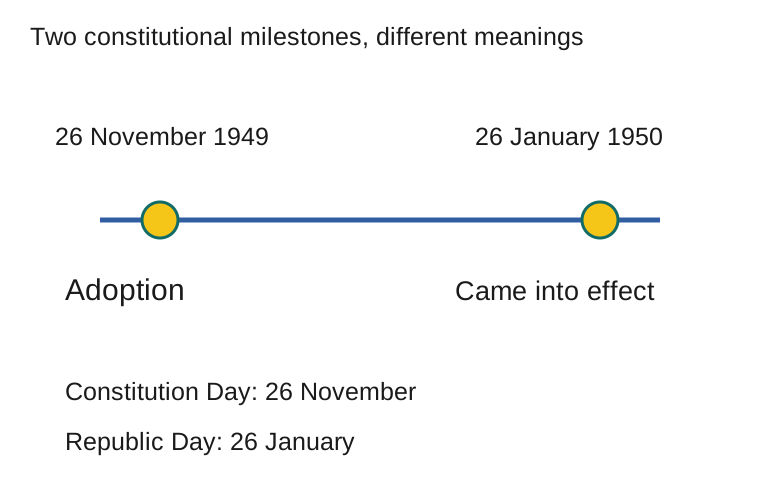
The date and the distinction to get right
India observes Constitution Day, also called Samvidhan Divas, on 26 November. The Constitution was adopted on 26 November 1949 and came into effect on 26 January 1950. Government sources confirm these dates. This guide was checked on 31 October 2026 and does not announce an unverified annual theme or school instruction.
Use the activities for an English/civics discussion at suggested Classes 6–9. They are original classroom examples, not a legal interpretation or an official assessment. Read the official Preamble through the source link if your school asks for its exact wording; do not rely on an improvised paraphrase as a quotation.
Explain the Preamble’s purpose before memorising words
A preamble introduces the broad purposes and principles of a document. India’s Preamble identifies the people as the source of constitutional authority and sets out foundational commitments. For a school explanation, focus on what ideals such as justice, liberty, equality and fraternity ask us to consider.
A classroom example can make an ideal easier to discuss, but a class rule is not the Constitution itself. Distinguish a learning analogy from a statement about how every legal question is decided. Avoid reducing a broad principle to one slogan whose meaning the speaker cannot explain.
Use everyday scenarios to explore values
Imagine a class choosing representatives. Allowing everyone an appropriate chance to share views can illustrate participation. Applying a published selection rule consistently can illustrate fair procedure. Helping a newcomer join a group can illustrate respect and belonging. These are examples for discussion, not definitions that exhaust the constitutional ideals.
Equality does not always mean giving every person an identical object regardless of need. For example, a larger-print instruction card may help a learner access the same task. Discuss how an arrangement supports participation instead of treating every difference in support as unfair privilege.
An original short assembly speech
Good morning everyone. Two dates help us understand today. On 26 November 1949, India adopted its Constitution. On 26 January 1950, it came into effect. Constitution Day gives us a reason to look beyond remembering those dates and ask what the document’s ideals mean in our shared life.
In school, we make choices about who is heard, how rules are explained and how we treat someone who is different from us. A classroom cannot stand in for the whole country, but it can help us practise listening, giving reasons and treating others with respect. When we disagree, we can challenge an idea without insulting the person who expressed it. When a rule affects everyone, we can ask whether its purpose is clear and whether it is applied fairly. Today, let us read an important constitutional idea carefully, explain it in our own words and choose one action that makes our class more respectful and inclusive. Remembering a document matters; thinking responsibly about its ideals matters too. Thank you.
A discussion activity: explain, question, improve
Give groups fictional scenarios: only the loudest pupils get speaking turns; instructions are too small for one learner to read; a book-borrowing rule is applied differently without explanation; a newcomer is excluded from a group task. Ask each group to identify the concern and propose an improvement with a reason.
No pupil needs to disclose a private experience or identify another child. Keep the exercise about the fictional arrangement. An adult can help groups distinguish respectful disagreement from personal accusation. Encourage more than one workable solution when the reasons and practical limits are clearly explained.
Turn a value into a reasoned paragraph
Use a point–example–explanation structure. Point: A fair discussion should let more than one confident voice be heard. Example: A chair can invite a turn from someone who has not spoken. Explanation: This makes it easier to collect different views before deciding. The paragraph explains an action instead of merely listing an abstract word.
Avoid claims such as our class has now achieved complete equality. A small improvement is evidence about that arrangement, not proof that every barrier has disappeared. In a speech, a concrete commitment is stronger than an exaggerated declaration. Use a timer to rehearse rather than assuming every speaker delivers the same number of words per minute.
Check the final speech and display
Verify adoption versus commencement, spell names and dates accurately and distinguish exact quotations from your own explanations. If using the Preamble, copy its official wording faithfully from the linked government source and label the source. Keep an original speech separate from the official text.
For a display, include the two-date timeline, one principle explained in student language, a fictional scenario and a proposed action. Review the action after a week. Parents can ask what the chosen example illustrates and where the analogy stops, helping the learner explain meaning without pretending to give legal advice.
A values discussion record
Copy the record into a notebook or use it to organise your own answer. Blank spaces are for your work.
| Fictional situation | Concern | Relevant ideal | Proposed change | Reason | Review |
|---|---|---|---|---|---|
| Speaking turns | ___ | ___ | ___ | ___ | ___ |
| Access to instructions | ___ | ___ | ___ | ___ | ___ |
| Your scenario | ___ | ___ | ___ | ___ | ___ |
10 questions with explained answers
Try the questions before opening the answers. Explain the reason, then try a changed example to check your understanding.
What happened on 26 November 1949?
Show answer and explanation
The Constitution of India was adopted
Do not confuse adoption with its commencement.When did it come into effect?
Show answer and explanation
26 January 1950
That is the date associated with Republic Day.When is Constitution Day observed?
Show answer and explanation
26 November
The recurring observance commemorates adoption.Is a classroom rule identical to the Constitution?
Show answer and explanation
No
It can be a learning analogy, not a substitute for the actual document.Why label a paraphrase as your own explanation?
Show answer and explanation
So it is not mistaken for an exact quotation
Official wording and student interpretation are different things.Does equal access always require identical support?
Show answer and explanation
No
Different support can help learners participate in the same task.Give a way to hear quieter pupils.
Show answer and explanation
Example: invite turns from pupils who have not spoken
The arrangement aims to include more views.Is insulting a person necessary to disagree with an idea?
Show answer and explanation
No
Challenge the reason or claim respectfully.What should a reasoned paragraph include beyond a value word?
Show answer and explanation
A concrete example and explanation
These connect the principle to an understandable action.Does one successful class change prove every fairness problem is solved?
Show answer and explanation
No
A conclusion should match the limited evidence.
Keep the ideas connected
- Explain a proposal with reasons
- Separate statements from interpretations
- Connect to the separate January occasion
- Prepare a clear assembly notice
For help with a school-learning difficulty, bring one attempted question to a discussion about tutoring and curriculum fit. Maths is our priority; English and Science tutoring are also available.
Sources, scope and sharing
The examples, diagrams and practice are original BananaLearn work. Grade labels suggest a learning level; teaching sequences and school requirements can differ. Official sources below support the stated facts and resource links. These activities are independent resources, not official exam questions or endorsed campaign materials.
How we prepare learning guides · Report a correction
Share this guide: https://bananalearn.com/learn/constitution-day-2026-preamble-school-activity.html