
Start with the key idea
A notice is a brief announcement for a defined audience. It should make the event or purpose, essential details, required action and issuing authority easy to find. Follow the format and word limit given in the task.
1. Think about the reader’s next action
A notice is designed to be read quickly by many people. It might announce a meeting, invite participation, report a lost item or share an important change. Identify the exact audience before drafting: all students, one class, club members or parents. An event open only to Classes 6 and 7 should not be advertised as open to everyone.
Write down what the reader should do after reading. Register, attend, bring an item or contact someone are different actions. If you cannot state the action clearly, the notice may be trying to do too much.
Use the facts supplied in the task. In a fictional writing exercise, you may choose reasonable missing details if allowed. In a real notice, verify arrangements before announcing them; a confident tone does not turn an unconfirmed booking into a fact.
2. Use a recognisable hierarchy
A common school format includes the institution or organisation name, NOTICE, date of issue, heading, short body, and the writer’s name and designation. A box is often requested in classroom formats, but follow the particular instructions rather than treating one decorative convention as universal.
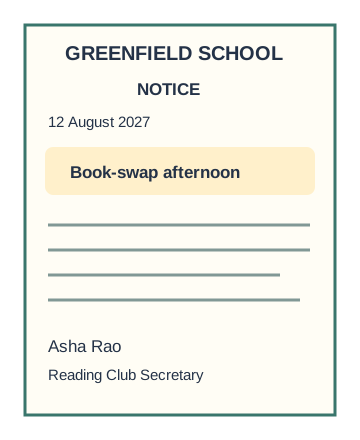
The heading should identify the topic immediately: “Book-swap afternoon” is more useful than “Important information”. The date of issue is not necessarily the event date, so put the event date clearly in the body too.
Keep spacing simple and consistent. The body carries the action details; the signature area tells the reader who is responsible. A notice normally does not need a letter-style greeting such as Dear students or a long courteous closing. Its brevity comes from structure, not from leaving out essential facts.
3. Read a complete fictional notice
GREENFIELD SCHOOL
NOTICE
12 August 2027
Book-swap afternoon
Students of Classes 6 and 7 may join a book swap in the school library on 20 August, from 1:30 to 2:15 p.m. Bring one suitable book in good condition. Register with the reading club by 18 August. Books with missing pages will not be accepted.
Asha Rao
Reading Club Secretary
The school, names and event are fictional practice details. The issue date is 12 August, the registration deadline is 18 August and the event date is 20 August. Those dates have different jobs. The notice also names the audience, place, time, item to bring and condition for acceptance.
If a task gives a strict word limit, check whether its marking convention includes headings and signature details. Do not assume every school counts the same way. Shorten repeated wording first; keep the details that prevent confusion.
4. Audit what, who, when, where and how
Read the body as a student who has heard nothing about the event. Can you tell whether you are eligible, where to go, when to arrive and what to bring? A location such as “the usual place” may be clear to organisers but useless to new members. Use the actual named venue.
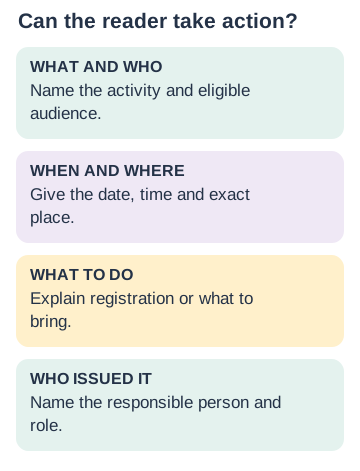
Include a deadline when the reader must act before the event. Distinguish “register by 18 August” from “attend on 20 August”. If the time could be misunderstood, use a.m. or p.m. or an unambiguous 24-hour format.
For a lost-item notice, describe the item sufficiently for identification and give an appropriate contact route. Do not publish unnecessary private contact details in a classroom example. The relevant questions change slightly with purpose, but the test remains the same: can the intended reader take the right action?
5. Keep sentences short without becoming abrupt
Use precise verbs such as register, bring, collect and attend. Avoid long openings like “This is to inform all concerned that it has been decided that…” when a direct sentence works. “Club members should meet in Room 4 at 1 p.m.” gives the message immediately.
Concise writing still needs enough grammar to be understandable. A list of fragments such as “Books. Friday. Hall. Bring.” forces readers to guess the connections. Short connected sentences are usually clearer than unexplained notes.
Do not use exaggerated claims to make an ordinary notice exciting. “The greatest event in school history” adds little useful information. A specific title and a meaningful activity can attract interest without unsupported promises. Match tone to purpose: a safety instruction should be especially unambiguous.
6. Test the notice before sharing it
Ask a partner to answer five questions using only your draft: who is it for, what is happening, when, where and what must I do? Any unanswered question identifies a useful revision. This is a practical content check, not just a spelling test.
Compare the body with the heading and date. A changed event date must be updated everywhere; otherwise readers may follow the wrong instruction. Check names, numbers, eligibility and the authority under which the notice is issued.
Then check the requested length and format. Remove repetition rather than shrinking the text until it is difficult to read. A notice succeeds when a reader can understand it quickly and act correctly, even if the layout is simple. For real school announcements, obtain the required approval before displaying or sending them.
5 worked examples with reasoning
1. Repair: Book swap soon in the usual place.
- Soon and usual place are unclear to new readers.
- Add the confirmed date, time and venue.
- For example: Book swap in the library on 20 August, 1:30–2:15 p.m.
2. Which date in the model is the registration deadline?
- Find the action register.
- The phrase by 18 August sets the deadline.
- It is different from both issue date and event date.
3. Shorten: This is to inform all students of Classes 6 and 7 that they may participate.
- Remove the introductory filler.
- Keep the eligible audience.
- Students of Classes 6 and 7 may participate.
4. What is missing if a notice says “Bring a book” only?
- The book’s suitability or condition may matter.
- Add relevant restrictions from the event plan.
- The model asks for a suitable book in good condition.
5. Why include the writer’s role?
- It identifies the issuing authority or organiser.
- Readers know whom the announcement comes from.
- Use a real authorised role, not an invented title.
Save the guide or print the practice
Download to save or share
Complete guide with answers (PDF) · Worksheet without answers (PDF) · Worksheet and answer key (PDF)
Try each task before opening its answer. Give an example or reason, not only a label.
14 practice questions with explanations
Try each task before opening its answer. Give an example or reason, not only a label.
Write an answer and your reason before opening the explanation. Check the reasoning as well as the final answer.
- Audience
Who may join the model book swap?
Answer and reasoning
Students of Classes 6 and 7.
The audience is explicitly limited.
- Date
When was the model notice issued?
Answer and reasoning
12 August 2027.
This is the date under NOTICE.
- Event
When is the book swap?
Answer and reasoning
20 August, 1:30–2:15 p.m.
Event date and time appear in the body.
- Place
Where will it take place?
Answer and reasoning
The school library.
A named place is clearer than usual place.
- Deadline
By when should readers register?
Answer and reasoning
18 August.
The deadline comes before the event.
- Condition
What kind of book should a participant bring?
Answer and reasoning
One suitable book in good condition.
Books with missing pages are excluded.
- Heading
Improve the heading “Important”.
Answer and reasoning
For example: Book-swap afternoon.
A specific heading identifies the purpose.
- Format
Does a notice normally need Dear students?
Answer and reasoning
No.
It is not a personal letter.
- Time
Why add p.m. to a time?
Answer and reasoning
To avoid ambiguity.
Readers should not guess morning or afternoon.
- Length
What should be removed first to shorten a notice?
Answer and reasoning
Repetition and filler.
Keep essential action details.
- Authority
What should the designation identify?
Answer and reasoning
The writer’s relevant role.
Do not invent authority.
- Privacy
Should a public practice notice include a real child’s private number?
Answer and reasoning
No.
Use an appropriate fictional or institutional contact route.
- Review
What should you do after an event date changes?
Answer and reasoning
Update every occurrence and verify consistency.
Conflicting dates can mislead readers.
- Test
What is the best final content test?
Answer and reasoning
Can the intended reader act correctly from the notice alone?
That checks practical completeness.
Use the ideas without looking at the notes
Create a fictional notice for a reading meeting. Give it to someone who has not seen your plan and ask them to identify audience, event, place, time and required action.
Common questions
Is a box compulsory?
Follow the task or school convention; clarity and required elements are essential.
Is the issue date the same as the event date?
Not necessarily. Label the event date in the body.
Can a notice use bullet points?
Yes if the task permits and they make the details clear.
Should a notice include opinions?
Usually focus on verified facts and the requested action.
How do I know whether it is too short?
If essential action details are missing, add them even if the wording looks tidy.
Connect your learning
Ask about guided English learning if your child needs help explaining these ideas.
About this guide
Original explanations, examples, diagrams and practice by BananaLearn. The grade label indicates the intended learning level; this is not an official textbook extract or exam paper.