
Start with the key idea
A short Republic Day speech can use four parts: greet the audience, explain the occasion accurately, connect a value to an everyday example, and close with one thoughtful action. Adapt the wording to the child and rehearse aloud to check the time. These are original models for preparation, not official 2027 event announcements.
Check these facts before writing
Republic Day is observed on 26 January. The Constitution of India was adopted on 26 November 1949 and came into effect on 26 January 1950. Adoption and commencement are different events; do not swap their dates. Independence Day is a different occasion, on 15 August.
Counting 1950 as the first Republic Day makes 2027 the 78th Republic Day. That is 77 years after 1950. “78th Republic Day” and “78 years since 1950” therefore do not mean the same thing. You can simply say “Republic Day” if the ordinal makes the sentence harder to deliver.
This page is a preparation resource. It does not name a 2027 chief guest, theme, parade schedule or school event time. Confirm event-specific details with the organiser. A future year in a title does not make an unannounced detail a fact.
For the speech, explain the Constitution in accessible terms as a document setting out how the country is governed and recognising rights. A classroom example can introduce fairness; it should not imply that classroom rules are the Constitution itself.
A short model: one fact and one everyday action
Good morning everyone. Today we celebrate Republic Day. On 26 January 1950, the Constitution of India came into effect. It sets out how our country is governed and recognises important rights. One value we can practise at school is fairness. When we listen to a classmate and give everyone a chance to join in, we show respect through our actions. Today, let us choose one small action that makes our classroom kinder and fairer. Thank you, and Jai Hind!
This model uses a classroom example to make an abstract value concrete. Read it aloud at a comfortable pace and time the actual delivery. Do not promise a precise duration from word count alone: pauses, confidence and pronunciation change the time.
Change the final action if it does not feel natural to the speaker. For example, the child might promise to listen without interrupting, take turns in a group or look after shared books. Choose something the child understands and can give an example of.
A longer model: start with a question
Good morning respected teachers and my friends. Imagine a classroom where only the loudest person is allowed to speak. Would everyone feel heard? Today, on Republic Day, we can think about why fairness and respect matter. On 26 January 1950, the Constitution of India came into effect. It explains how our country is governed and recognises the rights of its people. The Constitution was prepared through the work of the Constituent Assembly. Dr B. R. Ambedkar chaired its Drafting Committee. Many people contributed to this important work. We can begin learning about its values through everyday choices. In a group activity, we can listen to someone whose idea is different from ours. On the playground, we can invite a classmate who has been left out. In our classroom, we can take care of things that everyone uses. These small actions are not the whole meaning of citizenship, but they are a place for children to begin. My promise today is to listen before interrupting and to help make our class a place where everyone feels respected. What small promise will you make? Thank you, and Jai Hind!
The opening question gives the audience something to picture. The history is brief, and the examples carry the explanation. If your school gives a shorter time limit, remove one example instead of reading every line faster.
The model mentions Ambedkar’s role without suggesting that one person alone wrote the entire Constitution. Avoid adding quotations unless you can verify both their wording and attribution. A child’s own clear sentence can be more suitable than a borrowed quotation.
Build your own four-part speech
On the first cue card, write the greeting and the occasion. On the second, write the date and its meaning. On the third, write one familiar example. On the fourth, write the final action and thanks. Use a few reminder words rather than copying the whole paragraph.
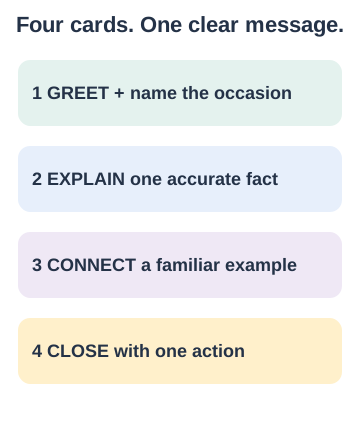
A planning example: Greeting: teachers and friends. Fact: Constitution came into effect, 26 January 1950. Example: listen to each person in a group. Close: make room for someone else’s idea. Turn those notes into sentences you would actually say.
Keep the connection honest. “I helped a new classmate yesterday” should be used only if that happened. Otherwise say “We can help a new classmate”. A speech does not need a fictional personal experience presented as real.
Rehearse for clarity, not a race
First, ask the child to explain each sentence in their own words. Replace any word they cannot explain with a simpler accurate phrase, or teach its meaning before keeping it. “Constitution” may need a short explanation; replacing it with “school rules” would lose accuracy.
Second, read aloud and mark natural pauses after complete ideas. Practise the opening and closing separately. Listen for clear endings of words and a steady pace. Volume should suit the room; shouting can make a sentence harder to understand.
Third, put the full text aside and try the cue cards. If the speaker forgets a line, return to the next idea rather than restarting from the first word every time. Use whichever support the school permits.
Finally, time one comfortable rehearsal. Trim repeated points if it runs long. Keep a small margin for pauses and audience response. A shorter speech delivered clearly can communicate more than a longer one rushed to fit.
How an adult can help without taking over
Ask “Which example feels true for you?” and let the child choose. Check factual sentences together, then leave room for the child’s natural phrasing. The goal is a speaker who understands the message, not an adult essay delivered from memory.
Give one useful piece of feedback at a time: a difficult word, a rushed sentence or an unclear connection. First name what the listener understood, then suggest a specific change. “Pause after the date” is easier to act on than “be more confident”.
For a child who finds reading or speaking difficult, shorten the script, enlarge the cue cards and rehearse with a familiar listener. Follow the school’s agreed support arrangements. Do not make public performance the only measure of whether the child understood the topic.
Save the final script with the event date and time limit. The downloadable worksheet below contains planning and editing tasks; the complete guide includes both original models.
4 worked examples with reasoning
1. Repair “India became independent on Republic Day in 1950.”
- The sentence confuses two national occasions.
- For this speech write: “On 26 January 1950, the Constitution of India came into effect.”
- If mentioning independence, give 15 August 1947 separately.
2. Make “We must uphold noble ideals” easier for a child to explain.
- Ask which ideal the speaker means.
- If the idea is respect, try: “We can listen when someone else is speaking.”
- Keep a link to the larger value without leaving the message abstract.
3. The speech is too long for the allotted slot. What can be cut?
- Find repeated greetings, repeated promises and extra examples.
- Retain one factual explanation, one concrete example and the closing thought.
- Time the revised speech at a comfortable pace rather than compensating by rushing.
4. The child cannot remember the middle paragraph.
- Identify its main idea: perhaps listening in a group.
- Put two reminder words on the cue card, such as “group — listen”.
- Practise moving from that idea to the closing action. Exact recitation is not the only way to deliver a clear message.
Save the guide or print the practice
Download to save or share
Complete guide with answers (PDF) · Worksheet without answers (PDF) · Worksheet and answer key (PDF)
Try each question before opening its explanation. Show the calculation, evidence or reasoning that supports your answer.
10 practice questions with explanations
Try each question before opening its explanation. Show the calculation, evidence or reasoning that supports your answer.
Write an answer and your reason before opening the explanation. Check the reasoning as well as the final answer.
- Facts
Complete: the Constitution came into effect on ___.
Answer and reasoning
26 January 1950.
Its adoption date was 26 November 1949; keep the events distinct.
- Facts
Is 2027 the 78th Republic Day or 78 years after 1950?
Answer and reasoning
The 78th Republic Day; 77 years after 1950.
Inclusive event counting and elapsed years differ by one.
- Choose
Choose one value and an everyday example that illustrates it.
Answer and reasoning
Example: respect — listen without interrupting.
Several answers are possible; the example should clearly connect to the named value.
- Write
Write a two-sentence opening in your own words.
Answer and reasoning
Greet the audience and name the occasion.
Keep it appropriate for the school and avoid an unsupported event detail.
- Edit
Replace “I always treat everybody perfectly” with a believable commitment.
Answer and reasoning
“I will try to listen before I interrupt.”
A concrete intention is more credible than an absolute claim.
- Plan
Write four cue-card headings.
Answer and reasoning
Greeting; occasion and fact; everyday example; closing action.
The headings give a sequence without requiring every word to be memorised.
- Check
Should you include an unverified 2027 chief guest?
Answer and reasoning
No.
Use confirmed organiser information or omit the detail.
- Rehearse
What should you do if the speech exceeds the time limit?
Answer and reasoning
Remove repetition or one example, then time it again.
Rushing makes the message harder to follow.
- Explain
Explain “Constitution” in a sentence suitable for this speech.
Answer and reasoning
It sets out how our country is governed and recognises important rights.
This is an introductory explanation, not a complete account of the document.
- Reflect
What did a listener remember after your rehearsal?
Answer and reasoning
Record the listener’s actual response.
Use it to find an unclear idea; do not invent positive feedback.
Use the ideas without looking at the notes
My speech planner: Audience ___. Time limit ___. Accurate fact ___. Example I understand ___. Final action ___. Words to practise ___. Timed rehearsal result ___. One change I made ___.
Before the event, check the date, remove any unverified claim and read the final version aloud. Use the school’s preferred greeting and permitted cue-card arrangements.
Common questions
Can I use these speeches at school?
Yes, use these original BananaLearn models as a starting point and adapt them to the child and the school’s instructions.
How long will the model take?
Time a real rehearsal. Speaking pace and pauses vary, so no exact duration is guaranteed.
Should a Grade 3 child use the longer version?
Choose by understanding and the event’s time limit. A shorter clear version may fit better; grade alone does not decide.
Does a speech need a famous quotation?
No. A clear original statement is enough. Verify any quotation before adding it.
Why not add every historical detail?
A short speech needs a focused message. Keep facts accurate and choose details that the speaker can explain.
Connect your learning
Ask about guided English · Speaking learning if your child needs help explaining these ideas.
About this guide
Original explanations, examples, diagrams and practice by BananaLearn. The grade label indicates the intended learning level; this is not an official textbook extract or exam paper.