English · Suggested Grade 7
Class 7 Persuasive Paragraphs: Claims, Reasons & Evidence
“We need a reading corner because it would be amazing” gives an opinion. A persuasive paragraph becomes stronger when it explains who would benefit, how it would work and what evidence supports the idea.
Original explanations and practice by BananaLearn · Published 31 October 2026
On a small screen, swipe across the illustration to read every label.
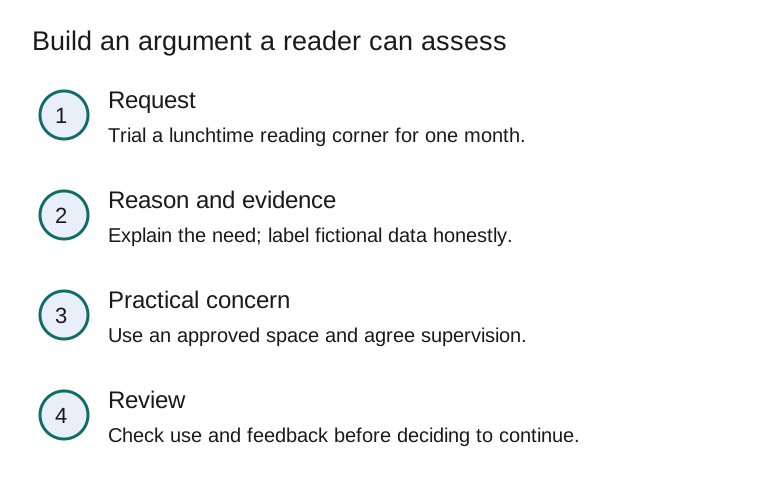
What a persuasive paragraph tries to do
A persuasive paragraph asks a reader to accept an idea or take a particular action. Begin with a precise claim, develop relevant reasons and support them with examples or evidence. Finish by connecting the reasons back to a practical request. A long list of enthusiastic adjectives cannot do the work of reasoning.
Choose an audience before you draft. A principal deciding how to use a spare room needs different information from a friend choosing a book. Ask what the reader can decide, what constraints matter and what would count as a reasonable next step. Persuasion works best when it engages with those questions.
Make the claim small enough to support
Compare Every school must build a huge library immediately with Our class should try a small lunchtime reading corner for one month. The second claim names a place, action and trial period. It is easier to evaluate and can be supported without pretending to know every school’s budget.
A focused claim is not necessarily a timid one. It tells the reader what is actually proposed. Avoid always, everyone and guaranteed unless the evidence justifies them. If one pupil enjoys quiet reading, that example supports the existence of a need; it does not prove all pupils want exactly the same space.
Separate reasons, examples and evidence
A reason explains why the proposal matters: pupils who want a quieter break need somewhere to read. An example makes it concrete: a learner could finish a chapter while others play outside. Evidence would be a reliable observation or a properly described survey, not a number invented to sound convincing.
For the teaching example below, imagine a fictional class survey of 24 pupils: 15 prefer a quiet reading option on at least one lunchtime a week. These are invented practice data, not research about real children. A genuine school proposal should replace them with real observations and explain how they were collected.
Read an original model paragraph
Our class should trial a lunchtime reading corner for one month. Some pupils enjoy active games every day, but others would welcome a quiet choice. In our fictional survey, 15 of 24 pupils said they would use a reading space at least once a week. We could begin with a labelled book box and the existing tables rather than ask for new furniture. Two volunteers could check that books return to the box, with a teacher agreeing the supervision arrangements. At the end of the month, we could review use and feedback before continuing. A small trial would let us test the idea while keeping the playground available for everyone.
This is an original demonstration, not a report of a real BananaLearn survey. Notice that the paragraph asks for one trial, gives a reason, labels its evidence and addresses cost and management. The ending offers a way to learn whether the proposal works rather than claiming a guaranteed outcome.
Compare a weak paragraph with a useful revision
Weak version: Everyone loves reading and the school must buy a perfect library because it will make all students brilliant. The wording assumes universal agreement and promises an outcome it cannot establish. It gives the decision-maker no workable action, cost boundary or evidence to assess.
A useful revision replaces the broad claim with the trial proposal, changes everyone to some pupils and explains what the space would provide. Do not simply swap amazing for excellent. Improve the argument: who needs it, what will happen, what supports the claim, and how the school can review the result.
Answer an objection fairly
A reader might reasonably ask whether supervising another room is possible. Acknowledge the concern instead of dismissing it: The trial should use a space and time already approved for supervision; if that is not available, we should adjust the plan. This response keeps the proposal honest about its practical limit.
Do not invent the reader’s views or attack people who disagree. A counterargument is a relevant concern you can address with reasoning or a change to the proposal. If the evidence is insufficient, requesting a small test can be stronger than pretending the uncertainty does not exist.
Plan, draft and revise your own paragraph
Use five planning boxes: request, audience, reason, evidence or example, and practical next step. Choose a manageable topic such as a refill-water reminder, a classroom book swap or a different homework deadline. Write the paragraph only after you can explain why the audience should care.
Read the draft once for argument and once for sentences. Underline the claim, circle evidence and check whether each sentence supports the request. Then remove an unsupported exaggeration and answer one reasonable concern. A parent can play the reader and ask what they are being asked to decide, without supplying the child’s opinion.
A persuasion planning sheet
Copy the record into a notebook or use it to organise your own answer. Blank spaces are for your work.
| Audience | Precise request | Reason | Evidence or labelled example | Concern and response | Next step |
|---|---|---|---|---|---|
| ___ | ___ | ___ | ___ | ___ | ___ |
10 questions with explained answers
Try the questions before opening the answers. Explain the reason, then try a changed example to check your understanding.
Which is a focused claim: improve everything or trial a reading corner for one month?
Show answer and explanation
Trial a reading corner for one month
It specifies an action and a review period.Is amazing a reason by itself?
Show answer and explanation
No
It expresses approval without explaining the benefit.In the fictional survey, how many of 24 pupils preferred the reading option?
Show answer and explanation
15
This is stated in the model; it is invented teaching data.Does that survey prove every pupil wants the corner?
Show answer and explanation
No
15 of 24 is not all pupils, and the example is fictional.Name one practical concern the model addresses.
Show answer and explanation
Example: furniture cost or book organisation
It starts with existing tables and a labelled book box.Replace guaranteed to make every child brilliant with a supportable benefit.
Show answer and explanation
Example: gives pupils a quiet reading option
The revision describes what is provided instead of promising an unmeasured outcome.What should genuine survey evidence describe?
Show answer and explanation
Who was asked, what was asked and what the responses showed
Context helps the reader judge how relevant the evidence is.Write a fair objection to the reading-corner plan.
Show answer and explanation
Example: Who will supervise the space?
This is a practical concern the proposal needs to address.What is the purpose of the final review after one month?
Show answer and explanation
To decide whether and how the trial should continue
Review allows the decision to depend on actual use and feedback.Write your own one-sentence request with an audience and action.
Show answer and explanation
Example: Our class teacher should allow a two-week book-swap trial.
Other answers work when the requested action and decision-maker are clear.
Keep the ideas connected
- Build a paragraph from a plan
- Turn a request into a formal letter
- Describe evidence without overstating it
- Support a child’s own writing
For help with a school-learning difficulty, bring one attempted question to a discussion about tutoring and curriculum fit. Maths is our priority; English and Science tutoring are also available.
Sources, scope and sharing
The examples, diagrams and practice are original BananaLearn work. Grade labels suggest a learning level; teaching sequences and school requirements can differ. Official sources below support the stated facts and resource links. These activities are independent resources, not official exam questions or endorsed campaign materials.
How we prepare learning guides · Report a correction
Share this guide: https://bananalearn.com/learn/class-7-persuasive-paragraph-evidence.html