1. An atom has A=23, Z=11 and is neutral. Count its particles.
- Protons=11. Neutrons=23−11=12.
- Neutrality gives electrons=11.
- Check mass: 11+12=23; check charge: 11−11=0.
Science · Suggested Class 9 · school sequences vary
Two atoms can be the same element with different masses. An ion can change its charge without changing its element. Keep three particle counts separate.
Start here
Atomic number Z counts protons; mass number A counts protons plus neutrons. An ion’s electron count changes with charge, while isotopes differ in neutrons.
Original BananaLearn guide · 7 November 2026
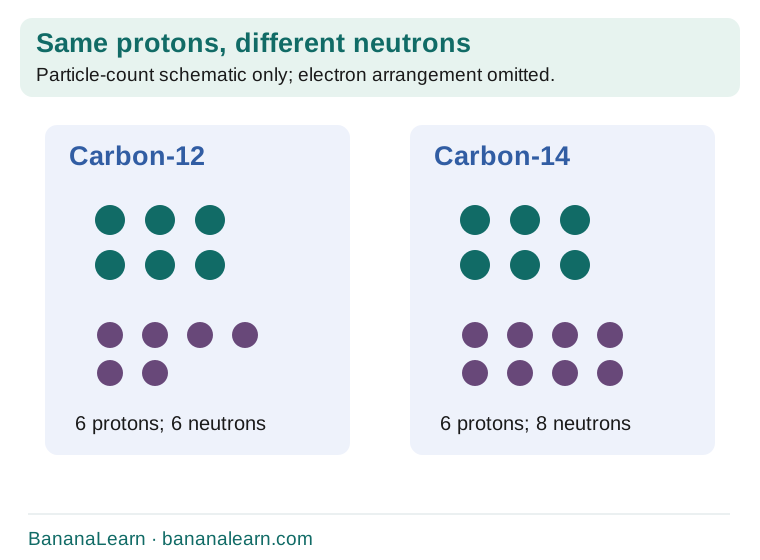
On a narrow screen, swipe the diagram or open it full size.
Protons have positive charge and neutrons have no charge; both are in the nucleus. Electrons carry negative charge and occupy the region around the nucleus. A simplified shell picture helps count them but is not a scale drawing of an atom.
Use one row each for protons, neutrons and electrons. Changing one row does not automatically change all three.
The atomic number Z is the number of protons. Every carbon atom has 6 protons. If the proton number changed, it would no longer be carbon.
A neutral atom has equal proton and electron counts. This neutrality condition does not tell you the neutron count; you need its mass number or isotope information.
Mass number A is protons plus neutrons. Therefore neutrons=A−Z. Carbon-14 has 14−6=8 neutrons. Carbon-12 has 6. Both have 6 protons.
Mass number is not the same as the relative atomic mass printed as a decimal in a periodic table. The latter reflects isotopic masses and abundances; do not round it and treat that rounded number as the mass number of every atom.
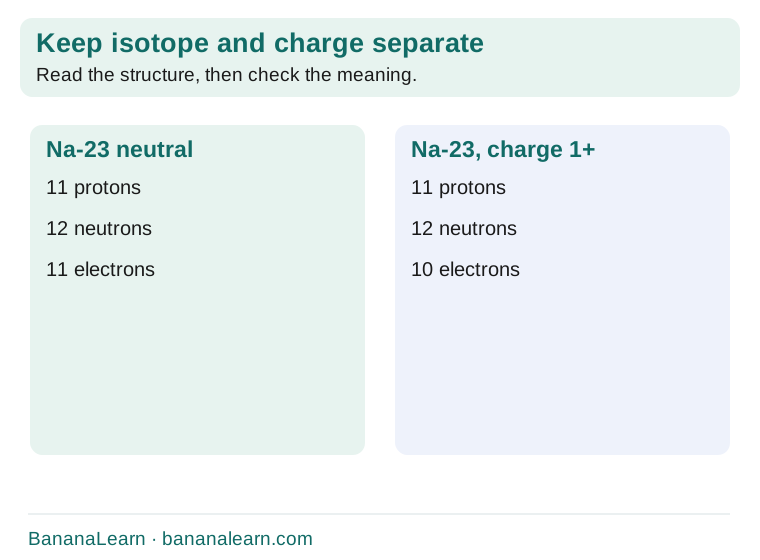
On a narrow screen, swipe the diagram or open it full size.
Isotopes are atoms of the same element with different neutron counts and therefore different mass numbers. They have the same atomic number. Neutral isotopes of the same element also have the same electron count.
Isotopes can have different physical and nuclear properties. An isotope is not automatically radioactive, and a heavier isotope is not automatically a different element.
A positive ion has fewer electrons than protons; a negative ion has more. Sodium has Z=11. Na⁺ has 11 protons and 10 electrons. Chlorine has Z=17, so Cl⁻ has 17 protons and 18 electrons.
In ordinary chemical ion formation, the nucleus remains unchanged. Saying “sodium loses a proton to become Na⁺” would change the element and is not this process.
An isotope can be written with A above Z beside the element symbol, with charge at the upper right. For an ion with A=24, Z=12 and charge 2+, count 12 protons, 12 neutrons and 10 electrons.
Read the charge separately from A and Z. A negative charge does not mean a negative number of particles; it describes an excess of electrons relative to protons.
Compare carbon-12 and carbon-14: neutrons differ, so they are isotopes. Compare neutral carbon-12 and a carbon-12 ion: electrons differ, so they are different charge states of that isotope.
A species can be both a particular isotope and an ion. These labels answer different questions rather than competing for one category.
Add protons and neutrons to recover A. Subtract electrons from protons to recover the charge in elementary-charge units. Confirm that Z matches the named element.
This count-and-check approach is useful before studying bonding or nuclear topics. The exercises give the needed atomic numbers; no periodic-table memorisation is required to infer missing information.
See the reasoning
Try, explain, check
Try each task before opening its explanation. These are original BananaLearn questions, not official exam or past-paper questions. Where several answers can work, the explanation gives the criteria.
9
Atomic number counts protons.
10
19−9=10.
9
Neutrality requires p=e.
10
One extra electron gives charge −1.
3+
13−10=+3.
No; it remains 14
Ion formation changes electrons in this model.
Isotopes
Their neutron counts differ.
No
Radioactivity is not part of the isotope definition.
No
Element identity depends on protons, which differ.
No
Negative charge means more electrons than protons.
No
It represents isotope-weighted relative atomic mass.
p+n=A and p−e=charge
Also check p=Z for the named element.
Copy these headings and fill them for one worked task, then for a fresh attempt. Use your own evidence rather than copying the model answer.
Explore BananaLearn’s games, learning features and one-to-one tutoring. Maths is our priority; English and Science tutoring are also available. Bring a recent example of schoolwork when checking teaching fit.
Original BananaLearn explanations, examples, illustrations and practice. Source facts checked 7 November 2026. Suggested levels are learning guides, not a claim that every board or textbook uses the same sequence.
How we prepare guides · Report a correction
Share the complete guide: https://bananalearn.com/learn/class-9-atomic-number-isotopes-ions.html