Science · Suggested Class 8
Metals & Non-metals: Class 8 Properties, Uses & Exceptions
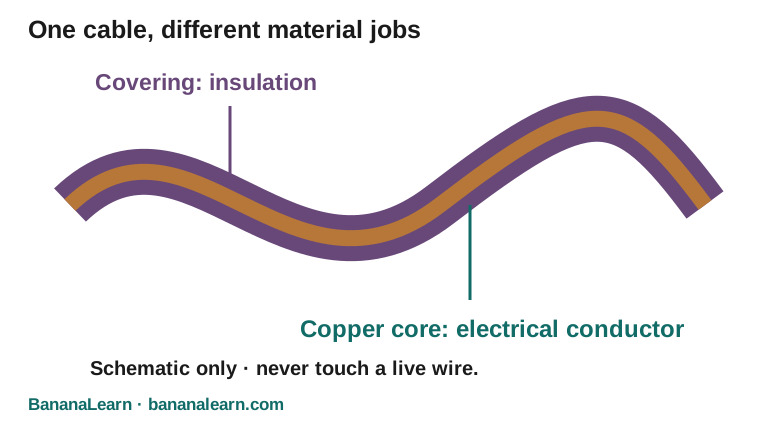
A copper wire must let electricity through. Its plastic covering must keep that current away from your hand. The useful question is which property each part needs, rather than whether both parts look shiny.
Original BananaLearn guide · 2 November 2026
On a phone, swipe across the illustration to read every label.
Start with properties, then name the material
Metals and non-metals are broad classes of chemical elements. Iron, copper and aluminium are metals; oxygen, sulfur and carbon are non-metals. Everyday objects can also contain mixtures, compounds or combinations of materials. Plastic is a useful electrical insulator, but it is not a chemical element and should not be labelled a non-metal element.
A material choice usually needs several properties. A cooking-pan base should transfer heat well and withstand its operating temperature, while a suitable handle reduces heat reaching the hand. Looking shiny is not enough to explain either job. This guide introduces properties and their uses; it is not a complete reactions chapter or a universal current-board syllabus list.
Conductors let heat or electrical charge transfer
Many metals conduct electricity well. Copper is used inside many electrical wires because it conducts and can be drawn into wire. The outside coating is a different material chosen to insulate and protect. The coating does not stop the copper conducting along its intended path; it helps prevent unwanted contact with the conductor.
Thermal conductivity is about heat transfer, while electrical conductivity is about electric current. They are distinct properties even though many metals have both. A saucepan can use a metal base for heat transfer and a handle designed for insulation. Never test a household socket, mains wire, charger or plugged-in appliance for this lesson.
Malleability and ductility describe different changes of shape
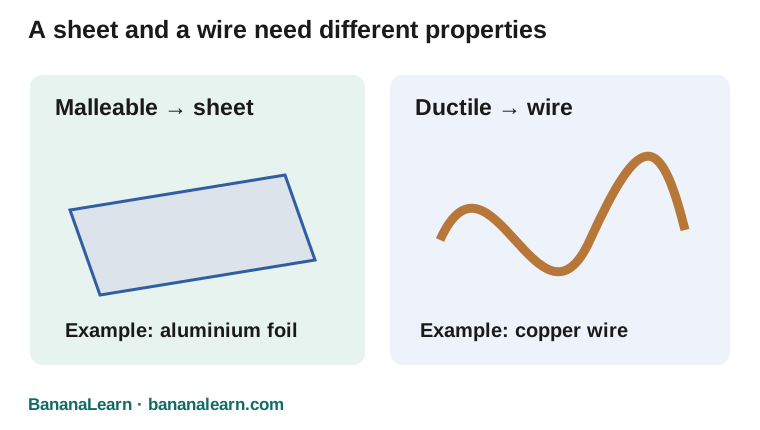
Malleability is the ability to be shaped into thin sheets by hammering or rolling without breaking in that process. Aluminium foil illustrates a sheet. Ductility is the ability to be drawn into wire; copper wiring illustrates a wire. A learner who simply writes metals can bend has not distinguished the two properties.
Many solid non-metals are brittle rather than malleable. Brittle means tending to crack or break under a suitable force, not merely being soft. These descriptions are general patterns, not instructions to hammer unknown objects. Use pictures or teacher-prepared samples; fragments and sharp edges make unsupervised hammer tests unsuitable.
On a phone, swipe across the illustration to read every label.
Lustre, sound and room-temperature state
Lustre describes how a surface reflects light and appears shiny. Many freshly exposed metal surfaces have metallic lustre, but coatings, dirt and corrosion can change appearance. Many metals are sonorous: a suitable metal object can ring when struck. The sound also depends on shape and how it is held, so a dull sound alone is not a reliable classification test.
Many metals are solid at ordinary room temperature, but mercury is liquid. Non-metals occur in different states: oxygen is a gas and sulfur is a solid under ordinary room conditions. Room temperature is a condition, not a fixed state for every material at all temperatures. Mercury and unfamiliar chemicals should be studied through information or pictures, not handled for a home activity.
The exceptions prevent an unsafe shortcut
Graphite, a form of the non-metal carbon, conducts electricity. Iodine is a non-metal with a lustrous appearance. Mercury is a liquid metal at ordinary room temperature. Sodium and potassium are unusually soft metals and react strongly with water. These examples are reasons to avoid sentences beginning all metals or all non-metals unless the claim is genuinely universal.
Do not turn exceptions into home demonstrations. A pencil core contains graphite mixed with other material, so it is not a pure-element sample or a reliable basis for measuring pure graphite’s conductivity. A collection of observations can suggest an explanation, but one property does not uniquely identify an element.
Explain a use with a property and a limitation
Worked example: Why can aluminium be used for foil? It is malleable, allowing thin sheets to be produced. That explanation links a named property to the required shape. It does not mean every thin wrapping is aluminium; paper and plastic can also be made into sheets by different processes.
Worked example: Why is copper useful for a wire core? It combines electrical conductivity with ductility. The outer insulation has a different function. Do not say the plastic coating conducts electricity safely: its useful role is normally resisting current through the covering. A real cable’s safety also depends on design and condition; this lesson does not authorise electrical repairs.
A safe observation activity with household objects
Gather an intact spoon, a piece of clean foil, a wooden pencil and a plastic ruler. Look only: do not scratch, heat, taste, plug in, burn or break anything. Record the known material from a reliable label or adult knowledge separately from what you actually observe. If a material is uncertain, write uncertain rather than guessing.
List each object’s job and the properties that would help it perform that job. For foil, note its thin sheet shape and discuss malleability as a manufacturing property; you have not directly tested industrial rolling. For the ruler, discuss the usefulness of rigidity and readable markings. Being a non-metallic object does not make plastic a non-metal element.
How to write a stronger science answer
Use a three-part answer: the property, what it allows, and the object’s requirement. For example, Copper is ductile, so it can be drawn into a long thin wire, and it conducts electricity along the wire. A list such as copper is shiny and hard misses the connection to the use.
When given an unfamiliar substance, distinguish an observation from a conclusion. A shiny surface is an observation; this must be a metal is a stronger claim that the observation alone does not establish. If your school chapter includes reactions, displacement or corrosion, study those separately with the correct current text and a teacher-supervised laboratory method.
Observation record: look, describe, separate inference
Copy this record into a notebook. Fill each blank using your own example or the activity above.
On a phone, swipe across a wide table to see every column.
| Object | Known material or uncertain | Observed feature | Property relevant to its job |
|---|---|---|---|
| Clean foil | ___ | ___ | ___ |
| Intact spoon | ___ | ___ | ___ |
| Wooden pencil | ___ | ___ | ___ |
| Plastic ruler | ___ | ___ | ___ |
12 questions with explained answers
Try each question first. Open the explanation to check your reasoning. These are original BananaLearn questions, not official exam questions.
Which property helps aluminium become foil?
Check answer and reasoning
Malleability.
It can be formed into thin sheets; ductility refers to making wire.Which two properties suit copper for a wire core?
Check answer and reasoning
Electrical conductivity and ductility.
One allows current to flow; the other allows the required wire shape.Is plastic a non-metal element?
Check answer and reasoning
No.
Plastic is not a chemical element. It can be a non-metallic material without belonging to a list of non-metal elements.Name a non-metal form that conducts electricity.
Check answer and reasoning
Graphite, a form of carbon.
It is an important exception to the general poor-conductivity pattern for non-metals.Does a shiny surface prove that a substance is a metal?
Check answer and reasoning
No.
Iodine is a lustrous non-metal; coatings and mixtures also complicate appearance.Name a metal liquid at ordinary room temperature.
Check answer and reasoning
Mercury.
Its state is an exception to the common solid-metal pattern. Do not handle it for this activity.What is the purpose of the plastic around an electrical wire?
Check answer and reasoning
Insulation and protection.
The coating helps prevent unwanted contact with the conducting core; it is not chosen to carry current through the covering.Is brittleness the same as softness?
Check answer and reasoning
No.
Brittleness concerns cracking or breaking under force. Softness concerns resistance to scratching or deformation in its relevant test.Why might an old metal object not look shiny?
Check answer and reasoning
Its surface may be coated, dirty or corroded.
Appearance of an object is not a complete account of the underlying material’s properties.Can a dull ringing sound alone identify a non-metal?
Check answer and reasoning
No.
Sound also depends on shape, support and how the object is struck. Do not classify from that one observation.Why should a pupil not cut sodium to check its softness?
Check answer and reasoning
It is reactive and unsuitable for an unsupervised home test.
Learn the exception from a reliable source or an appropriately controlled teacher demonstration.Repair: A metal saucepan has a plastic handle because plastic transfers heat quickly.
Check answer and reasoning
The handle is designed to reduce heat reaching the hand.
Suitable handle materials and construction can limit heat transfer. The base and handle have different jobs.
Choose your next learning step
- Understand conductors and insulators
- Separate the three ways heat transfers
- Revisit simple low-voltage circuit ideas
- Plan the next science revision step
Explore BananaLearn games, learning resources and tutoring. Maths is our priority; English and Science tutoring are also available. Share your current schoolwork when checking teaching fit.
Sources and scope
Explanations, activities, diagrams and practice are original BananaLearn work. Class labels suggest a learning level; school sequences and current textbook editions can differ. Sources checked 2 November 2026.
How we prepare guides · Report a correction
Share the complete guide: https://bananalearn.com/learn/class-8-metals-nonmetals-properties.html