
Start with the key idea
Balance a chemical equation by changing coefficients so each element has the same number of atoms on both sides. Keep every chemical formula unchanged, then reduce the coefficients to their simplest whole-number ratio.
1. Begin with the substances and the conservation rule
A chemical equation represents reactants changing into products. The arrow separates the two sides; it does not mean that the written formulae are interchangeable. Before balancing, check that the reactants and products are correctly identified. A mathematically balanced line with the wrong product is still a wrong chemical description.
In an ordinary chemical reaction, atoms are rearranged. The count of each element must match across the equation. For ionic equations, charge must also be conserved, though this guide practises neutral formula equations. An equation balanced only in its total number of atoms can still fail if individual element counts differ.
State symbols such as (s), (l), (g) and (aq) provide additional information. They do not alter atom counts, and balancing alone does not determine all the reaction conditions or whether a proposed reaction actually occurs.
2. Change coefficients, never subscripts
A coefficient multiplies the entire formula following it. In 2H₂O, it gives four hydrogen atoms and two oxygen atoms. The subscript 2 within H₂O belongs to the chemical formula and must remain fixed. Changing H₂O into H₂O₂ would replace water with hydrogen peroxide rather than balance water formation.
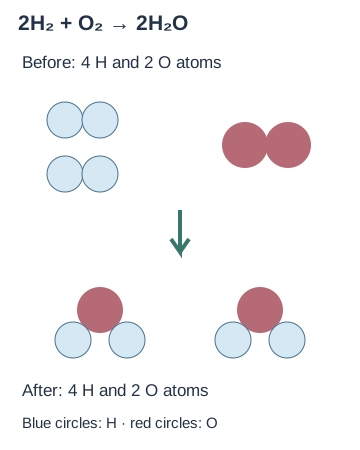
A missing coefficient means one. Use whole-number coefficients in their simplest ratio for the final school answer. Fractions may help during working, but multiply every coefficient by a suitable common factor before finishing.
Keep a count table with one row per element and columns for left and right. Recount after every change because a coefficient can affect several elements at once. Circle the formula as a group if you are tempted to multiply only its first element.
3. Use an orderly inspection method
List the elements and count the current atoms. Choose an element appearing in relatively few formulae, often one in a more complex compound. Adjust a coefficient to balance it, then move to another element. Hydrogen and oxygen are often convenient to leave later in combustion equations, but this is a strategy rather than a universal law.
If a polyatomic group remains unchanged on both sides, it can sometimes be counted as a unit during working. You must still check individual atoms at the end. Do not use the shortcut when the group breaks apart or changes composition.
After each adjustment, return to earlier rows. For Al + Cl₂ → AlCl₃, matching chlorine requires six chlorine atoms on each side: 3Cl₂ and 2AlCl₃. That product coefficient then requires 2Al on the left.
4. Handle odd and even counts without guessing
An odd oxygen count in a product and O₂ on the reactant side can create a temporary fraction. For C₂H₆ + O₂ → CO₂ + H₂O, balance carbon with 2CO₂ and hydrogen with 3H₂O. The product side then contains seven oxygen atoms, requiring 7/2 O₂.
Multiply the entire equation by two: 2C₂H₆ + 7O₂ → 4CO₂ + 6H₂O. Multiplying only the oxygen coefficient would spoil the other balances. Check carbon, hydrogen and oxygen again after clearing the fraction.
An alternative is to begin with two ethane molecules to avoid fractions, but both methods express the same final ratio. The useful habit is a transparent count table, not lucky trial and error. Never alter a formula to avoid an awkward number.
5. Perform an independent final audit
Read the completed equation afresh and calculate each count from coefficient × subscript. For 2Al + 3Cl₂ → 2AlCl₃, aluminium is 2 on each side and chlorine is 6 on each side. Check that the coefficients have no common factor greater than one.
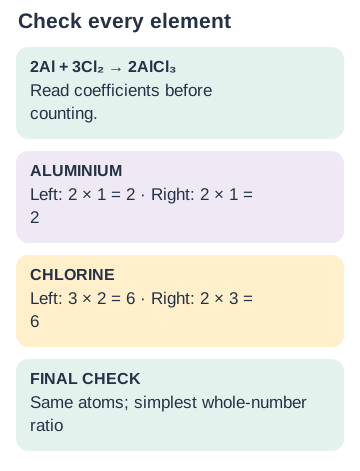
A correct balance states a ratio, not a claim that only that many particles can react. Twice or ten times the quantities preserve the same ratio, although the simplest whole numbers are the expected conventional presentation. Do not infer a mass ratio directly from coefficients; particle ratios and mass ratios differ.
Finally check legibility. A leading 2 and a subscript 2 perform different jobs. On paper, leave space before formulae, write subscripts clearly and include the reaction arrow.
6. Use balancing to explain a reaction responsibly
A balanced equation does not tell you the reaction speed, yield, energy change or practical safety. It also cannot establish an unknown product without chemical evidence. The equations here are paper-based practice; they are not instructions to mix chemicals, burn fuels or generate gases at home.
When a question asks why an equation must be balanced, connect it with conservation of atoms and mass in the complete system. When it asks for a method, demonstrate counts and coefficients rather than writing only the final line. When it asks for state symbols or conditions, treat those as separate information requirements.
Use errors diagnostically: a wrong oxygen count after fixing hydrogen suggests you forgot to recount the whole product. A changed subscript suggests confusion between particle number and identity. Correct the specific habit, then solve a new equation without looking at the model.
5 worked examples with reasoning
1. Balance H₂ + O₂ → H₂O.
- Oxygen: place 2 before H₂O.
- Hydrogen is now 4 on the right, so place 2 before H₂.
- 2H₂ + O₂ → 2H₂O; H: 4 each, O: 2 each.
2. Balance Fe + O₂ → Fe₂O₃.
- Use 2Fe₂O₃ to give 6 O atoms.
- Use 3O₂ and 4Fe on the left.
- 4Fe + 3O₂ → 2Fe₂O₃; Fe: 4 each, O: 6 each.
3. Balance Na + H₂O → NaOH + H₂.
- Use 2H₂O and 2NaOH to give 2 O atoms each.
- Their H counts leave two H atoms for H₂.
- 2Na + 2H₂O → 2NaOH + H₂; Na: 2, O: 2, H: 4 each.
4. Balance CaCO₃ → CaO + CO₂.
- Count Ca: 1 each and C: 1 each.
- Oxygen on the right is 1 + 2 = 3.
- It is already balanced with coefficients 1:1:1.
5. Balance C₂H₆ + O₂ → CO₂ + H₂O.
- Balance C and H as 2CO₂ and 3H₂O.
- Seven product O atoms need 7/2 O₂; multiply all terms by 2.
- 2C₂H₆ + 7O₂ → 4CO₂ + 6H₂O; C: 4, H: 12, O: 14 each.
Save the guide or print the practice
Download to save or share
Complete guide with answers (PDF) · Worksheet without answers (PDF) · Worksheet and answer key (PDF)
Try each task before opening its answer. Give an example or reason, not only a label.
14 practice questions with explanations
Try each task before opening its answer. Give an example or reason, not only a label.
Write an answer and your reason before opening the explanation. Check the reasoning as well as the final answer.
- Count
How many H atoms are represented by 3H₂O?
Answer and reasoning
6.
Multiply the coefficient 3 by subscript 2.
- Rule
May H₂O be changed to H₂O₂ to balance oxygen?
Answer and reasoning
No.
That changes the substance.
- Balance
Balance Mg + O₂ → MgO.
Answer and reasoning
2Mg + O₂ → 2MgO.
Mg: 2 and O: 2 on each side.
- Balance
Balance N₂ + H₂ → NH₃.
Answer and reasoning
N₂ + 3H₂ → 2NH₃.
N: 2 and H: 6 on each side.
- Balance
Balance Al + Cl₂ → AlCl₃.
Answer and reasoning
2Al + 3Cl₂ → 2AlCl₃.
Al: 2 and Cl: 6 on each side.
- Balance
Balance KClO₃ → KCl + O₂.
Answer and reasoning
2KClO₃ → 2KCl + 3O₂.
K: 2, Cl: 2 and O: 6 each.
- Balance
Balance Zn + HCl → ZnCl₂ + H₂.
Answer and reasoning
Zn + 2HCl → ZnCl₂ + H₂.
Zn: 1, H: 2 and Cl: 2 each.
- Balance
Balance CH₄ + O₂ → CO₂ + H₂O.
Answer and reasoning
CH₄ + 2O₂ → CO₂ + 2H₂O.
C: 1, H: 4 and O: 4 each.
- Balance
Balance Na₂CO₃ + HCl → NaCl + H₂O + CO₂.
Answer and reasoning
Na₂CO₃ + 2HCl → 2NaCl + H₂O + CO₂.
Na: 2, C: 1, O: 3, H: 2 and Cl: 2 each.
- Simplify
Simplify 4H₂ + 2O₂ → 4H₂O.
Answer and reasoning
2H₂ + O₂ → 2H₂O.
Divide every coefficient by 2.
- Check
Is C + O₂ → CO₂ already balanced?
Answer and reasoning
Yes.
C: 1 and O: 2 each.
- Meaning
Do equal total atom counts guarantee balance?
Answer and reasoning
No.
Each individual element must match.
- Fraction
If one coefficient is 1/2, what must you multiply to remove it?
Answer and reasoning
Every coefficient by 2.
The ratio must remain unchanged.
- Scope
Does balancing prove a reaction is safe to perform?
Answer and reasoning
No.
It is a conservation check, not a safety assessment.
Use the ideas without looking at the notes
Choose three equations from the practice set. Draw a separate atom-count table for each, show every coefficient change, and ask a partner to audit the final formulae without seeing your working.
Common questions
Why not change subscripts?
They define the substances. Coefficients change the number of whole particles instead.
Can an equation already be balanced?
Yes. Always count before adding coefficients.
Must final coefficients be simplest whole numbers?
That is the usual school convention. Divide by a common factor when possible.
Do state symbols change atom counts?
No. They describe physical states.
Does balancing identify unknown products?
No. Correct reactants and products must be established first.
Connect your learning
Ask about guided Science learning if your child needs help explaining these ideas.
About this guide
Original explanations, examples, diagrams and practice by BananaLearn. The grade label indicates the intended learning level; this is not an official textbook extract or exam paper.