
Start with the key idea
An atom is the smallest unit of an element retaining its chemical identity. A molecule is a discrete group of bonded atoms. Formulae show composition, but ionic substances such as sodium chloride are described using formula units rather than individual molecules.
1. Separate atom, element and molecule
An element contains atoms with the same atomic number, meaning the same number of protons. At this stage, the key idea is identity: oxygen atoms remain oxygen atoms when they take part in ordinary chemical reactions, even when their partners change. Atoms are not absolutely indivisible; the historical atomic model was refined as smaller particles were discovered.

A molecule is a discrete bonded group. Oxygen gas contains O₂ molecules made of two oxygen atoms. Water contains H₂O molecules with atoms of two different elements. A molecule can therefore represent an element or a compound. Helium commonly exists as individual atoms, so do not force every element into a two-atom picture.
A particle drawing must include a key. Different colours are convenient symbols, not literal atom colours. Count circles and groups separately.
2. Read symbols and subscripts carefully
Chemical symbols use a capital first letter and, when present, a lowercase second letter. Co represents cobalt; CO represents carbon monoxide with carbon and oxygen. Letter case therefore changes meaning. A missing subscript means one atom of that element in the formula, not zero.
In H₂O, the 2 applies only to hydrogen. The oxygen count is one. In CO₂, there is one carbon atom and two oxygen atoms per molecule. A formula describes composition and should not be changed merely to make arithmetic easier.
A coefficient in front multiplies the whole formula. In 3H₂O, multiply both the hydrogen count and oxygen count by three. Brackets also matter: Ca(OH)₂ contains two copies of the OH group, so it has two oxygen and two hydrogen atoms for each calcium.
3. Distinguish ions and formula units
An ion has a net electrical charge because its electron count differs from its proton count. A positive ion has fewer electrons than protons; a negative ion has more. Ordinary ion formation changes electron number, not the element-defining proton number. A polyatomic ion contains several bonded atoms carrying a net charge, such as the sulfate ion.
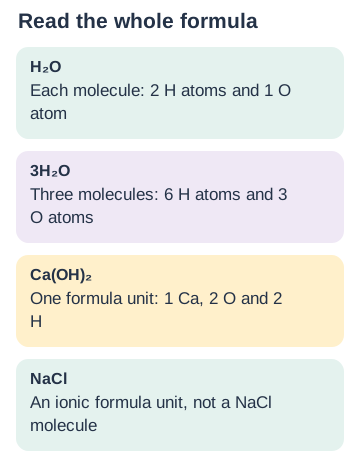
Ionic solids consist of extended arrangements of oppositely charged ions. Sodium chloride is not usefully pictured as a collection of separate NaCl molecules. Its formula gives the simplest whole-number ratio of sodium ions to chloride ions: one to one. We call this a formula unit.
This distinction also affects mass language. Relative molecular mass applies to a molecular substance; relative formula mass is appropriate when using a formula unit. The arithmetic can look similar while the particle model differs.
4. Build simple formulae by balancing charge
For an ionic compound, the total positive and negative charges must balance. Magnesium ions have charge 2+ and chloride ions charge 1−. One magnesium ion therefore combines with two chloride ions in the simplest neutral ratio, giving MgCl₂. Do not write Mg₂Cl because the larger charge does not become a count of the same ion.
Calcium ions have charge 2+ and oxide ions charge 2−, so a one-to-one ratio already balances: CaO. Simplify a proposed ratio such as 2:2 when writing this kind of ionic formula. For calcium hydroxide, two OH groups are required, giving Ca(OH)₂; brackets preserve the group.
Use the charges or valencies supplied by the question, and learn common ions with their names. A cross-over shortcut is safe only when followed by a check of charge, grouping and simplest ratio.
5. Add relative masses with the correct counts
Relative atomic mass compares an element’s average atomic mass with one twelfth of the mass of a carbon-12 atom. Relative masses are ratios and have no unit. For school calculations, use the values supplied, often rounded numbers such as H = 1, C = 12 and O = 16.
Relative molecular mass of water is 2 × 1 + 16 = 18. For carbon dioxide it is 12 + 2 × 16 = 44. A common error is to add the subscript itself instead of multiplying the element’s mass. Write a small count table before adding.
If a question asks for the mass of one molecule in atomic mass units, the corresponding value may be expressed in u. Do not confuse that with the dimensionless relative molecular mass or the mass of an arbitrary sample in grams.
6. Connect particle counts with conservation
In an ordinary chemical reaction, atoms rearrange into new combinations. A balanced equation preserves the number of atoms of each element. This particle picture explains conservation of mass when the complete reacting system is considered. Gas leaving an open container can make the measured container mass fall without breaking the conservation principle.
A pure compound has elements in a fixed composition. Water has a hydrogen-to-oxygen atom ratio of 2:1, but its mass ratio using H = 1 and O = 16 is 2:16, or 1:8. Atom ratio and mass ratio answer different questions.
Use these ideas together: identify the particles, count each element, then apply the appropriate mass values. Do not conduct chemical mixing experiments at home to test a formula; drawings and teacher-provided data are enough for this practice.
5 worked examples with reasoning
1. Count atoms in 3H₂O.
- One molecule contains 2 H and 1 O.
- Multiply each by 3: 6 H and 3 O.
- There are 9 atoms altogether across 3 molecules.
2. Count atoms in Ca(OH)₂.
- There is 1 calcium outside the brackets.
- The bracket multiplier gives 2 oxygen and 2 hydrogen.
- Total: 5 atoms per formula unit.
3. Write the formula for Mg²⁺ and Cl⁻.
- One Mg ion contributes +2.
- Two chloride ions contribute −2.
- The neutral simplest ratio is 1:2, giving MgCl₂.
4. Find relative molecular mass of CO₂ using C = 12, O = 16.
- One carbon contributes 12.
- Two oxygens contribute 32.
- Total relative molecular mass = 44, without a unit.
5. Explain why water has atom ratio 2:1 but mass ratio 1:8.
- Two H atoms contribute relative mass 2.
- One O atom contributes 16.
- The mass ratio 2:16 simplifies to 1:8; masses per atom differ.
Save the guide or print the practice
Download to save or share
Complete guide with answers (PDF) · Worksheet without answers (PDF) · Worksheet and answer key (PDF)
Try each task before opening its answer. Give an example or reason, not only a label.
14 practice questions with explanations
Try each task before opening its answer. Give an example or reason, not only a label.
Write an answer and your reason before opening the explanation. Check the reasoning as well as the final answer.
- Particles
How many atoms are in one O₂ molecule?
Answer and reasoning
2.
The subscript counts oxygen atoms.
- Compound
Is O₂ a compound?
Answer and reasoning
No.
It contains only one element.
- Water
How many oxygen atoms are in 4H₂O?
Answer and reasoning
4.
Each of four molecules contains one O.
- Total
How many total atoms are represented by 2CO₂?
Answer and reasoning
6.
Two groups of three atoms.
- Brackets
Count oxygen atoms in Al₂(SO₄)₃.
Answer and reasoning
12.
There are three sulfate groups, each with four O.
- Case
Are Co and CO the same?
Answer and reasoning
No.
Co is cobalt; CO represents carbon monoxide.
- Ionic
Should solid NaCl be described as separate NaCl molecules here?
Answer and reasoning
No.
Use formula units for its ionic structure.
- Charge
Does a positive ion have excess electrons?
Answer and reasoning
No.
It has fewer electrons than protons.
- Formula
Balance Ca²⁺ and O²⁻ into a simplest formula.
Answer and reasoning
CaO.
One of each balances charge.
- Formula
Balance Na⁺ and O²⁻.
Answer and reasoning
Na₂O.
Two positive charges balance one oxide ion.
- Mass
Find relative molecular mass of H₂ using H = 1.
Answer and reasoning
2.
Two hydrogen atoms contribute 2 × 1.
- Mass
Find relative molecular mass of CH₄ using C = 12 and H = 1.
Answer and reasoning
16.
12 + 4 × 1 = 16.
- Conserve
Why may an open reaction container lose measured mass?
Answer and reasoning
Gas can leave the measured system.
The complete system still conserves mass.
- Meaning
Does a coefficient change a substance’s formula?
Answer and reasoning
No.
It changes the amount represented, not the composition of each particle.
Use the ideas without looking at the notes
Make count tables for 2H₂O, 3CO₂ and Ca(OH)₂. Separate particle count, element counts and total atoms. Then calculate relative masses using explicitly stated atomic-mass values.
Common questions
Are atoms indivisible?
No. Atoms contain smaller particles; ordinary chemical reactions rearrange atoms rather than changing their nuclei.
Can a molecule contain one element only?
Yes. O₂ is a molecule of an element.
Why use brackets in Ca(OH)₂?
The 2 applies to the whole OH group.
Is relative molecular mass measured in grams?
No. It is a dimensionless ratio; sample mass is a different quantity.
Can formula subscripts be changed while balancing an equation?
No. That changes the substances. Change coefficients instead.
Connect your learning
Ask about guided Science learning if your child needs help explaining these ideas.
About this guide
Original explanations, examples, diagrams and practice by BananaLearn. The grade label indicates the intended learning level; this is not an official textbook extract or exam paper.