Learning · Suggested Classes 4–8
World Philosophy Day 2026: A Thinking Activity for Ages 9–14
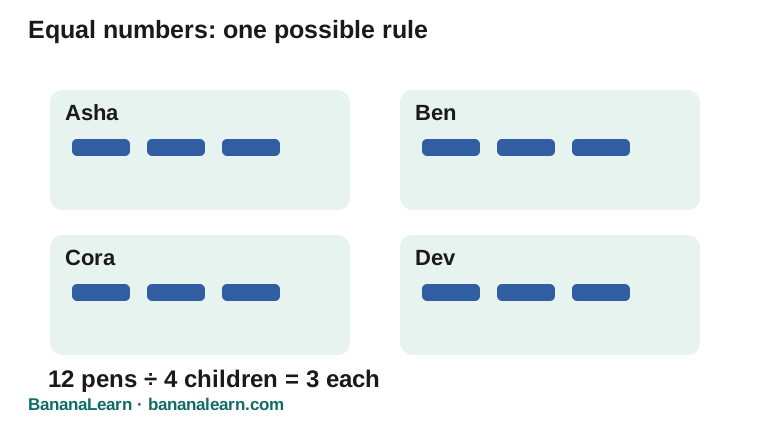
Four children share twelve art pens. Does fair always mean three each? Change one detail of the story and a confident answer suddenly needs a reason.
Original BananaLearn guide · 2 November 2026
On a phone, swipe across the illustration to read every label.
When it is, and what this resource offers
World Philosophy Day follows UNESCO’s third-Thursday-of-November rule. In 2026 that falls on Thursday 19 November. Individual events may use different dates; check their organiser for attendance details. This is an independent BananaLearn discussion activity, not an official UNESCO programme or annual theme.
The activity suits roughly ages 9–14, with adult support adjusted to the group. It practises making a claim, offering a reason, listening to a counterexample and revising an idea. There is no score for agreeing with the adult. A child can change their conclusion and still show stronger reasoning than at the start.
Prepare a 30-minute session
Use twelve paper pen tokens, four named place cards, scrap paper and a timer. Real working pens are optional; paper tokens keep the discussion about allocation rather than the condition of a pen. With one child, the adult can voice another possible position instead of pretending to be a whole class.
Spend 3 minutes reading the story, 5 on first proposals, 8 changing conditions, 7 testing a counterexample, 5 writing a revised rule and 2 reflecting. Allow a pass or a drawn answer. Do not force personal disclosure about a child’s friends, money or school conflict; the fictional scenario is enough.
The original story: twelve pens and four artists
Asha, Ben, Cora and Dev are making separate posters. They have twelve working pens of the same type available for the activity. In the first round, treat the pens as interchangeable; a later round will add a colour constraint. There are no personal ownership claims and no school rule about how to share. Decide how access should be organised and explain the rule so someone else could follow it.
One proposal is three pens per person: 12÷4=3. This is a correct equal allocation. Whether it is the fairest arrangement depends on what the group thinks matters. Invite a second proposal, such as shared access from a central box. Ask how it would work if two people wanted the same pen at once. Practical details test a rule.
On a phone, swipe across the illustration to read every label.
Round two: change one condition at a time
First change: Asha is drawing a small title and Dev is colouring a large background. Ask whether need should change access, and how the group could judge need without simply rewarding the loudest request. Keep the total at twelve and the number of children at four; otherwise the comparison becomes harder to interpret.
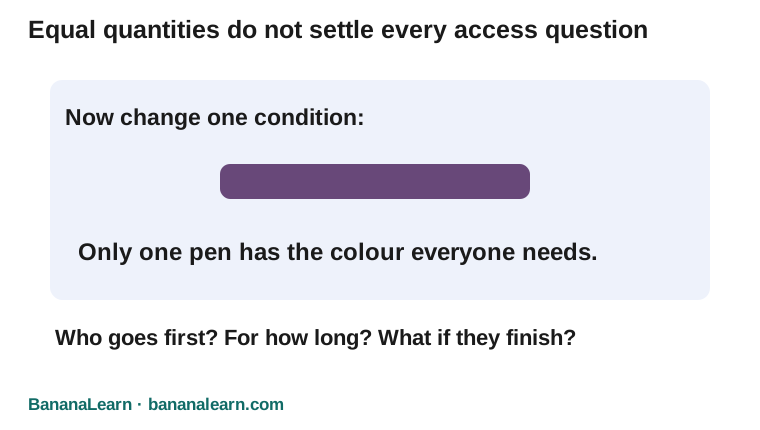
Second change: all four want a particular colour, and there is only one pen of that colour. Equal numbers of pens no longer solve simultaneous access. Proposals might include timed turns, a queue or changing the design. The group should specify the order, length of turn and what happens when someone finishes early. These details turn a slogan into a workable rule.
Use questions that test reasons
Ask What makes your rule fair?, Who could reasonably object?, Would the rule still work if you were last in the queue? and What new fact would change your answer? Give thinking time before the next speaker. Ask a listener to restate the previous person’s idea accurately before disagreeing.
Avoid steering questions such as Surely sharing equally is always best? They reveal the adult’s preferred conclusion. Replace You are wrong with Which part of the story supports that? A mathematical error can be corrected directly while the fairness judgement remains open. The pens must still total twelve even when several ethical proposals are reasonable.
Worked discussion: a reason becomes more precise
An initial answer might be Everyone gets three because equal numbers are fair. A counterexample is the single popular colour: everyone can hold three pens and still have unequal access to the colour they need. The original reason addressed quantity but not timing or colour.
A revised rule could be Everyone can use ordinary colours from the shared box, and the scarce colour rotates in two-minute turns. This is a plausible proposal, not the answer key. Test it: what if a task needs five uninterrupted minutes? The group may revise again, or keep the rule and explain why predictable access matters more in this situation.
Make the activity easier or more demanding
For younger or quieter learners, keep only the first scenario and let them move tokens before speaking. Offer sentence starters: My rule is…; I chose it because…; A problem might be…. An adult can read the written record aloud for the child to approve, preserving the child’s meaning.
For older learners, compare equality, need and a queue as different principles. Ask them to state where each principle works and where it struggles. Do not require advanced terminology before a child can express a sound reason. Discuss the fictional case rather than ranking children as more or less deserving.
Finish with a usable reasoning record
Record the original rule, its reason, a challenge and a revised rule. Use the table below in a notebook. A completed record might say Equal numbers; easy to check; one colour is scarce; equal access over time with a visible queue. The useful output is a reasoned revision, not a poster filled with abstract words.
Look for whether the child can connect a reason to a conclusion and describe another person’s objection fairly. One short activity cannot establish a lasting improvement in critical thinking. Try a different harmless scenario another day, such as choosing a group game, and see which reasoning steps the learner can use independently.
My reasoning record
Copy this record into a notebook. Fill each blank using your own example or the activity above.
On a phone, swipe across a wide table to see every column.
| Step | Write or draw your answer |
|---|---|
| Our first rule | ___ |
| A reason for it | ___ |
| A challenge or changed condition | ___ |
| Our revised rule | ___ |
| What would we check next? | ___ |
10 questions with explained answers
Try each question first. Open the explanation to check your reasoning. These are original BananaLearn questions, not official exam questions.
What date follows the third-Thursday rule in November 2026?
Check answer and reasoning
19 November 2026.
The Thursdays are 5, 12, 19 and 26 November. A local event may have a different schedule.How many pens does each child get in an equal split of twelve between four?
Check answer and reasoning
Three.
12÷4=3. The arithmetic is fixed even when the fairness principle is debated.Is Everyone gets three a reason or a proposed rule?
Check answer and reasoning
A proposed rule.
A reason explains why that rule should be used, such as predictability or equal quantities.Give a reason supporting a central shared box.
Check answer and reasoning
For example, unused pens remain available to others.
This is one plausible reason; also consider simultaneous demand and how access would be managed.What condition challenges equal numbers as a complete solution?
Check answer and reasoning
One colour is wanted by everyone but has only one pen.
Equal counts do not guarantee simultaneous access to that scarce resource.Improve That is unfair.
Check answer and reasoning
Name who is affected and why, then offer a reason.
A specific objection can be examined; a label alone gives the group little to discuss.What is missing from Take turns?
Check answer and reasoning
A workable order, duration and rule for early finishing.
The principle needs details before it can organise access.Must a child agree with the adult to do well?
Check answer and reasoning
No.
The focus is explaining, listening and testing reasons, within respectful discussion rules.Give an example of revising an idea without abandoning it completely.
Check answer and reasoning
Keep equal access but measure it over time rather than by pens held at once.
The fairness aim remains while the practical rule changes.What should an adult do if a child prefers to pass?
Check answer and reasoning
Allow the pass and offer another way to contribute.
Drawing or moving tokens can support participation without forced public speaking.
Choose your next learning step
- Turn a reason into a supported paragraph
- Explore a story without turning it into a quiz
- Distinguish statements, interpretations and evidence
Explore BananaLearn games, learning resources and tutoring. Maths is our priority; English and Science tutoring are also available. Share your current schoolwork when checking teaching fit.
Sources and scope
Explanations, activities, diagrams and practice are original BananaLearn work. Class labels suggest a learning level; school sequences and current textbook editions can differ. Sources checked 2 November 2026.
How we prepare guides · Report a correction
Share the complete guide: https://bananalearn.com/learn/world-philosophy-day-2026-thinking-activity.html