
Start with the key idea
Help your child say a complete idea aloud before writing it. Use a drawing or a simple “who or what, then what happened” scaffold if needed. Write one manageable sentence, read it back and improve one feature at a time while keeping the child’s own idea.
Separate having an idea from recording it
A child may tell you a lively story yet find writing it down difficult. They are managing several things at once: the idea, sentence structure, spelling, handwriting or typing, and punctuation. Start by finding the point where they need support rather than asking for a longer piece immediately.
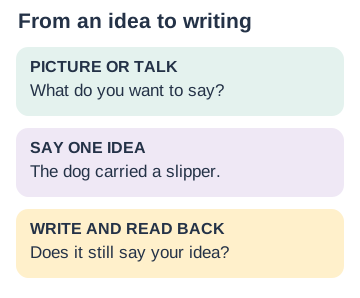
Invite a spoken sentence about something concrete: a drawing, a recent activity or an object on the table. If the child cannot yet form the idea aloud, help them describe what happened. If the idea is clear aloud but writing stalls, reduce the amount to record and discuss persistent difficulty with the teacher.
This guide is for practising simple written statements. It does not cover every kind of English sentence; commands, questions and more complex constructions need their own teaching.
Build one sentence without taking over the story
Imagine a child has drawn a dog carrying a slipper. They say, “Dog. Slipper.” Ask, “What is the dog doing?” They answer, “The dog carried a slipper.” That gives a complete statement with a subject and an action.
Who or what? The dog
What happened? carried a slipper
Whole sentence: The dog carried a slipper.
Say the whole sentence together once. Ask the child to repeat their idea before writing. Keep it short enough to hold in mind; if they choose a very long sentence, help them split the idea into two.
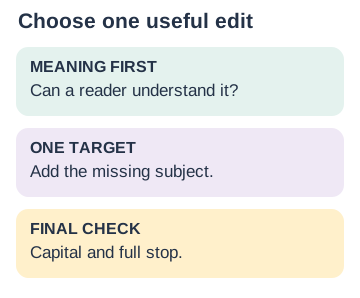
After writing, read it back. Begin with meaning: does it say what the child intended? Then check a capital letter and a full stop. If spelling needs work, choose a useful word to discuss rather than covering the page in corrections.
Compare fragments and complete ideas
| Starting words | What is missing? | One possible complete statement |
|---|---|---|
| The little boat | What did it do, or what is being said about it? | The little boat floated in the bowl. |
| Ran across the playground | Who ran? | Aman ran across the playground. |
| Because it was raining | What happened because of the rain? | We played indoors because it was raining. |
The answers are examples, not the only acceptable sentences. “The little boat is blue” is also complete: a sentence does not always describe a physical action. Explain the purpose of the scaffold without turning it into a false rule.
Add one useful detail
Once the simple sentence is comfortable, invite one detail that helps a reader picture it. “The dog carried a slipper” could become “The dog carried a muddy slipper into the kitchen.” Ask which detail matters to the child's story. Longer is not automatically better.
For a Science observation, begin with what was seen: “The folded paper held more counters.” A later sentence can explain a possible reason. Keeping observation and explanation separate helps the writer organise the idea.
For a reading response, try “Meera used the bowl because it was raining outside.” Then ask the child to check the story for evidence. Sentence practice can connect to something worth saying instead of becoming a page of unrelated copying.
Use the printable sheet for a short practice session
- Draw, choose or describe one scene.
- Say a complete statement aloud. An adult may model a different example first.
- Write the child's own sentence. Use support agreed with the teacher if needed.
- Read it back for meaning, then check one or two features.
- Try a different scene later to see what the child can do with less help.
For an early writer, a spoken answer and a drawing may be the right starting point. For a more confident writer, remove the scaffold and ask them to explain an editing choice. Do not force every sentence to begin with the same pattern.
If this is homework assessing independent writing, follow the teacher's instructions about adult help. Clearly distinguish a sentence the child composed from one an adult dictated. Our homework-help guide shows how to model without supplying the assigned answer.
Further reading: NSW Department of Education: supporting literacy at home. The examples and printable activities on this page were created by BananaLearn.
My idea becomes a sentence
Start with a drawing or a spoken idea. The boxes support simple statements; not every English sentence follows this pattern.
A completed example
Who or what?: The dog
What happened / what is true?: carried a slipper
My whole sentence: The dog carried a slipper.
One check: Capital letter and full stop
Opens a separate sheet with the completed example and writing space. Save it as a PDF or print it using your browser. No account is required.
5 worked examples with reasoning
1. A child says “Dog. Slipper.”
- Ask what the dog did.
- Accept the child’s own action idea.
- Rehearse “The dog carried a slipper” before writing.
2. A child writes “Ran across the playground.”
- Ask who ran.
- Add the intended person: Aman ran across the playground.
- Do not replace the child’s event with your own story.
3. A child writes “The boat is blue.”
- The sentence says something complete about the boat.
- Is is a verb describing a state.
- Do not demand a physical action in every sentence.
4. A long spoken sentence is lost during writing.
- Ask the child to choose the first complete idea.
- Say and write that sentence.
- Record the next idea separately rather than keeping an overlong sentence in memory.
5. The sentence communicates an idea but has several spelling errors.
- Read for meaning first.
- Choose a useful correction matching the lesson focus.
- Keep a separate spelling target rather than replacing the whole sentence.
Save the guide or print the practice
Download to save or share
Complete guide with answers (PDF) · Worksheet without answers (PDF) · Worksheet and answer key (PDF)
These are practice decisions for parents and learners, not an assessment or diagnosis. Compare the suggested response with the explanation and adapt it to the actual task.
14 practice questions with explanations
These are practice decisions for parents and learners, not an assessment or diagnosis. Compare the suggested response with the explanation and adapt it to the actual task.
Write an answer and your reason before opening the explanation. Check the reasoning as well as the final answer.
- Complete
Complete “The little boat” in one possible way.
Answer and reasoning
The little boat floated in the bowl.
Many complete statements are possible.
- Subject
What is missing from “Carried the heavy bag”?
Answer and reasoning
Who or what carried it.
For this ordinary statement, supply the intended subject.
- State
Is “The room is quiet” complete?
Answer and reasoning
Yes.
A sentence may describe a state rather than a physical action.
- Meaning
Should a longer sentence always replace a shorter one?
Answer and reasoning
No.
Extra detail should help communicate the intended idea.
- Support
What does writing down a child’s spoken idea help separate?
Answer and reasoning
Composing from handwriting or spelling.
Label adult support and follow school rules for assessed tasks.
- Detail
Add one useful detail to “The dog carried a slipper.”
Answer and reasoning
For example: The dog carried a muddy slipper.
The detail helps a reader picture the object.
- Fragment
Complete “Because it was raining”.
Answer and reasoning
We played indoors because it was raining.
The reason clause needs the rest of the idea here.
- Sequence
Should punctuation be the first discussion if the sentence does not mean what the child intended?
Answer and reasoning
No.
Clarify meaning before polishing surface features.
- Observation
Why keep a Science observation separate from an explanation?
Answer and reasoning
What was seen and a proposed reason are different claims.
This helps avoid presenting a guess as an observed fact.
- Independence
Is an adult-dictated sentence independent composition?
Answer and reasoning
No.
Record the support accurately.
- Read back
What can reading the sentence aloud reveal?
Answer and reasoning
Missing words or a meaning different from the intended idea.
The child can compare speech with the written result.
- Adapt
What can precede writing for an early learner?
Answer and reasoning
A drawing and a spoken sentence.
These give a concrete idea to express.
- Transfer
How can you see whether the scaffold is still needed?
Answer and reasoning
Try a different scene with less help.
A fresh attempt shows more than copying the earlier sentence.
- Next step
What evidence helps a teacher understand persistent difficulty?
Answer and reasoning
A spoken idea, the written attempt and the support needed.
It locates the difficult step without assigning a diagnosis.
Use the ideas without looking at the notes
Use this record for one real task: What happened? What help was offered? What could the learner then do? What new example will we use next? Record support honestly and choose one next step.
Common questions
Should I correct every spelling mistake?
For sentence practice, prioritise meaning and the feature being taught. Choose a small number of useful corrections and follow the teacher’s guidance.
Can I write down what my child says?
That can help separate composing from handwriting during practice. Label the support and follow school rules for assessed work.
Does every sentence need an action word?
A complete statement can describe a state as well as an action, such as “The boat is blue.” The scaffold is a starting aid, not a rule for every sentence type.
Connect your learning
Ask about guided English learning if your child needs help explaining these ideas.
About this guide
Original explanations, examples, diagrams and practice by BananaLearn. The grade label indicates the intended learning level; this is not an official textbook extract or exam paper.