Science · Suggested Class 10 · school sequences vary
Mendelian Inheritance: Class 10 Punnett Squares & Probability
Four boxes do not promise four children with one of each outcome. A Punnett square lists probabilities in a model, not a family’s guaranteed results.
Start here
In a simple single-gene model, each parent contributes one allele. A Punnett square combines possible gametes; genotype and phenotype ratios describe probabilities under stated assumptions.
On a narrow screen, swipe the diagram or open it full size.
Find a section, worked example or practice question
State the model before using the letters
Use a simplified pea-height model with alleles T and t. Assume T produces the dominant tall phenotype in TT or Tt, while tt is short. The model concerns one gene, two alleles, complete dominance and equal gamete probabilities.
Real traits can involve many genes and environmental effects. Do not use this simple model to make confident predictions about complex human traits such as eye colour or intelligence.
Separate genotype and phenotype
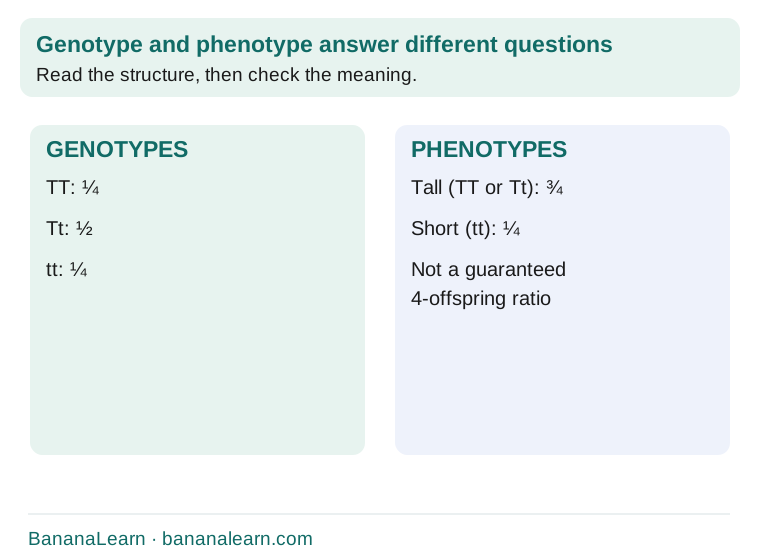
Genotype is the allele combination, such as TT, Tt or tt. Phenotype is the expressed trait in the model, such as tall or short. TT and Tt differ in genotype but share the tall phenotype under the assumption.
Dominant does not mean better, stronger or necessarily more common. It describes how the heterozygote’s trait appears in this specified model.
Write the possible gametes
A TT parent contributes T to each gamete in the model; tt contributes t. A Tt parent can contribute T or t, each with probability 1/2. Each gamete carries one allele at the locus.
Do not put a whole Tt pair into one gamete. The two parental alleles separate during gamete formation; the pair is restored when the two gametes combine.
On a narrow screen, swipe the diagram or open it full size.
Fill a Tt × Tt square
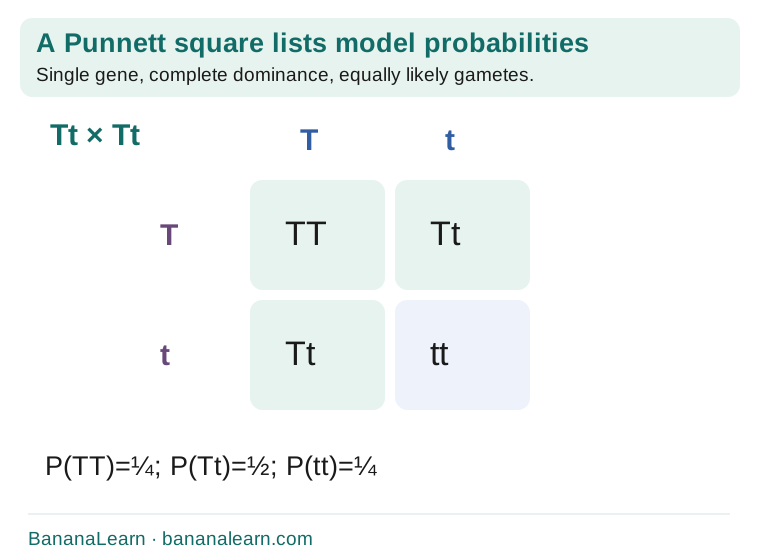
Place T and t from one parent along the top and T and t from the other down the side. The four combinations are TT, Tt, Tt and tt. Each box has probability 1/4 under these assumptions.
The genotype probabilities are 1/4 TT, 1/2 Tt and 1/4 tt. Phenotype probabilities are 3/4 tall and 1/4 short. The two Tt boxes represent different gamete combinations leading to the same genotype.
Compare homozygous and heterozygous crosses
TT × tt gives Tt in every box, so all offspring are heterozygous and tall in this model. Tt × tt gives Tt and tt with probability 1/2 each.
A square with four identical labels is not an error if the parental gametes require it. Reducing repeated rows or columns is fine as long as probabilities remain correctly weighted.
Expected ratios are not a schedule
For Tt × Tt, four independent offspring do not have to include exactly one tt. Each offspring has a 1/4 short probability; previous outcomes do not force the next one to restore a ratio.
In a larger ideal sample, observed proportions may be nearer the model’s probabilities, but random variation remains. A sample count supports evaluating a model; it is not a guarantee for the next case.
Infer only what the model permits
A tall pea in this model could be TT or Tt. Appearance alone does not distinguish them. Crossing with tt can provide evidence: any short offspring shows that the tall parent supplied t.
A small sample of all tall offspring does not prove the unknown parent is TT. A Tt parent might, by chance, contribute T in all those observed cases. State that limitation.
Use a probability record
Record the trait assumptions, parental genotypes, gamete options and probabilities, offspring genotypes and phenotypes, and an explanation of what the square cannot predict.
For practice, draw the same cross with parents swapped along the axes and check that probabilities are unchanged. This single-trait guide does not cover linked genes, incomplete dominance or multigene inheritance.
See the reasoning
Worked examples and checks
1. Find the offspring probabilities for Tt × tt.
The first parent supplies T or t with probability 1/2. The second supplies t.
Combinations are Tt and tt, each probability 1/2.
Under complete dominance, tall and short are each 1/2; not every pair of offspring must split one and one.
2. Find the genotype and phenotype for TT × tt.
Every gamete from the first parent is T; every gamete from the second is t.
Every offspring genotype is Tt.
All are tall in the stated model, but none is TT.
3. A tall unknown pea crossed with tt produces a short offspring. What follows?
A short offspring is tt, so it received t from each parent.
The tall parent must carry t and therefore be Tt in this model.
The inference depends on the stated simple inheritance assumptions.
Try, explain, check
12 questions with explained answers
Try each task before opening its explanation. These are original BananaLearn questions, not official exam or past-paper questions. Where several answers can work, the explanation gives the criteria.
What is a genotype?
Check answer and reasoning
An allele combination Examples here are TT, Tt and tt.
What is a phenotype?
Check answer and reasoning
An expressed trait under the model Tall or short are the examples.
Which genotypes are homozygous?
Check answer and reasoning
TT and tt Their two alleles match.
Which is heterozygous?
Check answer and reasoning
Tt The alleles differ.
Which gametes can Tt produce?
Check answer and reasoning
T or t Each carries one allele at this locus.
What is P(tt) for Tt × Tt?
Check answer and reasoning
1/4 Only the t-from-each combination gives tt.
What is P(Tt) for that cross?
Check answer and reasoning
1/2 Two of the four equally likely boxes give Tt.
What is the tall phenotype probability for that cross?
Check answer and reasoning
3/4 TT and Tt are tall under complete dominance.
Does dominant mean most common?
Check answer and reasoning
No It describes expression in a heterozygote, not population frequency.
Does a 3:1 expected ratio guarantee three tall in every four offspring?
Check answer and reasoning
No Each independent outcome is probabilistic.
Can a tall phenotype alone distinguish TT from Tt?
Check answer and reasoning
No Both are tall in this model.
Does a small all-tall sample from an unknown × tt cross prove TT?
Check answer and reasoning
No A Tt parent can yield that sample by chance.
A checking record to use in your notebook
Copy these headings and fill them for one worked task, then for a fresh attempt. Use your own evidence rather than copying the model answer.
Question or sentence
What am I being asked to explain?
Model or evidence
Which diagram, rule or passage detail supports my method?
Work
What steps connect the question to the answer?
Independent check
Can I substitute, recount, trace a path or check the text?
Original BananaLearn explanations, examples, illustrations and practice. Source facts checked 7 November 2026. Suggested levels are learning guides, not a claim that every board or textbook uses the same sequence.