
Start with the key idea
A cell is the basic structural and functional unit of life. Cells have a boundary and living contents; different types have structures suited to their jobs. A typical plant cell has a cell wall outside its cell membrane.
1. Start with the living unit, not a list of names
A cell carries out activities needed for life. In a single-celled organism, one cell performs the functions needed by that organism. In a multicellular organism, many cells work together and often specialise. A human nerve cell and a leaf cell are both cells, but they do different jobs and need not have identical shapes.
The phrase basic unit does not mean smallest object of any kind. Cells contain smaller structures and molecules. It means that cellular organisation is central to how living organisms are built and function. A brick-wall comparison can help with structure, but bricks are not alive and do not exchange substances or respond like cells.
Begin a labelled drawing with its scope: a simplified typical plant cell, for example. A diagram is a model chosen to explain relationships, not a photograph of every cell in a plant.
2. Separate membrane, cytoplasm and nucleus
The cell membrane forms a boundary around the cell contents and controls movement of substances into and out of the cell. Describing it as a completely sealed wall would be misleading: cells need exchanges with their surroundings. Cytoplasm is the material inside the membrane, excluding the nucleus in the common school description; many cell activities occur there.

The nucleus contains genetic material and plays an important role in directing cell activities. Most familiar plant and animal cell diagrams include a nucleus. Avoid turning this into the claim that every cell has a distinct nucleus: bacteria do not have a membrane-bound nucleus, and some specialised cells differ from the typical model.
For Class 8, learn the three common labels first, then explain each role in an ordinary sentence. A label without a function is only half an answer.
3. Add plant structures without removing shared ones
A plant cell still has a membrane even though a cell wall is present outside it. The wall helps support and protect the cell. Many mature plant cells have a large central vacuole containing cell sap; it helps with storage and maintaining firmness when filled with water. Animal cells may also have small vacuoles, so vacuole alone is not an absolute plant-only label.
Chloroplasts contain chlorophyll and are involved in photosynthesis. They are common in green parts exposed to light, but not in every plant cell. A root cell usually does not need the same chloroplast arrangement as a green leaf cell.
Compare like with like: use a typical green leaf cell versus a typical animal body cell. Saying all plant cells are green or all are perfect rectangles takes a useful classroom model too far.
4. Connect cell shape, size and function
Many cells are too small to see clearly without a microscope. Large organisms generally contain many cells; a bigger animal does not simply have proportionately gigantic versions of every cell. Some cells are unusually long or large, so statements about size should allow variation.
A nerve cell may have long extensions that help transmit information across distances. A muscle cell is adapted for contraction. These examples show that structure supports a job; they do not mean that a single drawing represents every nerve or muscle cell.
When observing a prepared slide, distinguish what you can actually see from what a textbook diagram includes. A structure can exist without being visible under that preparation, magnification or staining method. Write not visible in this view rather than concluding absent.
5. Build the cell-to-organ relationship
A tissue is a group of cells working together in a particular function, often with material between them. An organ contains different tissues organised to perform a larger job. The heart is an organ containing muscle, connective, nervous and other tissues; it is not merely one enormous muscle cell.
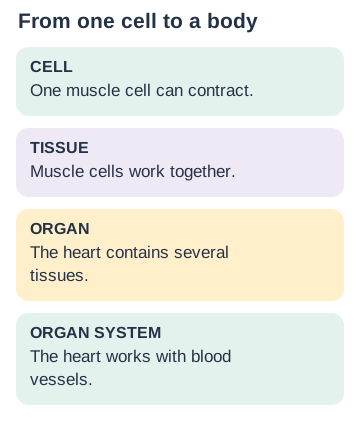
Several organs cooperate in an organ system. This nesting helps explain why a problem at one level can affect a larger function. It also prevents a common category mix-up: nucleus is a structure within a cell, while tissue is a level above cells.
Practise arranging terms rather than memorising a slogan. For a familiar body example, move from muscle cell to muscle tissue to heart to circulatory system. In plants, tissues also combine into organs such as leaves and roots.
6. Make a useful labelled drawing and comparison
Draw a large, simple outline and leave enough room for labels. Keep label lines separate, make them end on the intended structure, and add a title specifying the cell type. In a plant model, show the membrane just inside the wall rather than using one line with two unrelated labels.
Use a table with a feature, typical plant cell and typical animal cell column. Include shared features before differences: membrane, cytoplasm and usually a nucleus. Then add wall, chloroplasts where relevant and the typical vacuole pattern. Qualifiers such as typical and green leaf make the comparison more accurate.
Use prepared images or teacher-approved slides for practice. Do not collect body samples or handle stains without appropriate adult instruction. Finish by explaining one structure-function link in your own words.
5 worked examples with reasoning
1. A diagram labels the thick outer plant boundary as the membrane only. Repair it.
- Show the cell wall on the outside.
- Place the cell membrane just inside.
- Both boundaries have different roles; the wall does not replace the membrane.
2. A root cell diagram has no chloroplasts. Is that automatically wrong?
- No. Not every plant cell photosynthesises.
- Roots usually receive little light and specialise in other functions.
- Check the cell type before adding labels.
3. A pupil calls a heart a tissue. Explain the error.
- A tissue is one organised grouping of cells.
- The heart contains several tissue types.
- It is an organ.
4. An animal cell has a nucleus and cytoplasm. What boundary is missing?
- Add the cell membrane.
- It separates the cell contents from the surroundings while allowing controlled exchange.
- Do not add a plant-style cell wall.
5. A structure is not visible on a slide. Can you say it does not exist?
- Not from visibility alone.
- Preparation and magnification affect what can be seen.
- Record the observation and compare it with the model.
Save the guide or print the practice
Download to save or share
Complete guide with answers (PDF) · Worksheet without answers (PDF) · Worksheet and answer key (PDF)
Try each task before opening its answer. Give an example or reason, not only a label.
14 practice questions with explanations
Try each task before opening its answer. Give an example or reason, not only a label.
Write an answer and your reason before opening the explanation. Check the reasoning as well as the final answer.
- Unit
What is the basic structural and functional unit of life?
Answer and reasoning
The cell.
Cells carry out living functions.
- Boundary
Which structure controls exchange at the cell boundary?
Answer and reasoning
Cell membrane.
It is not simply an impermeable seal.
- Contents
Name the material where many cell activities occur outside the nucleus.
Answer and reasoning
Cytoplasm.
Use the common school-level description.
- Nucleus
Give one important role of the nucleus.
Answer and reasoning
It contains genetic material and helps direct cell activities.
Most typical plant and animal diagrams include it.
- Wall
Where is the plant cell wall relative to the membrane?
Answer and reasoning
Outside it.
They are separate structures.
- Plant
Must a root cell contain chloroplasts?
Answer and reasoning
No.
Plant cells vary by job and location.
- Green
Which structure is involved in photosynthesis?
Answer and reasoning
Chloroplast.
It contains chlorophyll.
- Vacuole
What is typical of a mature plant cell vacuole?
Answer and reasoning
A large central vacuole containing cell sap.
This is a typical pattern, not every possible cell.
- Compare
Name two shared features of typical plant and animal cells.
Answer and reasoning
For example, membrane and cytoplasm.
The comparison includes similarities.
- Levels
Arrange: organ, cell, tissue.
Answer and reasoning
Cell → tissue → organ.
Each level builds on the earlier one.
- Function
Why can a nerve cell have long extensions?
Answer and reasoning
They help transmit information over distances.
Shape relates to function.
- Observe
Does not visible on a slide mean definitely absent?
Answer and reasoning
No.
Observation conditions matter.
- Scope
Do all cells have a membrane-bound nucleus?
Answer and reasoning
No.
Bacteria are an important exception.
- Draw
Why should a cell diagram have a title?
Answer and reasoning
It identifies the cell type and model.
Readers can interpret the intended structures.
Use the ideas without looking at the notes
Draw one typical green plant cell and one typical animal cell. Label shared structures first, then differences. Explain why a root cell might differ from your green plant model.
Common questions
Are plant cells alive?
Yes. They carry out living activities; the wall is only one part of the cell.
Is cytoplasm the same as the nucleus?
No. They are different parts in a typical plant or animal cell.
Are all plant cells rectangular?
No. Shapes vary with tissue, function and viewing angle.
Is a cell wall found in animal cells?
No. Typical animal cells have a membrane but no cell wall.
Do bigger animals simply have bigger cells?
Not as a general rule. Cell number and specialised cell types matter.
Connect your learning
Ask about guided Science learning if your child needs help explaining these ideas.
About this guide
Original explanations, examples, diagrams and practice by BananaLearn. The grade label indicates the intended learning level; this is not an official textbook extract or exam paper.