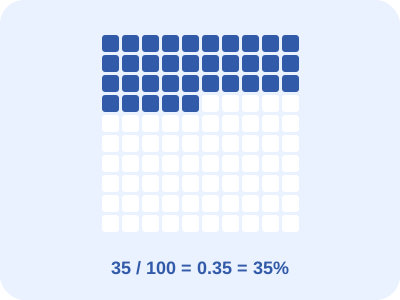
See the idea
How to add decimals with different numbers of decimal places
Line up the decimal points so equal place values share a column. You can add trailing zeros to show empty places, then add from right to left. Keep the decimal point in that same column in the answer.

- Hundredths: 0 + 5 = 5 hundredths.
- Tenths: 4 + 7 = 11 tenths. Exchange 10 tenths for 1 one; leave 1 tenth.
- Ones: 2 + 0 + the exchanged 1 = 3 ones. The sum is 3.15.
Writing 2.4 as 2.40 does not change its value. Aligning only the last digits would put tenths underneath hundredths. If those units are unclear, revisit the decimal place-value chart.
Try it: add 4 + 0.36.
Write 4 as 4.00. Then 4.00 + 0.36 = 4.36. A whole number belongs in the ones column; it does not move into the hundredths column.
Before you start
Identify ones, tenths and hundredths, and regroup ten of a unit into one of the next larger unit. Addition works the same way across the decimal point.
Words used in this guide
- Align
- Place equal units in the same column: ones under ones, tenths under tenths.
- Regroup
- Exchange ten hundredths for one tenth, or ten tenths for one one.
- Estimate
- Find a sensible approximate total before or after calculating exactly.
Why the method works
Decimal addition combines like units. In 1.6 + 0.27, six tenths must line up with two tenths, not with seven hundredths. Writing 1.60 is helpful because the zero makes the missing hundredths visible. The decimal point in the answer remains under the other decimal points; it separates whole units from fractional units rather than being counted as a digit.
Rename if it helps
Write 1.2 as 1.20 before adding 0.35. Then 1.20 + 0.35 = 1.55. The zero is a placeholder, not an extra amount.
Exchange ten smaller units
0.7 + 0.6 is thirteen tenths. Exchange ten tenths for one whole to get 1.3. A sum can cross a whole just as a whole-number sum can cross a ten.
Estimate before you calculate
2.85 + 1.2 should be a little more than 4. If the written answer is 2.97, the tenths and hundredths have probably been misaligned. Estimation catches this without repeating the whole method.
See it, then explain it
Two illustrated examples, explained step by step
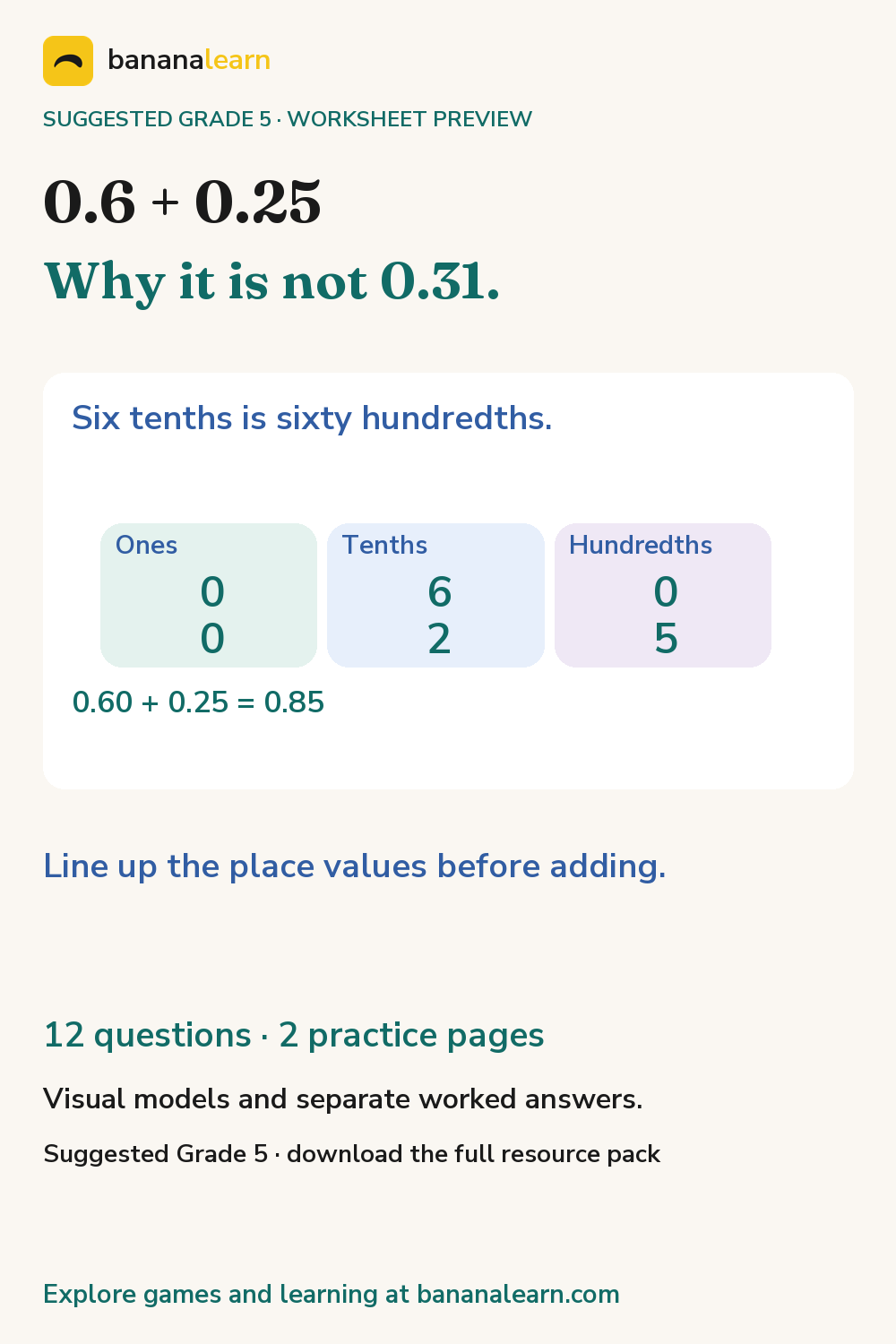
Why 0.6 + 0.25 is 0.85
Swipe across the diagram to see each part.
- Write 0.6 = 0.60; a trailing zero does not change the value.
- Add 60 hundredths and 25 hundredths: 60 + 25 = 85 hundredths.
- Write 85 hundredths as 0.85. It is between 0.6 and 1, which fits the estimate.
Writing 0.31 would combine digits from different places. In the chart, tenths stay under tenths and hundredths under hundredths. You can also count 0.60 + 0.20 = 0.80, then add 0.05 to reach 0.85.
Save this illustration on Pinterest · Download the illustrated summary
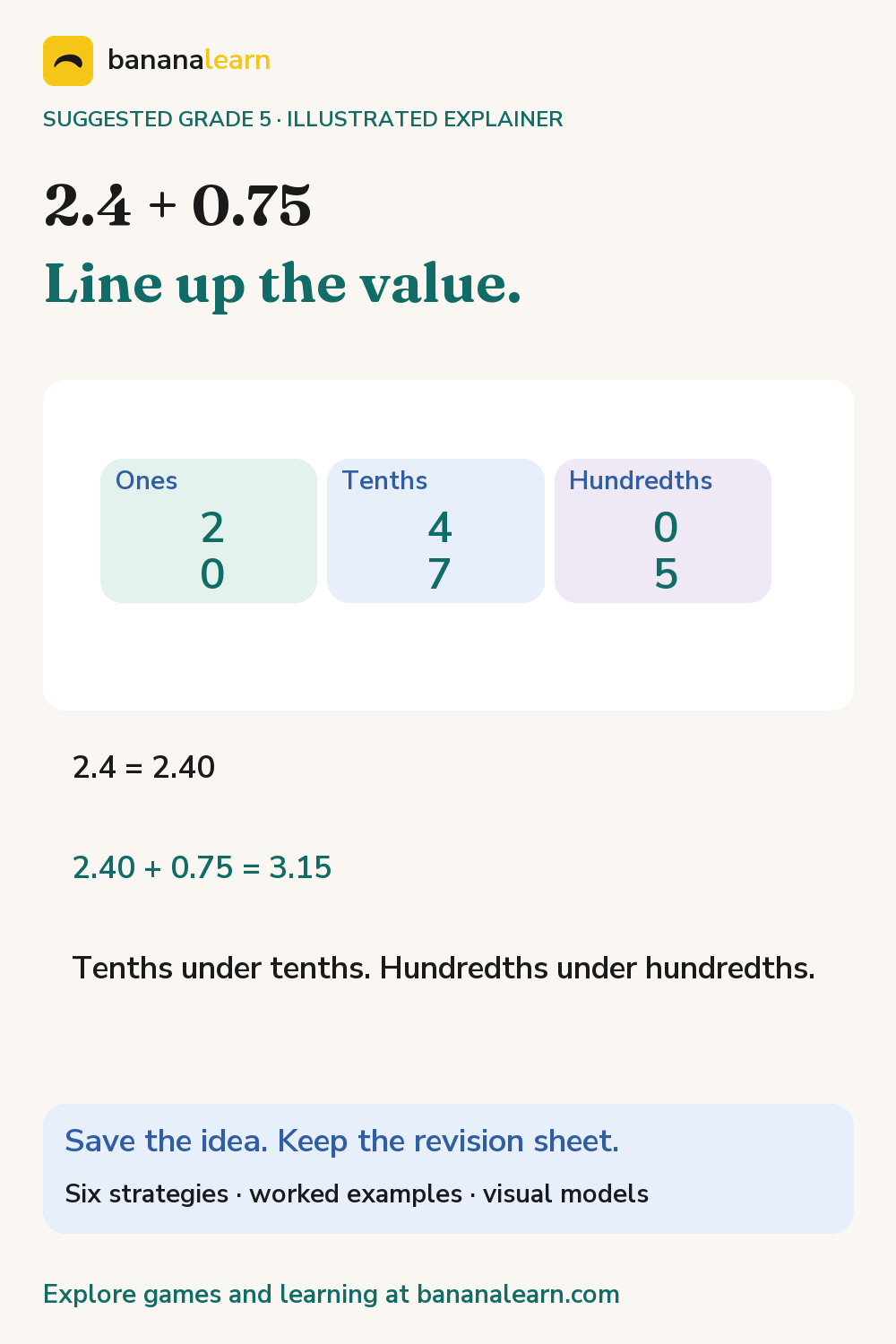
2.4 + 0.75: what happens when ten tenths become one whole?
Swipe across the diagram to see each part.
- Rename 2.4 as 2.40 so hundredths are visible.
- Add hundredths: 0 + 5 = 5. Add tenths: 4 + 7 = 11 tenths.
- Exchange 10 tenths for 1 one. Two ones plus that extra one gives 3 ones, 1 tenth and 5 hundredths: 3.15.
A quick estimate catches many errors: adding 0.75 to 2.4 should give a number greater than 3 and less than 3.4. Check exactly by subtracting: 3.15 − 0.75 = 2.40.
Save this illustration on Pinterest · Download the illustrated summary
Choose mental addition or columns, then check the total
The number of decimal places does not decide the method. Choose a method that keeps equal units together and makes the calculation easy to explain. Mental addition and a written column should produce the same exact total.
| Calculation | Useful method | Reason |
|---|---|---|
| 3.8 + 0.2 | Complete a whole: 4 | 8 tenths + 2 tenths = 10 tenths |
| 6.95 + 0.4 | Add 0.05, then 0.35: 7.35 | Split 0.4 into 0.05 + 0.35 |
| 2.375 + 1.08 | Columns: 2.375 + 1.080 = 3.455 | Keep thousandths, hundredths and tenths aligned |
Word problem: do you have enough ribbon?
A craft needs 1.85 m for one edge and 0.675 m for another. You have 2.5 m. First find the required length: 1.850 + 0.675 = 2.525 m. The ribbon is not quite long enough: 2.525 − 2.500 = 0.025 m, or 2.5 cm, is missing.
Rounding both lengths to one decimal place before adding could hide that small difference. Estimate to check whether an answer is sensible; keep the original values when an exact length or payment is needed.
Regroup across more than one column
For 4.86 + 2.79, begin with hundredths: 6 + 9 = 15 hundredths. Write 5 hundredths and exchange 10 hundredths for 1 tenth. Tenths: 8 + 7 + 1 = 16 tenths. Write 6 tenths and exchange 10 tenths for 1 one. Ones: 4 + 2 + 1 = 7. The sum is 7.65.
Check an answer instead of repeating the same mistake
A child writes 5.2 + 0.34 = 0.86. What check exposes the problem?
Adding a positive amount to 5.2 must give more than 5.2. Write 5.2 as 5.20 and align decimal points: 5.20 + 0.34 = 5.54. The estimate reveals the misplaced units.
Find 0.48 + 0.52 + 2.7 in a convenient order.
Pair 0.48 and 0.52 to make 1.00, then add 2.7 to get 3.7. Addition lets you regroup the addends without changing their total.
Worked examples, step by step
Example 1: Add 2.35 and 0.8.
- Write 0.8 as 0.80.
- 2.35 + 0.80 = 3.15.
Example 2: Add 4.75 + 2.68.
- Hundredths: 5 + 8 = 13, so write 3 hundredths and carry 1 tenth.
- Tenths: 7 + 6 + 1 = 14, so write 4 tenths and carry 1 one. Ones: 4 + 2 + 1 = 7. The total is 7.43.
- Estimate 4.8 + 2.7 ≈ 7.5; the exact answer is close.
Example 3: Add 8 + 0.46 + 1.7.
- Write 8.00 + 0.46 + 1.70 so equal places line up.
- Hundredths total 6; tenths total 11, giving 1 tenth and 1 extra one. The answer is 10.16.
- Adding a whole number does not move the decimal point or append its digits to the other number.
Example 4: A parcel weighs 0.875 kg and its packaging weighs 0.06 kg. Find the total.
- Write the packaging as 0.060 kg. The hundredths and thousandths must keep their separate places.
- 0.875 + 0.060 = 0.935 kg.
- This is below 1 kg, which is reasonable because 875 g + 60 g = 935 g.
Choose a decimal addition method and check what the answer means
The decimal point marks the boundary between ones and tenths. It is a place-value marker, not a digit to add. You can calculate with columns, expanded form or a number-line jump; each method must combine the same kinds of units. Use an estimate to decide whether the exact answer is plausible.
| Situation | Useful approach | Example |
|---|---|---|
| Different numbers of decimal places | Rename with trailing zeros | 4.7 + 0.36 = 4.70 + 0.36 |
| A sum close to a whole | Bridge through the whole | 0.85 + 0.27 = 1 + 0.12 |
| Several small measurements | Keep units and precision consistent | 2.4 m + 0.075 m = 2.475 m |
| A missing addend | Use subtraction, then add to check | 7.2 + ? = 10.05 |
Regrouping does not change the total. Ten hundredths become one tenth; ten tenths become one one. Add from the smallest written place in the column method so any exchange is included in the place to its left. You do not need to round unless the question asks for an approximation.
Worked example: Find the missing amount: 7.2 + ? = 10.05.
- Write 7.2 as 7.20. The unknown is the difference between the total 10.05 and the known part 7.20.
- Subtract: 10.05 − 7.20 = 2.85. You can also count on 0.80 to reach 8, then 2.05 to reach 10.05.
- Check with addition: 7.20 + 2.85 = 10.05. The missing amount is 2.85.
Try a fresh example, then explain your check
Calculate 0.85 + 0.27 by bridging through 1.
Show answer and reasoning
0.85 needs 0.15 to reach 1. Split 0.27 into 0.15 + 0.12; the total is 1.12.
A ribbon is 2.4 m long and another is 0.075 m long. What is their combined length?
Show answer and reasoning
Align 2.400 and 0.075. Their sum is 2.475 m. The hundredths and thousandths must not be shifted to the tenths column.
A learner writes 5.08 + 0.7 = 5.15. Repair the calculation.
Show answer and reasoning
0.7 is 0.70, not 0.07. Add 5.08 + 0.70 = 5.78. Since seven tenths were added, an increase of only seven hundredths cannot be right.
Questions about choosing and checking a method
Should I round every decimal to two places before adding?
No. Rounding first can change an exact total. Keep the given values through the calculation, then round the final result only when the question requests it. Money and measurement questions should state the required unit or precision.
Can I add a length in metres to a length in centimetres?
Yes, after converting them to the same unit. For example, 1.2 m + 35 cm = 1.2 m + 0.35 m = 1.55 m. Lining up digits without converting units would combine different quantities.
Common mistakes and how to repair them
“Line up the last digits.”
For 2.4 + 0.35 that would mix tenths with hundredths. Align decimal points, then add 2.40 + 0.35 = 2.75.
“Round each number before finding an exact total.”
Rounding can change the total. Use estimates as a check and keep the original values for the exact calculation.
Check your understanding
Choose an answer for each question. You can check again after reading the explanation.
Worked answers
What is 1.2 + 0.35? 1.55. 1.20 + 0.35 = 1.55.
What is 0.7 + 0.6? 1.3. Thirteen tenths is one whole and three tenths.
Practise independently
Work these out on paper. Include a diagram or a sentence where the question asks you to explain. Open each solution after making an attempt.
3. Calculate 3.6 + 0.28.
Show the reasoning
3.60 + 0.28 = 3.88.
4. Calculate 0.79 + 0.46.
Show the reasoning
1.25; regroup 15 hundredths and then 12 tenths.
5. Calculate 12 + 3.045.
Show the reasoning
15.045. The 12 contributes only whole units.
6. Two lengths are 1.095 m and 0.87 m. Is their sum less than 2 m?
Show the reasoning
Yes. 1.095 + 0.870 = 1.965 m, which is 0.035 m below 2 m.
If a method still feels uncertain, revisit the closest worked example, then try a fresh problem. A correct answer copied from a solution tells you less than an explanation you can give independently.
Keep practising · suggested Grade 5
Worksheets and revision: Decimals made visual
Use the place-value questions first. The full suggested Grade 5 pack also includes calculation, rounding and mixed decimal problems.
Two worksheet pages, 12 questions and separate worked answers. Try the questions before checking. Downloads are PNG images; the ZIP contains the complete image pack.


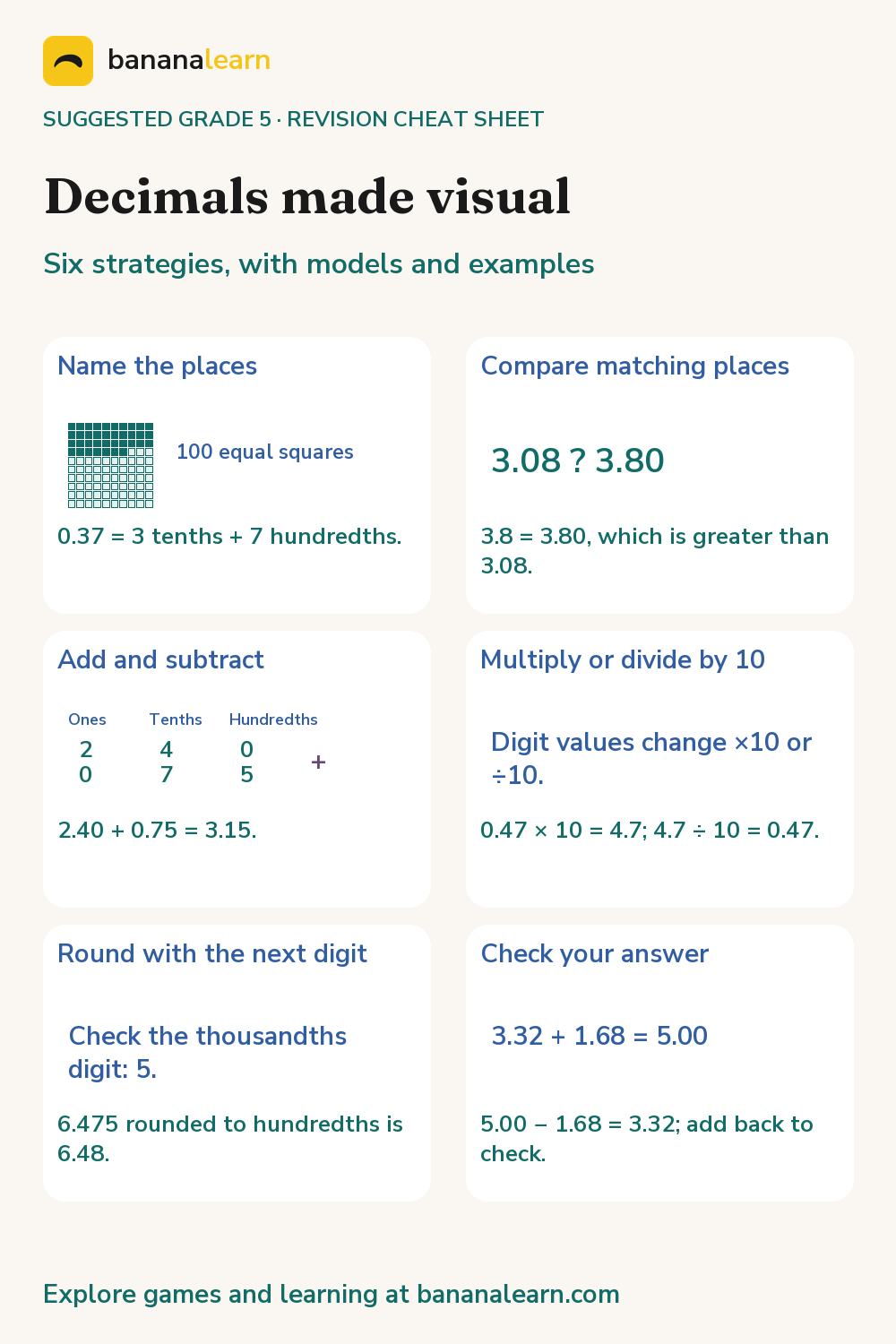
Download the complete image pack
Worked answer sheets: Answers 1 · Answers 2
Open the 12 additional questions and worked solutions
Open each question after you have attempted it. Refer to the matching worksheet diagram where indicated.
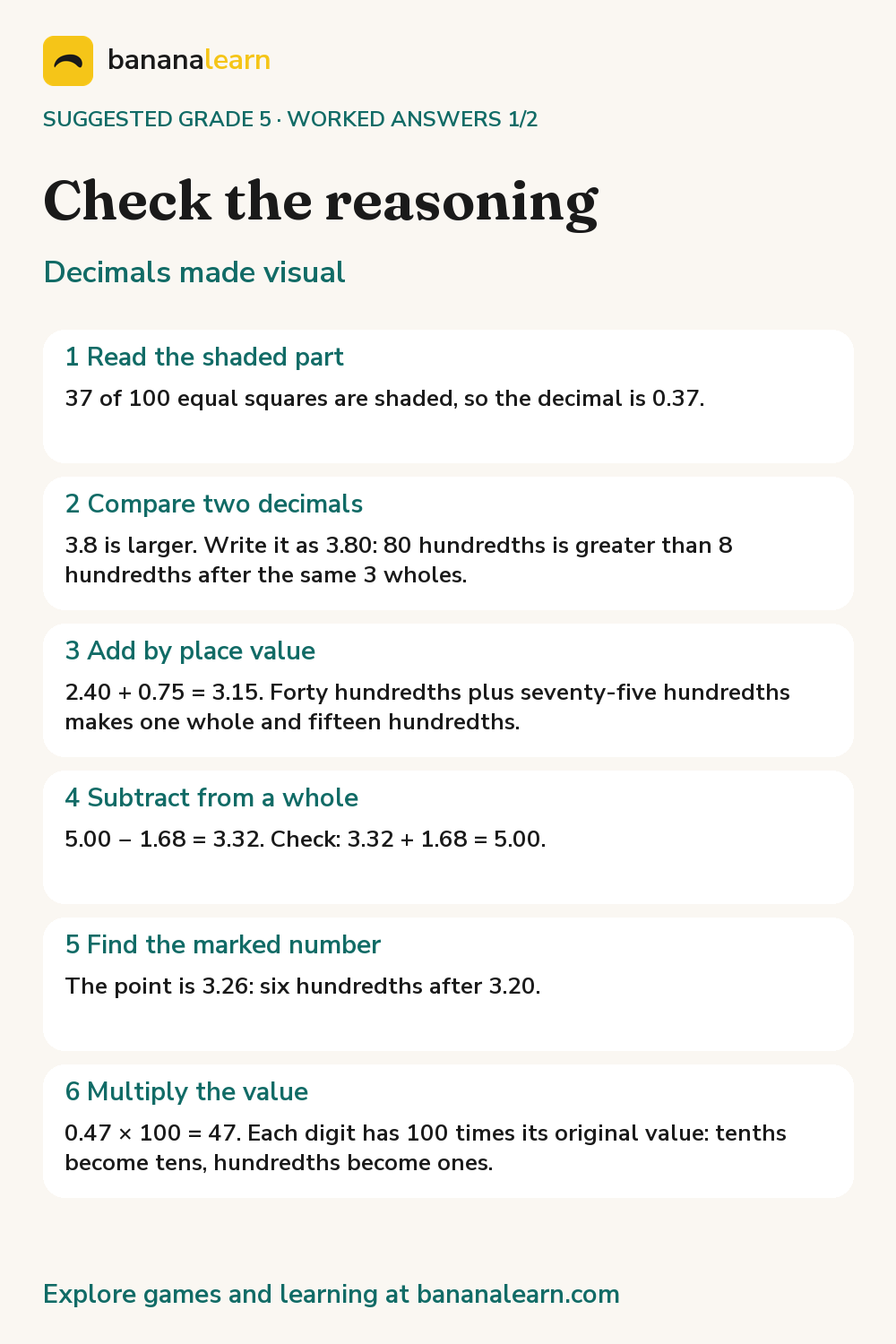
1. Read the shaded part
Write the shaded amount as a decimal.
Diagram: a ten-by-ten grid with 37 of its 100 equal squares shaded.
Show worked solution
37 of 100 equal squares are shaded, so the decimal is 0.37.
2. Compare two decimals
Which is larger? Explain using place value.
Shown model: 3.08; 3.8.
Show worked solution
3.8 is larger. Write it as 3.80: 80 hundredths is greater than 8 hundredths after the same 3 wholes.
3. Add by place value
Find 2.4 + 0.75. Align the decimal points.
Place-value chart: 2.40 and 0.75, with ones, tenths and hundredths aligned.
Show worked solution
2.40 + 0.75 = 3.15. Forty hundredths plus seventy-five hundredths makes one whole and fifteen hundredths.
4. Subtract from a whole
Find 5 − 1.68. Show your working.
Shown model: 5.00 − 1.68 = ?.
Show worked solution
5.00 − 1.68 = 3.32. Check: 3.32 + 1.68 = 5.00.
5. Find the marked number
Each small interval is 0.01. Name the point.
Diagram: the interval from 3.20 to 3.30 has ten equal steps. The point is six steps after 3.20.
Show worked solution
The point is 3.26: six hundredths after 3.20.
6. Multiply the value
Calculate 0.47 × 100. Explain the place values.
Shown model: 0.47 × 100 = ?.
Show worked solution
0.47 × 100 = 47. Each digit has 100 times its original value: tenths become tens, hundredths become ones.
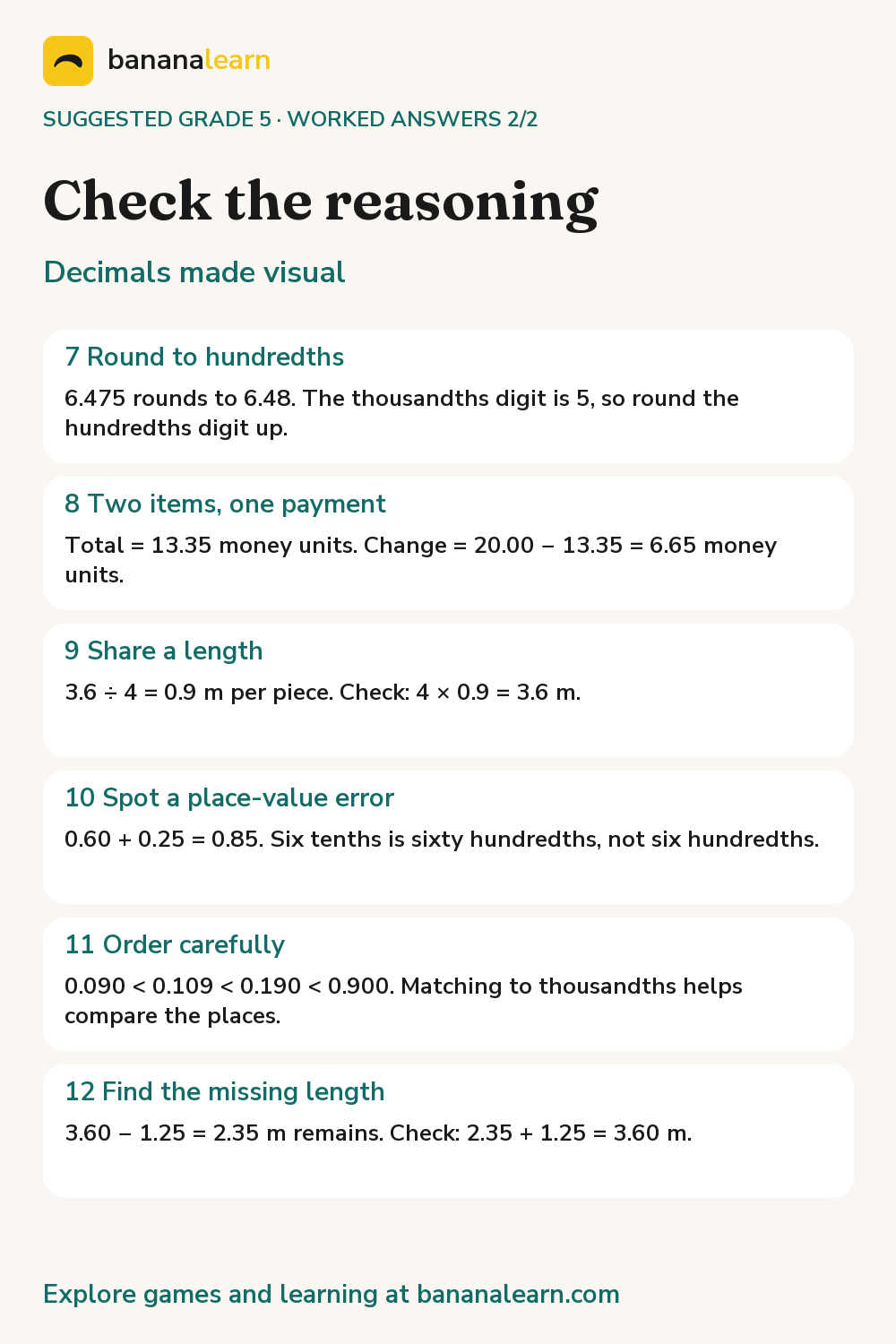
7. Round to hundredths
Round 6.475 to two decimal places.
Shown model: Round 6.475.
Show worked solution
6.475 rounds to 6.48. The thousandths digit is 5, so round the hundredths digit up.
8. Two items, one payment
Items cost 12.50 and 0.85 money units. Pay with 20.00. Find change.
Shown model: 12.50 + 0.85.
Show worked solution
Total = 13.35 money units. Change = 20.00 − 13.35 = 6.65 money units.
9. Share a length
Share 3.6 m of ribbon into 4 equal pieces. Find each length.
Model: total 3.6, split into 4 equal parts.
Show worked solution
3.6 ÷ 4 = 0.9 m per piece. Check: 4 × 0.9 = 3.6 m.
10. Spot a place-value error
A child says 0.6 + 0.25 = 0.31. Explain and correct it.
Place-value chart: 0.60 and 0.25, with ones, tenths and hundredths aligned.
Show worked solution
0.60 + 0.25 = 0.85. Six tenths is sixty hundredths, not six hundredths.
11. Order carefully
Put the four values in increasing order.
Shown model: 0.09 0.9 0.19 0.109.
Show worked solution
0.090 < 0.109 < 0.190 < 0.900. Matching to thousandths helps compare the places.
12. Find the missing length
A 3.6 m ribbon loses 1.25 m. How much remains?
Shown model: 3.60 − 1.25 = ?.
Show worked solution
3.60 − 1.25 = 2.35 m remains. Check: 2.35 + 1.25 = 3.60 m.
No registration is needed to download. Suggested grades describe readiness and are not a claim of alignment to every curriculum.
Make a target using decimals
Open Math Worm and choose Grade 5, then Decimal Operations. Build a connected addition or subtraction expression. Estimate the result first and explain your calculation after each attempt.
Try Math WormGuest play has level, question and time limits. Sign in to continue or save progress. A game score is not a mastery assessment.
Questions students and parents ask
Must both numbers have the same number of decimal places?
No. You may add trailing zeros to make alignment clearer; their values do not change.
How many decimal places should the answer have?
For an exact sum of terminating decimals, use enough places to include every input place. Trailing zeros can then be omitted unless the context requires them.
Does the order of addition matter?
The exact sum is unchanged when you swap the addends. This can help you pair numbers that make whole units.
Help at home: Use units before a written algorithm
Ask your child to read 0.4 + 0.35 as four tenths plus three tenths and five hundredths. Regroup the tenths in speech before writing columns.
If an answer is wildly too large or small, ask for an estimate rather than pointing immediately to the decimal point.
Try 0.8 + 0.27 next and ask where the extra whole unit came from. A clear regrouping explanation is more useful than speed.
Keep the conversation focused on the reasoning you can hear or see. One short activity cannot establish lasting mastery or diagnose a learning difficulty.
Match Maths support to your child’s class
If this topic is causing difficulty in schoolwork, start with your child’s current board and class. These guides explain the syllabus, show teaching examples and help you decide what to ask before booking.
CBSE Maths support
Topic sequences can differ between schools and books. Choose the class your child attends. For another class, browse Maths tuition for Classes 1–10; for a school outside India, check curriculum and time-zone fit.
Choose your next learning step
Use addition to check subtraction
If 2.75 + 2.25 = 5.00, then 5.00 − 2.75 = 2.25. Subtraction uses the same place-value columns, but you may need to exchange a whole for tenths and a tenth for hundredths.
Work through subtracting decimals with regrouping.
- Decimal place value — Revisit why 0.4 means four tenths.
- Decimal practice worksheet — Check unit names before using columns.
- Support independent homework — Use a check or model before supplying an answer.
If the decimal point keeps moving into the wrong column, bring one example to a free 50-minute class and work through the units with a teacher.
Ask about a free 50-minute class