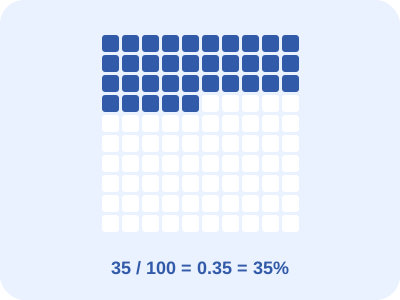
See the idea
Decimal place-value chart: tenths, hundredths and thousandths
| Place | Digit in 3.407 | Place unit | Digit value |
|---|---|---|---|
| Ones | 3 | 1 | 3 |
| Tenths | 4 | 1/10 = 0.1 | 4/10 = 0.4 |
| Hundredths | 0 | 1/100 = 0.01 | 0 |
| Thousandths | 7 | 1/1000 = 0.001 | 7/1000 = 0.007 |
Expanded form: 3.407 = 3 + 0.4 + 0.007. Read it as “three and four hundred seven thousandths” or say each digit after the point: “three point four zero seven”. The zero preserves the position of the 7.
Digit versus value: in 3.407 the digit is 7; its place is thousandths; its value is 0.007. Removing the placeholder zero makes 3.47, where 7 is worth 0.07 instead.
Ten thousandths make one hundredth; ten hundredths make one tenth. This is the same exchange used when adding decimals in columns.
Try it: what is the value of 6 in 2.063? What is the value of 3?
The 6 is in the hundredths place, so its value is 0.06. The 3 is in the thousandths place, so its value is 0.003. Together with two ones, they give 2 + 0.06 + 0.003 = 2.063.
Before you start
Understand ones, tens and hundreds, plus the idea of equal tenths. A decimal point marks the boundary after ones; it is not a separator for two unrelated whole numbers.
Words used in this guide
- Tenth
- One of ten equal parts of a whole: 0.1.
- Hundredth
- One of one hundred equal parts: 0.01. Ten hundredths make one tenth.
- Thousandth
- One of one thousand equal parts: 0.001.
Why the method works
Our base-ten system continues on either side of the decimal point. Ten ones make one ten; ten tenths make one one; ten hundredths make one tenth. In 2.47, the 4 counts tenths, not whole units. Writing 2.47 = 2 + 4/10 + 7/100 makes the units visible. A zero can hold an empty place so that later digits retain their intended value.
Build the number from its parts
0.36 = 3/10 + 6/100 = 36/100. A hundred square with 36 shaded cells shows the same amount as three complete columns of ten and six extra cells.
Trailing zeros preserve the value
0.5 = 0.50 because five tenths equal fifty hundredths. The extra zero records a place with no additional hundredths; it does not make the number ten times larger.
Compare place by place
To compare 0.7 and 0.65, write 0.70 and 0.65. Seventy hundredths is greater than sixty-five hundredths. The number of digits is not a reliable guide to decimal size.
A digit, its place and its value are different things
In 2.073, the digit 7 is in the hundredths place and its value is 7 hundredths, or 0.07. The place tells you the unit; the digit tells you how many of those units there are.
| Number | Ones | Tenths | Hundredths | Thousandths |
|---|---|---|---|---|
| 2.073 | 2 | 0 | 7 | 3 |
| 2.730 | 2 | 7 | 3 | 0 |
| 0.237 | 0 | 2 | 3 | 7 |
How do you rename 2.4 using tenths?
One whole contains 10 tenths. Therefore 2 wholes contain 20 tenths. Add the 4 tenths already present: 20 tenths + 4 tenths = 24 tenths. So 2.4 = 24/10. The digit in the tenths place is 4, but the number 2.4 contains 24 tenths. These answer different questions.
Rename again using a smaller unit
Every tenth contains 10 hundredths. Therefore 24 tenths = 240 hundredths, so 2.4 = 2.40 = 240/100. This is a change of unit, not a change of value. It explains why adding a trailing zero does not make 2.4 smaller.
Read a number line before naming its point
If the interval from 0.2 to 0.3 has 10 equal spaces, each space is 0.01. The third mark after 0.2 is 0.23, not 0.3 and not 0.203. Count spaces between neighbouring marks, and use both labelled endpoints to work out the scale.
Check the zero carefully
Are 4.06 and 4.6 equal? Explain using units.
No. 4.06 has 6 hundredths; 4.6 has 6 tenths, which is 60 hundredths. Rewrite 4.6 as 4.60 and compare 4.06 with 4.60.
Write 3.05 in hundredths. Is the answer 5 hundredths?
The whole number is 305 hundredths: 3 wholes = 300 hundredths, plus 5 hundredths. Only the fractional part is 5 hundredths.
Worked examples, step by step
Example 1: Write 0.48 as tenths and hundredths.
- The first digit after the point names tenths; the second names hundredths.
- 0.48 = 4/10 + 8/100.
Example 2: Explain every digit in 6.305.
- 6 is six ones, 3 is three tenths, 0 records no hundredths and 5 is five thousandths.
- 6.305 = 6 + 3/10 + 5/1000.
- Removing the middle zero gives 6.35, a different value. A placeholder zero is not the same as a trailing zero.
Example 3: Order 0.8, 0.08 and 0.808.
- Write equivalent forms with three decimal places: 0.800, 0.080 and 0.808.
- 0.080 < 0.800 < 0.808, so 0.08 < 0.8 < 0.808.
- Compare from the largest place first. More written digits does not automatically mean a larger number.
Example 4: A ribbon is 1.25 metres long. How many centimetres is that?
- One metre is 100 centimetres. One quarter of a metre is 25 centimetres.
- 1.25 metres = 125 centimetres.
- The measurement stayed the same; the numerical count grew because centimetres are smaller units.
Read, compare and locate decimals using the same whole
The value of a digit depends on its place. Moving one place to the right divides the place unit by ten: one one contains ten tenths, and one tenth contains ten hundredths. Keep the whole fixed when comparing diagrams; half of a small strip cannot be compared with half of a much larger strip as if the amounts were the same.
| Number | Read the places | Expanded form |
|---|---|---|
| 6.04 | 6 ones, 0 tenths, 4 hundredths | 6 + 0.04 |
| 6.40 | 6 ones, 4 tenths, 0 hundredths | 6 + 0.4 |
| 0.46 | 0 ones, 4 tenths, 6 hundredths | 0.4 + 0.06 |
| 0.460 | 46 hundredths or 460 thousandths | 0.460 = 0.46 |
To locate 1.27 on a number line, first find 1.2 and 1.3. Divide that tenth-wide interval into ten equal parts; each part is one hundredth. The point 1.27 lies seven small steps after 1.20. Count intervals, rather than counting the starting mark as step one.
Worked example: How much must be added to 0.37 to reach 0.80?
- Rename both amounts in hundredths: 37 hundredths and 80 hundredths.
- Find the gap: 80 − 37 = 43 hundredths, so the missing amount is 0.43.
- Check the units and total: 0.37 + 0.43 = 0.80. On a hundred-square model, 43 more small squares complete the first 80 shaded squares.
Try a fresh example, then explain your check
Which is greater: 6.04 or 6.4? Explain the first different place.
Show answer and reasoning
6.4 is greater. Both have six ones, but 6.4 has four tenths while 6.04 has zero tenths. Four hundredths cannot make up that difference.
A number line from 2.30 to 2.40 is split into ten equal intervals. What is the fourth point after 2.30?
Show answer and reasoning
Each interval is 0.01, so four steps give 2.34. The starting point is not counted as an extra step.
Are 0.46 and 0.460 equal? What about 0.046?
Show answer and reasoning
0.46 = 0.460 because the added zero contributes no thousandths. But 0.046 is 46 thousandths, one tenth of 46 hundredths.
Questions about choosing and checking a method
Does a longer decimal always represent a larger number?
No. Compare matching places from left to right. For example, 0.9 is greater than 0.89 because nine tenths exceeds eight tenths, even though 0.89 has more written decimal places.
Why can I add a zero at the end but not insert it anywhere?
A trailing zero adds zero of a smaller unit while leaving the other digits in their places. Inserting a zero immediately after the decimal point shifts the following digits into smaller places: 0.5 and 0.05 therefore have different values.
Common mistakes and how to repair them
“0.09 is larger than 0.1 because 9 is larger than 1.”
0.1 = 0.10. Ten hundredths exceed nine hundredths.
“Zeros never matter in decimals.”
Trailing zeros do not change value, but 0.04 and 0.4 differ by a factor of ten. Name each place.
Check your understanding
Choose an answer for each question. You can check again after reading the explanation.
Worked answers
Which number is greater? 0.7. 0.7 = 0.70, which is greater than 0.65.
What is the value of the 4 in 0.04? 4/100. The 4 is in the hundredths place.
Practise independently
Work these out on paper. Include a diagram or a sentence where the question asks you to explain. Open each solution after making an attempt.
3. What is the value of 7 in 2.073?
Show the reasoning
7/100 = 0.07; it is in the hundredths place.
4. Write 4 ones, 2 tenths and 6 thousandths as a decimal.
Show the reasoning
4.206. The zero holds the hundredths place.
5. Which is larger, 0.39 or 0.4?
Show the reasoning
0.4 = 0.40, so it is larger by 0.01.
6. Write a number strictly between 0.6 and 0.7. Can you find another?
Show the reasoning
For example, 0.65 and 0.601. There are infinitely many numbers between them, not just 0.61 to 0.69.
If a method still feels uncertain, revisit the closest worked example, then try a fresh problem. A correct answer copied from a solution tells you less than an explanation you can give independently.
Keep practising · suggested Grade 5
Worksheets and revision: Decimals made visual
Use the place-value questions first. The full suggested Grade 5 pack also includes calculation, rounding and mixed decimal problems.
Open the 12-question pack and answers
Download the illustrated revision sheet · Download all pack images
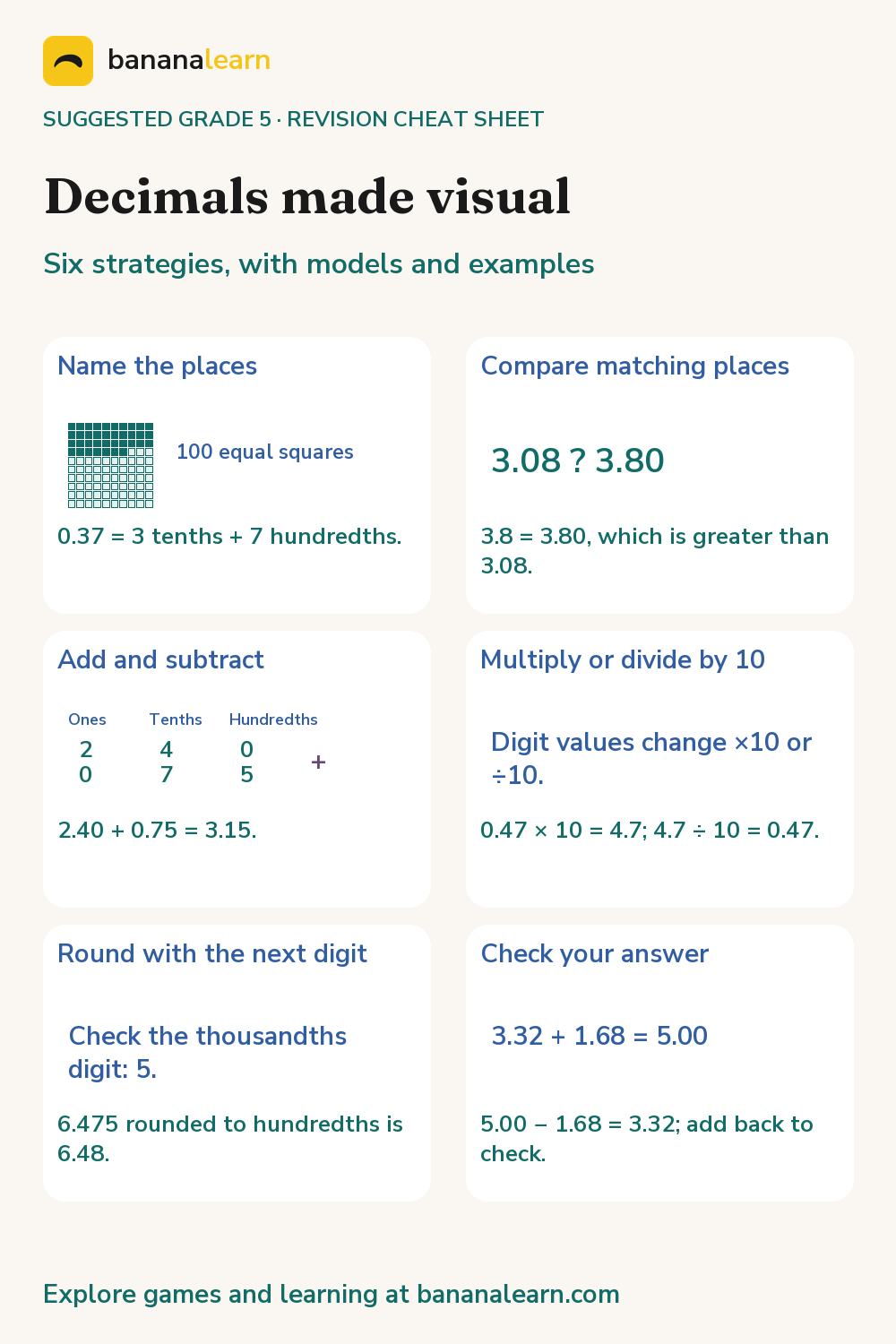
No registration is needed to download. Suggested grades describe readiness and are not a claim of alignment to every curriculum.
Use decimal values in Math Worm
Choose Grade 5, then Decimal Operations. Say each tile value in tenths before combining tiles to reach the target. This practises using decimal values in calculations; it does not replace the place-value models above.
Try Math WormGuest play has level, question and time limits. Sign in to continue or save progress. A game score is not a mastery assessment.
Questions students and parents ask
Are 2.5 and 2.50 equal?
Yes. Five tenths and fifty hundredths are equal. A measurement may use the extra zero to communicate precision, but the numerical value is unchanged.
Is there a ones place after the decimal point?
No. The first place after the point is tenths, followed by hundredths and thousandths.
Can decimals be greater than one?
Yes. For instance, 12.4 means twelve ones and four tenths.
Help at home: Build with a hundred square
Call the whole grid one. Shade 30 squares as three full columns, then four more. Ask your child to name 34 hundredths and write 0.34.
Compare 0.3 and 0.03 on two equal grids. Ask why one uses 30 squares and the other only 3.
Move to a number-line question: where would 0.34 lie between 0.3 and 0.4? This checks transfer beyond a familiar grid.
Keep the conversation focused on the reasoning you can hear or see. One short activity cannot establish lasting mastery or diagnose a learning difficulty.
Match Maths support to your child’s class
If this topic is causing difficulty in schoolwork, start with your child’s current board and class. These guides explain the syllabus, show teaching examples and help you decide what to ask before booking.
CBSE Maths support
Topic sequences can differ between schools and books. Choose the class your child attends. For another class, browse Maths tuition for Classes 1–10; for a school outside India, check curriculum and time-zone fit.
Choose your next learning step
- Add decimals — Combine matching units and regroup when needed.
- Decimal place-value worksheet — Practise reading and comparing values.
- Help without giving the answer — Make the next step visible without doing the calculation.
If your child confuses the digit with its value, a teacher can start with a place-value model in a free 50-minute class.
Ask about a free 50-minute class