Start with the meaning
This worksheet covers nonnegative numbers to hundredths. Read ones, tenths and hundredths before attempting the comparisons. It does not include rounding or decimal multiplication.
Keep the whole fixed
One whole contains ten tenths or one hundred hundredths. A tenth is ten times as large as a hundredth. The same digit therefore has a different value in different positions.
In 2.37, the three means three tenths, or 0.3. The seven means seven hundredths, or 0.07. Expanded form is 2 + 0.3 + 0.07.
Compare from left to right
Compare whole-number parts first, then tenths, then hundredths. Stop at the first different place. If every place matches after adding trailing zeros, the numbers are equal.
Only zeros at the end of the fractional part can be appended without changing value. 0.5 = 0.50, but inserting a zero after the decimal point gives 0.05, a different number.
Use the worksheet without the key visible
Try the questions on paper or print the practice sheet below. Write the place value you used for each comparison. Leave a question blank if you cannot yet explain it.
After checking, choose a fresh pair that uses the same idea. A child who gets 0.6 > 0.47 should also be able to explain 0.7 > 0.68 without copying the earlier answer.
Read the pattern of mistakes
If digit values are incorrect, revisit the place-value model. If values are secure but comparisons fail, practise looking at the first differing place. If only zero examples cause trouble, compare tenths and hundredths with a fixed whole.
Do not use a worksheet score as a diagnosis. It gives a small sample of what to practise next, and written explanations make that sample more useful.
Worked examples, step by step
Example 1: What is the value of 4 in 3.48?
- The first place to the right of the decimal point is tenths.
- The digit 4 is therefore four tenths: 0.4.
- 3.48 = 3 + 0.4 + 0.08.
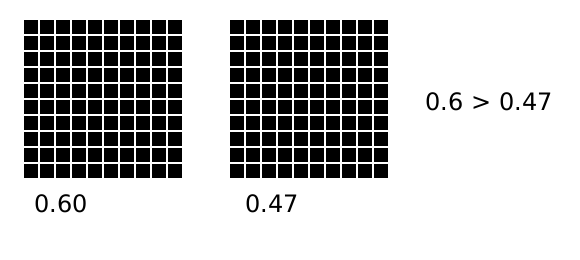
Example 2: Compare 0.6 and 0.47
- Write six tenths as sixty hundredths: 0.60.
- Sixty hundredths is greater than forty-seven hundredths.
- 0.6 > 0.47. Having fewer digits does not make 0.6 smaller.
Example 3: Order 1.05, 1.5 and 1.15 from smallest to largest
- All three have one whole. Compare tenths: 0, 5 and 1.
- Their order is 0 tenths, then 1 tenth, then 5 tenths.
- 1.05 < 1.15 < 1.5. You can write 1.50 to align the hundredths.
Use models to check the reasoning behind a worksheet answer
Use a fixed-size hundred square or a labelled number line when a written comparison is difficult to explain. A correct comparison symbol is only one part of the task: state which place value settles the decision. Try the three model tasks below after the main worksheet, using paper so the answer is not visible while you work.
| If this is difficult | Try this model | What to explain |
|---|---|---|
| Reading 0.28 | Shade 28 of 100 equal small squares | 2 full tenths and 8 hundredths |
| Comparing 0.6 and 0.58 | Shade 60 and 58 squares on equal-sized grids | 60 hundredths exceeds 58 |
| Locating 0.42 | Split 0.40 to 0.50 into ten intervals | Two steps after 0.40 |
| Understanding a trailing zero | Match 5 tenths with 50 hundredths | The same whole and the same amount |
Keep the quantity represented by one whole unchanged. If a grid contains 100 equal squares, one small square is one hundredth of that grid. If you draw only a ten-part strip, one part is a tenth instead. Explain the chosen whole before labelling a shaded amount.
Worked example: A learner shades 6 of 100 equal squares and labels the amount 0.6. How should it be labelled?
- The whole grid is one whole, split into 100 equal parts. Each shaded square is one hundredth.
- Six shaded squares represent six hundredths: 6/100 = 0.06.
- For 0.6, the learner would need six tenths, which is 60 of the small squares. Compare 6 shaded squares with 60 before retrying.
Try a fresh example, then explain your check
Draw a hundred square and shade 28 squares. Name the amount in tenths and hundredths.
Show answer and reasoning
The amount is 0.28: two tenths and eight hundredths. Two complete rows of ten plus eight more squares give 28 hundredths.
Use equal-sized hundred squares to compare 0.6 and 0.58.
Show answer and reasoning
Shade 60 squares and 58 squares. Since 60 is greater than 58, 0.6 > 0.58. The models must use the same-sized whole.
On a number line split into hundredths, how many steps go from 0.42 to 0.50?
Show answer and reasoning
50 − 42 = 8 hundredths, so there are eight steps. The gap is 0.08; do not count both endpoint marks as intervals.
Questions about choosing and checking a method
Should a child repeat the same worksheet after an error?
First explain or model the step that caused trouble, then try a fresh question using the same idea. A repeated answer may be remembered without the method being understood. For example, follow 0.6 versus 0.58 with 0.7 versus 0.69.
How do I choose between this worksheet and the mixed decimal pack?
Use this worksheet for digit values, comparisons and ordering to hundredths. The linked mixed pack adds calculation, rounding and broader revision. Move to those tasks when the place-value explanations are comfortable, rather than treating a suggested grade as a readiness guarantee.
Common mistakes and useful repairs
Reading 0.09 as nine tenths
Nine tenths is 0.9. In 0.09 the zero holds the tenths position, so nine occupies the hundredths position.
Treating the digits after the point as a whole number
Comparing 8 and 75 would suggest the wrong order for 0.8 and 0.75. Compare 80 hundredths and 75 hundredths instead.
Try before revealing
Quick understanding check
Read the check answers
0.07. Seven hundredths is 7/100, written 0.07.
0.4 > 0.35. 0.4 = 0.40; forty hundredths is greater than thirty-five.
Decimal place value worksheet with explained answers — practice sheet
Work on paper before opening an answer. Print this question sheet with or without a separate worked key; no account is needed.
Name: ____________________ Date: __________
What is the value of 7 in 4.72?
Show answer and reasoning
0.7. The seven is in the tenths place.
Write 5.06 in expanded form.
Show answer and reasoning
5 + 0.06. There are five ones, zero tenths and six hundredths.
Fill in <, > or =: 0.8 ___ 0.75.
Show answer and reasoning
>. 0.8 = 0.80, and 80 hundredths exceeds 75 hundredths.
Fill in <, > or =: 2.30 ___ 2.3.
Show answer and reasoning
=. A trailing zero after the tenths adds no hundredths.
Order 0.09, 0.9 and 0.19 from smallest to largest.
Show answer and reasoning
0.09, 0.19, 0.9. Compare 9, 19 and 90 hundredths.
Write the number with 3 ones, 2 tenths and 5 hundredths.
Show answer and reasoning
3.25. 3 + 0.2 + 0.05 = 3.25.
How much must be added to 0.46 to make 0.50?
Show answer and reasoning
0.04. 50 hundredths − 46 hundredths = 4 hundredths.
A child says 0.52 > 0.7 because 52 > 7. Explain the error.
Show answer and reasoning
0.52 < 0.7. 0.7 is 70 hundredths. Compare quantities in the same unit: 52 < 70.
Decimal place value worksheet with explained answers — worked answer key
0.7. The seven is in the tenths place.
5 + 0.06. There are five ones, zero tenths and six hundredths.
>. 0.8 = 0.80, and 80 hundredths exceeds 75 hundredths.
=. A trailing zero after the tenths adds no hundredths.
0.09, 0.19, 0.9. Compare 9, 19 and 90 hundredths.
3.25. 3 + 0.2 + 0.05 = 3.25.
0.04. 50 hundredths − 46 hundredths = 4 hundredths.
0.52 < 0.7. 0.7 is 70 hundredths. Compare quantities in the same unit: 52 < 70.
Keep practising · suggested Grade 5
Worksheets and revision: Decimals made visual
Use the place-value questions first. The full suggested Grade 5 pack also includes calculation, rounding and mixed decimal problems.
Open the 12-question pack and answers
Download the illustrated revision sheet · Download all pack images
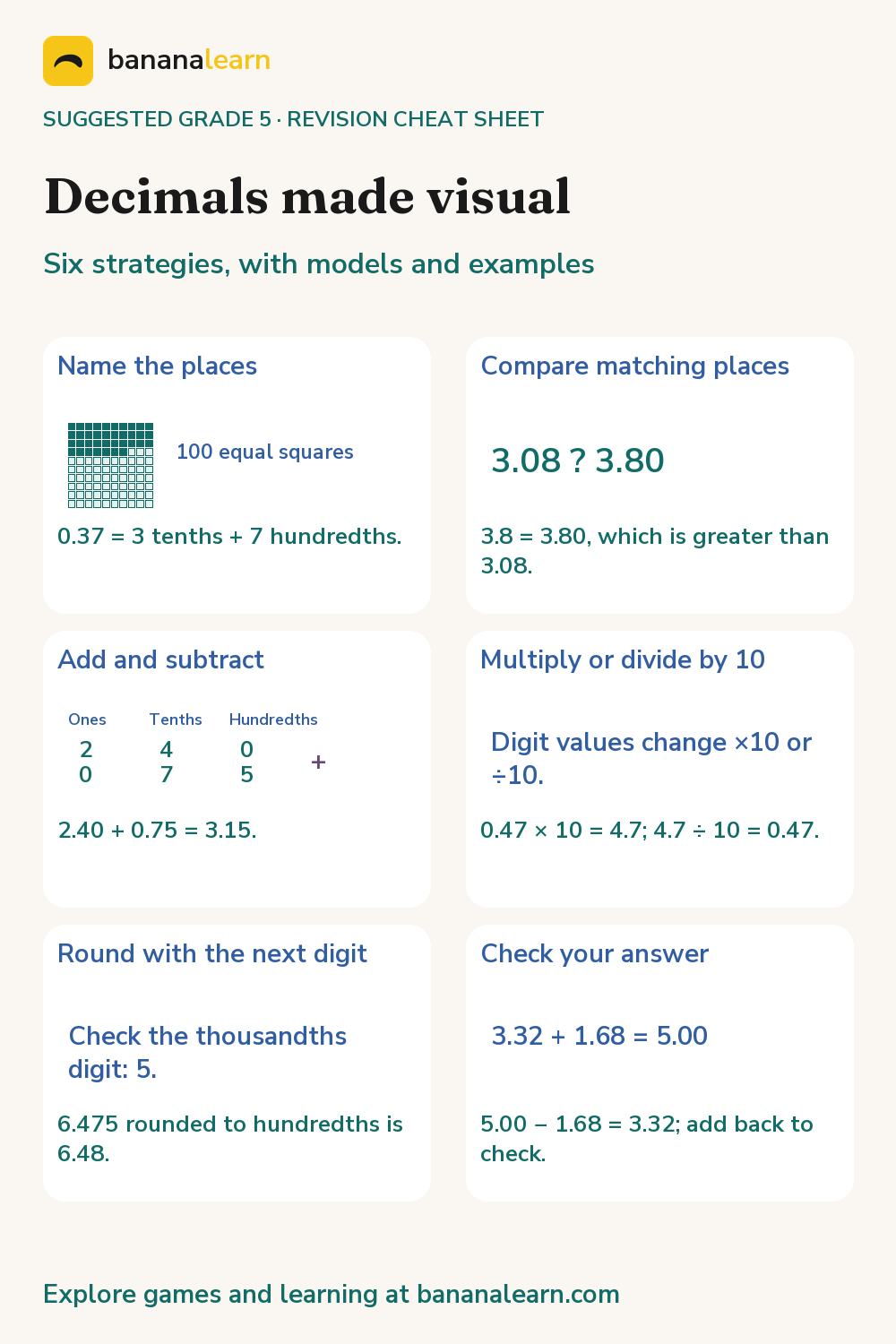
No registration is needed to download. Suggested grades describe readiness and are not a claim of alignment to every curriculum.
Apply decimal values in a game
After the worksheet, choose Grade 5 and Decimal Operations in Math Worm. This adds calculation practice; return to the hundred-square model if reading tenths and hundredths is still difficult.
Try Math WormGuest play has level, question and time limits. Sign in to continue or save progress. A game score is not a mastery assessment.
Help at home: Ask what the digit is worth
Write 0.4 and 0.04. Ask your child to name the position and value of the four in each. Then show both on equal-sized hundred grids.
If the whole changes size between pictures, the comparison becomes misleading. Keep equal-sized grids and label each as one whole.
Keep one example of your child’s own working. If the same confusion returns across fresh questions, share that attempt with their teacher and ask which next step fits their current learning.
Questions students and parents ask
Is this a PDF download?
This is a printable web worksheet. Use the print button for a question sheet and a separate answer key; your browser can also save the print output as PDF.
What age or grade is this for?
Use it when your child is learning tenths and hundredths. Curriculum timing varies; choose by the prerequisite skills rather than treating grades and school years as interchangeable.
About this resource
BananaLearn created these explanations, diagrams and practice questions. They are not reproduced textbook or past-exam questions. School sequences differ; use the prerequisites to choose a starting point. Read how we prepare learning guides.
Curriculum and teaching references used to check scope:
Bring the sticking point to a teacher
For 1-on-1 support, bring one question your child found difficult to a free 50-minute session. Tell us their grade, curriculum and time zone so we can discuss a suitable next step.
Request a free session