Learning · England Year 4 parents
Year 4 Multiplication Check 2027: England Parent Guide
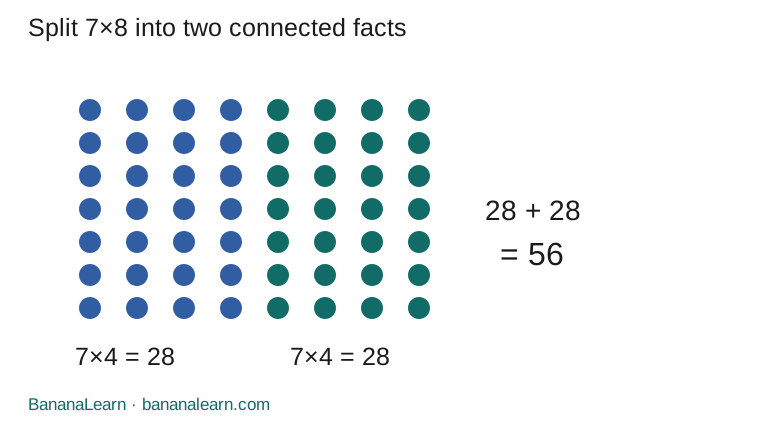
A quick answer of 56 is useful. Knowing that 7×8 is 7×4 doubled gives a child a way to rebuild the fact when it slips from memory.
Original BananaLearn guide · 2 November 2026
On a phone, swipe across the illustration to read every label.
The published 2027 information
England’s 2027 arrangements describe the multiplication tables check as 25 timed onscreen questions covering tables up to 12. The main two-week period opens Monday 7 June, with the published additional week for specified absences or technical delays beginning 21 June. Ask the school for the child’s schedule and check the official guidance for updates.
This guide is for England Year 4 parents, not every country’s fourth grade. It does not recreate the official check, supply unreleased questions or claim that a home practice score is an official result. The 2027 arrangements are a current published-resource signal, not measured rising query volume.
Separate understanding, recall and entering an answer
A learner can understand multiplication through equal groups while still recalling some facts slowly. Another may know a fact but mistype it on a device. These observations require different responses. An array explanation, a recall check and a basic input rehearsal should not be treated as the same test.
Ask the teacher which facts and representations are being taught and how home support can match them. Avoid turning every explanation into a speed competition. Accurate methods and growing recall can be developed together.
Use an array to connect a difficult fact
For 7×8, draw seven rows of eight. Split each row into four and four, producing two arrays of 7×4. Each contains 28, so the whole contains 56. The picture links the new fact to a known one rather than asking for an unexplained guess.
Alternatively, use 5×8+2×8=40+16=56. Both methods use distributivity. Let the child explain one chosen method and then connect it to the compact equation; collecting several tricks without understanding their relation can add confusion.
On a phone, swipe across the illustration to read every label.

Use related facts rather than an oversized list
For 9×6, a learner might use 10×6−1×6=60−6=54. For 12×8, use 10×8+2×8=80+16=96. These examples help rebuild facts, but the eventual recall task differs from carrying out a long written calculation each time.
Choose a small set the teacher has identified, mix it with secure facts and revisit after a gap. A varied later example can show whether a method transfers. Do not claim that one particular number of daily minutes or repetitions guarantees a score.
A brief original home routine
Start with one representation, such as the 7×8 array. Ask for an explanation, then cover it and try a related fact. Finish with a few untimed facts and a note of which were recalled and which were rebuilt. A later short recall session can be separate from the explanatory session.
For example, record 7×8: rebuilt using 7×4; 6×9: recalled independently; 8×12: used 10 groups plus 2. This is a fictional illustration of a useful record, not a BananaLearn student result or a published intervention effect.
Check the device workflow separately
Ask whether the child can find the question, enter a number, correct an entry in a practice environment and follow the school’s instructions. The school’s official familiarisation and any appropriate access arrangements are the relevant route; this page does not decide those arrangements.
A keyboard or screen-entry problem should be noted as such. Do not infer a multiplication misconception solely from a mistyped answer. Conversely, an easy interface does not establish secure recall. Keep these observations distinct when speaking with the teacher.
Interpret a result in the wider learning picture
Ask which facts need further teaching and whether the child can use multiplication in arrays, division and word problems. The check is a specific assessment of recall, not a complete description of Maths attainment. A practice list here is not identical to the official test.
Published results and school feedback should guide the next teaching step. Avoid labelling a child as good or bad at Maths from one score. A useful plan names the remaining fact family or method and checks a fresh task after teaching.
Use the record to make the next conversation specific
The table below separates a fact, a rebuilding strategy, independent recall and an input issue. Bring a short accurate observation to the teacher rather than an unverified comparison with other families’ scores.
BananaLearn’s Maths tutoring can be discussed using the actual school task and teacher priorities; support for an international curriculum should be checked rather than assumed from the country name. The original practice is a learning resource and not an official MTC simulator.
A useful multiplication practice record
Copy this record into a notebook. Fill each blank using your own example or the activity above.
On a phone, swipe across a wide table to see every column.
| Fact | Representation / rebuilding method | Recalled later? | Input issue? |
|---|---|---|---|
| 7×8 | ___ | ___ | ___ |
| 9×6 | ___ | ___ | ___ |
| 12×8 | ___ | ___ | ___ |
| Teacher-selected fact | ___ | ___ | ___ |
10 questions with explained answers
Try each question first. Open the explanation to check your reasoning. These are original BananaLearn questions, not official exam questions.
Which system does the 2027 guide concern?
Check answer and reasoning
England Year 4.
Other fourth-grade assessments may have different arrangements.How many timed questions does the published overview describe?
Check answer and reasoning
25.
The official overview covers multiplication tables up to 12.When does the main 2027 two-week period open?
Check answer and reasoning
Monday 7 June 2027.
The additional published variation week begins 21 June.Use doubling to find 7×8 from 7×4.
Check answer and reasoning
56.
7×4=28, then double 28.Use 10 groups to find 9×6.
Check answer and reasoning
54.
10×6−6=60−6.Split 12×8 into 10×8 and 2×8.
Check answer and reasoning
96.
80+16=96.Calculate 6×7.
Check answer and reasoning
42.
For example, 5×7+7=35+7.Calculate 8×9.
Check answer and reasoning
72.
10×8−8=80−8.Does a mistyped entry prove a fact is misunderstood?
Check answer and reasoning
No.
Input and recall need separate observations.What should a parent ask after a result?
Check answer and reasoning
Which fact families or methods need the next teaching step.
A specific plan is more useful than a fixed judgement about overall ability.
Choose your next learning step
- See equal groups as arrays
- Choose the next multiplication explanation
- Use facts in a meaningful problem
- Check the task workflow on the device
Explore BananaLearn games, learning resources and tutoring. Maths is our priority; English and Science tutoring are also available. Share your current schoolwork when checking teaching fit.
Sources and scope
Explanations, activities, diagrams and practice are original BananaLearn work. Class labels suggest a learning level; school sequences and current textbook editions can differ. Sources checked 2 November 2026.
How we prepare guides · Report a correction
Share the complete guide: https://bananalearn.com/learn/year-4-multiplication-tables-check-2027.html