Start with the meaning
Start with small whole-number groups. Your child needs to count objects reliably and recognise when groups have the same size. This guide does not require written long multiplication.
Find the sticking point before practising
Ask your child to make three groups of four counters, find 3 × 4, and tell a story that matches it. If the groups are unequal, work on the meaning of multiplication. If the groups are correct but they recount every counter, connect groups to known facts. If 3 × 4 is easy but the story is difficult, work on representing situations.
A correct answer alone does not tell you which method was used. Ask “How did you know?” and give time for a drawing or explanation. Avoid making speed the first test.
Build one fact from another
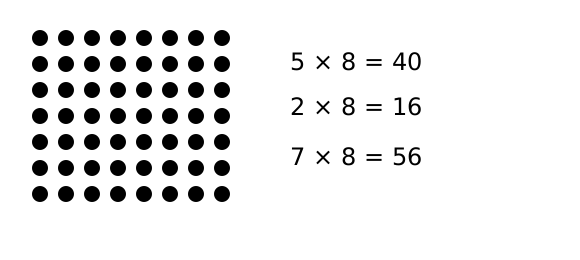
Arrange seven rows of eight counters. Separate five rows from the remaining two. Five eights are 40 and two eights are 16, so seven eights are 56. Keep the row size at eight throughout.
Then ask for 8 × 8. Your child can add one more row of eight to 56. This connects facts rather than treating each answer as an unrelated item to memorise.
Move from the picture to the story
Say “Four trays hold six cups each.” Let your child draw four boxes and put six marks in each. Label the number of groups and the number in each group before calculating.
Now change the question: “There are 24 cups, six on each tray. How many trays?” The same picture supports division. Naming what is unknown is more useful than searching for a single keyword.
A short routine you can repeat
Begin with one familiar fact. Build a nearby fact with a picture, practise a small mixed set, and finish with a new story. Stop while your child can still explain the reasoning.
On another day, ask a similar question with different numbers and no example visible. Use this fresh attempt to decide what needs revisiting. A single successful round is encouraging evidence, not proof of lasting mastery.
Worked examples, step by step
Example 1: Derive 6 × 9 from 5 × 9
- Five rows of nine contain 45 objects.
- One additional row contains nine. Add 45 + 9 = 54.
- Check that the drawing has six complete rows, not six extra counters.
Example 2: Use a known double for 4 × 7
- Two sevens make 14. Four sevens are twice as many groups.
- Double 14 to get 28.
- Do not double both factors: 8 × 14 describes a different array.
Example 3: A child answers 5 × 8 = 13
- Ask them to show five groups of eight.
- 13 is 5 + 8; it adds the group count to the group size.
- Count eight five times, or split into four eights and one eight: 32 + 8 = 40.
Considering support beyond this guide?
If the same difficulty keeps returning, bring one example and your child’s explanation to the free 50-minute session. Tell us the grade and school curriculum so we can discuss an appropriate next step.
Explore CBSE Maths tutoring, ICSE Maths tutoring or support for international families. You can check ongoing class packs and pricing before deciding.
Common mistakes and useful repairs
Counting everything again
Cover part of an array and name a known fact. Ask how one more row changes the total. Counting can be a starting strategy; gradually connect it to grouped reasoning.
Reciting only in order
Mix three familiar facts and ask for a picture or related division fact. Knowing the next line of a chant is different from retrieving a fact independently.
Try before revealing
Quick understanding check
Read the check answers
5 × 8 + 2 × 8. The two parts keep eight objects per row and count all seven rows.
24. 6 + 6 + 6 + 6 = 24.
How to help a child who struggles with multiplication — practice sheet
Work on paper before opening an answer. Print this question sheet with or without a separate worked key; no account is needed.
Name: ____________________ Date: __________
Use 5 × 6 = 30 to find 6 × 6.
Show answer and reasoning
36. Add one group of six: 30 + 6 = 36.
There are 7 boxes with 4 pencils in each. How many pencils?
Show answer and reasoning
28 pencils. Seven groups of four give 7 × 4 = 28.
Explain why 3 × 8 and 8 × 3 have the same total.
Show answer and reasoning
Both equal 24. Rotate a three-by-eight array. It contains the same 24 objects.
A child says 4 × 9 = 13. What should you ask them to draw?
Show answer and reasoning
Four equal groups of nine. The drawing distinguishes 4 + 9 from 9 + 9 + 9 + 9 = 36.
Five bags contain 35 counters altogether. Each bag is equal. How many per bag?
Show answer and reasoning
7 counters. 35 ÷ 5 = 7, checked by 5 × 7 = 35.
Make a story for 6 × 8.
Show answer and reasoning
For example, six packets containing eight stickers each. The story must contain six equal groups of eight; the total is 48.
How to help a child who struggles with multiplication — worked answer key
36. Add one group of six: 30 + 6 = 36.
28 pencils. Seven groups of four give 7 × 4 = 28.
Both equal 24. Rotate a three-by-eight array. It contains the same 24 objects.
Four equal groups of nine. The drawing distinguishes 4 + 9 from 9 + 9 + 9 + 9 = 36.
7 counters. 35 ÷ 5 = 7, checked by 5 × 7 = 35.
For example, six packets containing eight stickers each. The story must contain six equal groups of eight; the total is 48.
Explain → practise → play
Practise with Times Table Blaster
Choose a familiar table. Before tapping a product, say the fact and how you could reconstruct it if you forgot. After playing, solve a new tray or packet problem on paper. The game practises fact recall; the paper story checks application.
Try Times Table Blaster →Times Table Blaster is free to play; sign-in is optional.
After a game round, ask your child to draw 4 rows of 6 dots and explain why there are 24 dots. Then cover one row: how many dots remain, and why? Look for a connection between 4 × 6 = 24 and 3 × 6 = 18, not just a fast answer.
Help at home: Make it concrete
Use buttons, beans or drawn dots. Ask for four equal rows of five, then hide one row. Your child should explain the remaining total using a known fact.
If they keep losing their place, use smaller groups and move counted objects aside. If the representation is secure but recall is slow, practise a few related facts without increasing the numbers yet.
Keep one example of your child’s own working. If the same confusion returns across fresh questions, share that attempt with their teacher and ask which next step fits their current learning.
Questions students and parents ask
Should I practise for speed?
First establish an accurate method and understanding. Introduce brief fluency practice only when the child can explain the facts; stop if rushing makes their reasoning fall apart.
When should I ask the teacher for help?
Share a specific attempt and the method your child used if the same difficulty persists across different examples. Ask which representation the class uses so home support is consistent.
About this resource
BananaLearn created these explanations, diagrams and practice questions. They are not reproduced textbook or past-exam questions. School sequences differ; use the prerequisites to choose a starting point. Read how we prepare learning guides.
Curriculum and teaching references used to check scope:
Bring the sticking point to a teacher
For 1-on-1 support, bring one question your child found difficult to a free 50-minute session. Tell us their grade, curriculum and time zone so we can discuss a suitable next step.
Request a free session