
Start with the key idea
Multiplication combines equal groups or describes a multiplicative comparison. Identify the number of groups, the amount in each group and the quantity the question asks for. A model and a unit label help you distinguish multiplication from addition or division.
1. Identify equal groups
Four trays with six muffins on each tray form four equal groups. The total is 6 + 6 + 6 + 6, which can be written 4 × 6. Multiplication is useful because it records the repeated structure without writing a long sum.
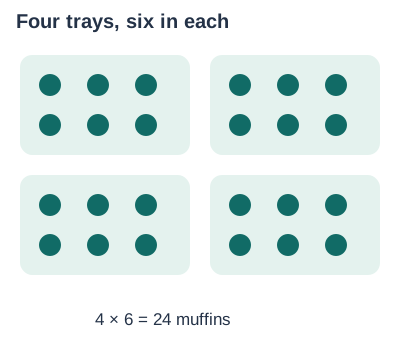
Check the equality before multiplying. Trays holding 6, 6, 5 and 7 muffins still total 24, but four equal groups of six is not a literal description of those trays. You would need addition or a justified rearrangement to explain the picture.
Make the groups visible before using a times-table fact. Draw four outlines, then place six marks in each. A child who draws six marks altogether has confused the amount in one group with the total. Point to one tray and then to all four while saying what each number represents.
2. Name the quantities and units
Say the calculation with units: four trays times six muffins per tray equals twenty-four muffins. The answer counts muffins, not trays. This spoken check prevents a correct number from being attached to the wrong quantity.
The product is unchanged if the factors are reversed: 4 × 6 = 6 × 4. However, six groups of four describe a different arrangement. In a word problem, explain the arrangement you were actually given before using the commutative property as a check.
Compare two questions about the same picture: “How many muffins altogether?” asks for a product, while “How many trays?” asks for the group count already shown. An answer should come from the requested quantity. Reading every number correctly is not enough if the learner has not identified what is unknown.
3. Distinguish times as many from more than
If Asha has four cards and Ravi has three times as many, Ravi has three groups of four cards: 12. If Ravi has three more than Asha, he has 4 + 3 = 7. The relationship changes even though the same numbers appear.
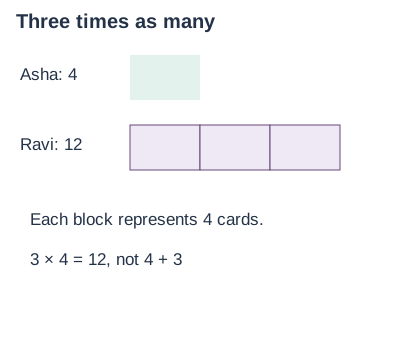
Draw one bar for Asha and three equal bars for Ravi. Every bar represents the same four cards. A bar model makes the multiplier visible and helps a child explain why adding three would answer a different question.
A comparison can also hide the smaller amount. If Ravi has twelve cards, which is three times Asha’s amount, divide twelve into three equal parts to find Asha’s four. The words “times as many” describe a multiplicative relationship, but the unknown position decides whether you multiply or divide to solve it.
4. Use an array when rows and columns are given
An array places objects in equal rows and columns. Five rows of seven chairs give 5 × 7 = 35 chairs. Count the number of rows separately from the number in each row; the picture should show both.
For a large array, split it into parts you know. Five rows of seven can be three rows of seven plus two rows of seven: 21 + 14 = 35. The parts must cover every chair exactly once, with no overlap or missing row.
For an array of six rows of eight, draw a line after the fifth row. The large part contains forty objects and the last row contains eight, giving forty-eight. Explain that five rows plus one row is still six rows. This connects the distributive property to a picture rather than introducing it as an unexplained rule.
5. Read the question again after multiplying
A two-step story may ask for what remains. If four boxes hold eight pencils each and five pencils are used, start with 4 × 8 = 32, then subtract five to get 27. The product is an intermediate answer.
Write a sentence beside each step: total pencils, then pencils left. Do not combine every number in the story immediately. A statement such as “The shop opens at nine” might be background information rather than a number to use.
Try the opposite order in the pencil story: subtract five from eight and then multiply by four. That gives twelve, which would mean removing five pencils from every box. The story removes only five pencils altogether. Comparing the two models reveals why the order of operations must follow the meaning.
6. Check with a second representation
After calculating, use a related fact, repeated addition or a drawing to check. Six bags of nine marbles can be six bags of ten minus six marbles: 60 − 6 = 54. This check explains the size of the answer.
For independent practice, change the story while keeping the structure. A learner who can explain four trays of six and then four shelves of six books is beginning to transfer the idea. If the model is sound but a fact is wrong, practise the fact separately.
A useful independent check is to invent a division question from the same facts. Twenty-four muffins in four equal trays means six per tray. If that inverse statement matches the original story, the factors and total are consistent. Keep fact fluency and story interpretation visible as separate skills when deciding what to practise next.
Extension for older learners (Grades 5–6): Two further illustrated applications
See it, then explain it
Two illustrated examples, explained step by step
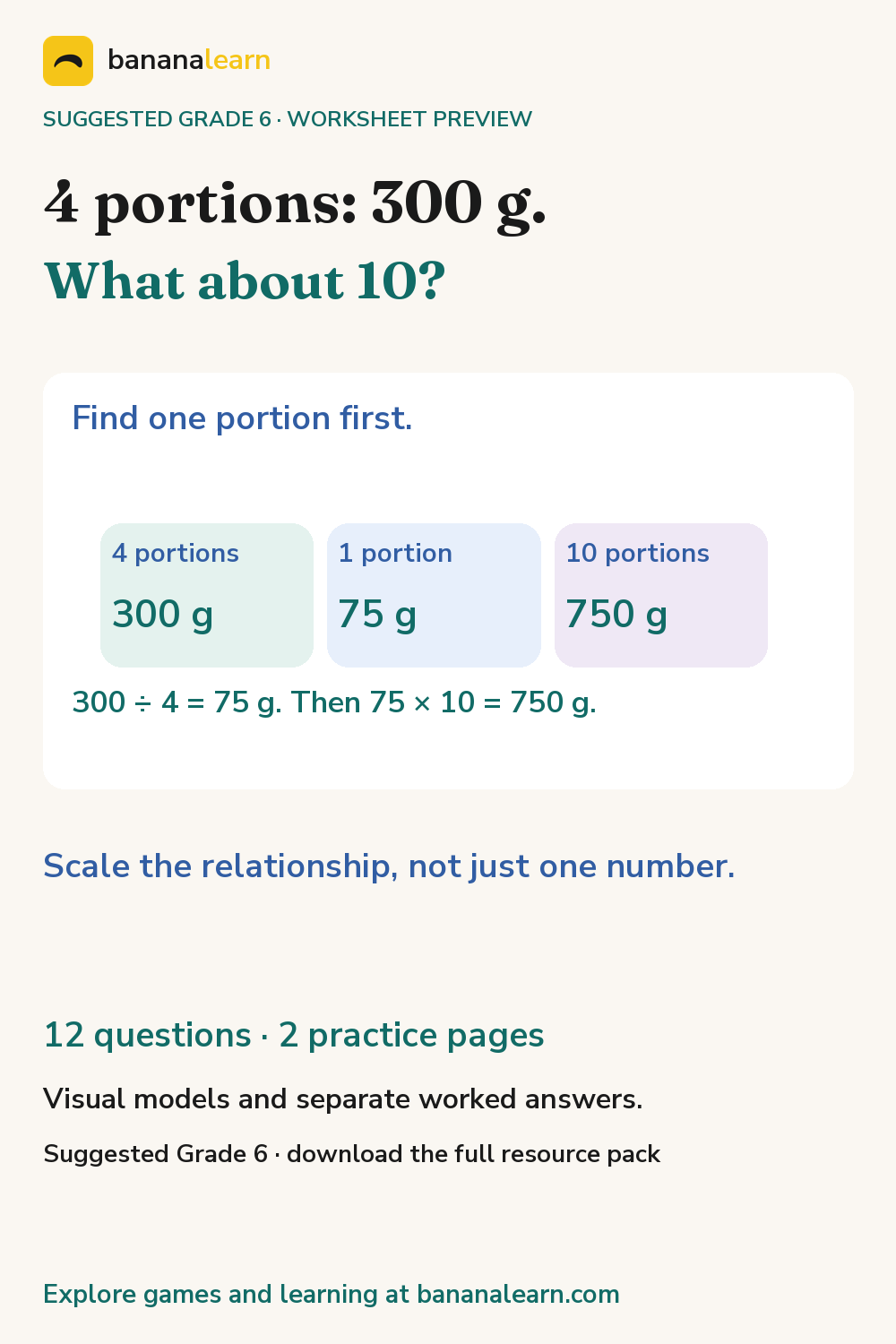
Scale a recipe from 4 portions to 10 portions
Swipe across the diagram to see each part.
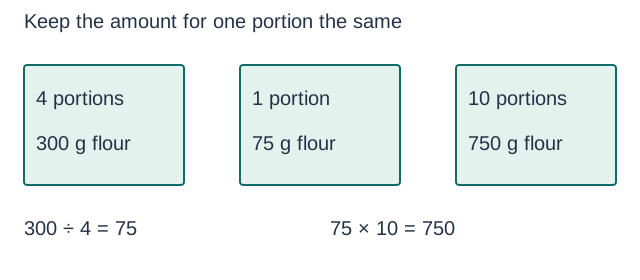
- Find one portion: 300 ÷ 4 = 75 g.
- Find ten portions: 75 × 10 = 750 g.
- Check the scale factor: 10 ÷ 4 = 2.5, and 300 × 2.5 = 750 g.
This assumes every portion uses the same amount of flour. Adding six portions does not mean adding six grams. The units in the table explain the relationship: portions are matched to grams of flour.
Save this illustration on Pinterest · Download the illustrated summary
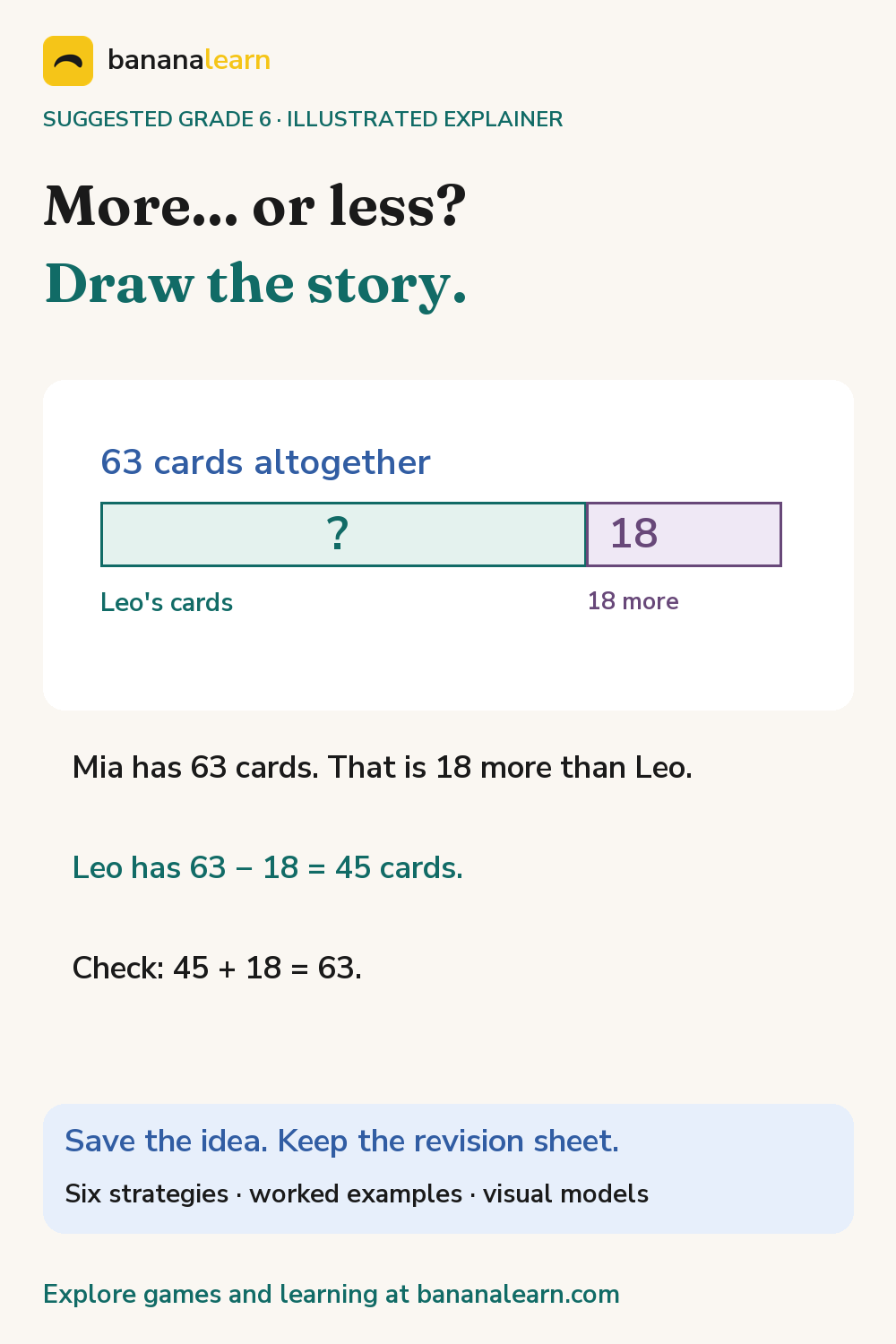
“18 more than” can mean subtracting: find Leo’s cards
Swipe across the diagram to see each part.
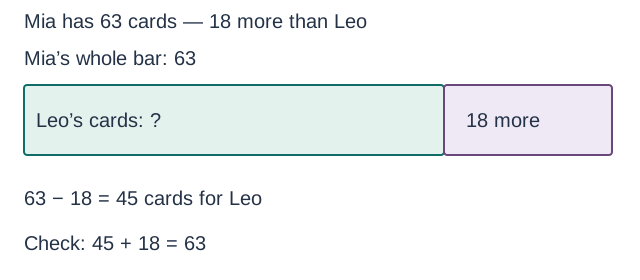
- Draw Mia’s total as one bar labelled 63.
- Split it into Leo’s unknown amount and a part labelled 18.
- Remove the extra part: 63 − 18 = 45. Leo has 45 cards. Check: 45 + 18 = 63.
Choose the operation from the relationship and the unknown, rather than one word. This comparison story uses subtraction; an equal-groups story may use multiplication. The mixed worksheet below gives practice in making that choice across several kinds of problem.
Save this illustration on Pinterest · Download the illustrated summary
Extension for older learners (Grades 5–6): Compare further problem structures
Identify the relationship before choosing an operation
A multiplication word problem describes equal groups, a comparison by a scale factor, an array, or equal-sized units. Identify what one unit represents and which amount is unknown. A word such as “more” or “each” is a clue to read carefully; it is not a complete rule for choosing an operation.
| Relationship | Represent it | Choose the operation |
|---|---|---|
| Equal groups | 5 bags, 8 counters in each | 5 × 8 finds the total |
| Times-as-many comparison | A has 4 times B’s 9 cards | 4 × 9 finds A’s cards |
| Unknown group size | 40 counters shared into 5 bags | 40 ÷ 5 finds counters per bag |
| Additive comparison | A has 9 cards more than B | Use addition or subtraction, depending on the unknown |
Units help expose the relationship: number of bags × counters per bag = counters. If the result is a number of bags, a calculation that produces a count of counters has not answered the question. In a proportional problem, the amount per unit must remain constant; not every real-life price or recipe scales without a change in conditions.
Worked example: Eight packs contain six pencils each. After some pencils are given away, seven remain. How many were given away?
- Find the starting total from equal groups: 8 × 6 = 48 pencils.
- The unknown is the amount removed, not the amount remaining. Represent the story as ? + 7 = 48.
- Subtract: 48 − 7 = 41 pencils given away. Check: 41 given away + 7 left = 48 originally.
Try a fresh example, then explain your check
A bottle holds 0.75 L. How much do six full bottles hold?
Show answer and reasoning
6 × 0.75 = 4.5 L. The unit is litres because the question asks for the total volume.
A recipe needs 200 g of rice for four equal portions. How much for seven portions?
Show answer and reasoning
One portion needs 200 ÷ 4 = 50 g. Seven portions need 7 × 50 = 350 g, assuming equal portion sizes.
Sam has 28 cards. This is four times Ali’s number. How many cards does Ali have?
Show answer and reasoning
Ali has 28 ÷ 4 = 7 cards. The larger quantity was given, so multiplying 28 by four would answer a different question.
Questions about choosing and checking a method
How do I know whether to multiply or divide in an equal-groups story?
If group count and group size are known, multiply to find the total. If the total and one group measurement are known, divide to find the other. Write the missing quantity in a model before calculating.
Why should I draw a bar or table when I can do the arithmetic mentally?
The model checks which quantities belong together and what is missing. Fast arithmetic can still answer the wrong question. A short labelled model is especially useful for reverse comparisons and multi-step stories.
More original practice from this guide
Multiplication word problems with models and explained answers — practice sheet
Try these additional questions on paper before opening an answer. The complete guide PDF includes this practice; no account is needed.
Name: ____________________ Date: __________
Seven shelves hold six books each. Find the total.
Show answer and reasoning
42 books. 7 × 6 = 42.
Nine packets contain eight seeds each. Find the total.
Show answer and reasoning
72 seeds. 10 × 8 − 8 = 80 − 8 = 72.
A garden has four rows of twelve plants. How many plants?
Show answer and reasoning
48 plants. 4 × 10 + 4 × 2 = 40 + 8 = 48.
A ribbon is 7 cm long. Another is three times as long. Find the second length.
Show answer and reasoning
21 cm. Three copies of 7 cm give 3 × 7 = 21 cm.
Five tables have four chairs each. Three chairs are added separately. Find the total.
Show answer and reasoning
23 chairs. First 5 × 4 = 20, then add the three extra chairs.
There are 36 cakes, six in each box. How many boxes?
Show answer and reasoning
6 boxes. The total and group size are known. 36 ÷ 6 = 6; this is a division contrast.
A child walks 15 metres on each of six laps. Find the total distance.
Show answer and reasoning
90 metres. 6 × 15 = 6 × 10 + 6 × 5 = 60 + 30.
Write two different stories represented by 4 × 9.
Show answer and reasoning
For example, four bags of nine marbles; a 9 cm strip repeated four times. Both stories give a total of 36 in their own units. The units need not match between stories.
Answers to the additional practice
Multiplication word problems with models and explained answers — worked answer key
42 books. 7 × 6 = 42.
72 seeds. 10 × 8 − 8 = 80 − 8 = 72.
48 plants. 4 × 10 + 4 × 2 = 40 + 8 = 48.
21 cm. Three copies of 7 cm give 3 × 7 = 21 cm.
23 chairs. First 5 × 4 = 20, then add the three extra chairs.
6 boxes. The total and group size are known. 36 ÷ 6 = 6; this is a division contrast.
90 metres. 6 × 15 = 6 × 10 + 6 × 5 = 60 + 30.
For example, four bags of nine marbles; a 9 cm strip repeated four times. Both stories give a total of 36 in their own units. The units need not match between stories.
Existing worksheets and revision resources
Keep practising · suggested Grade 6
Worksheets and revision: Word problems with models
Extend this lesson with mixed word problems using bars and tables. The suggested Grade 6 pack includes ratio, percentages and time as well as multiplication and division.
Two worksheet pages, 12 questions and separate worked answers. Try the questions before checking. Downloads are PNG images; the ZIP contains the complete image pack.
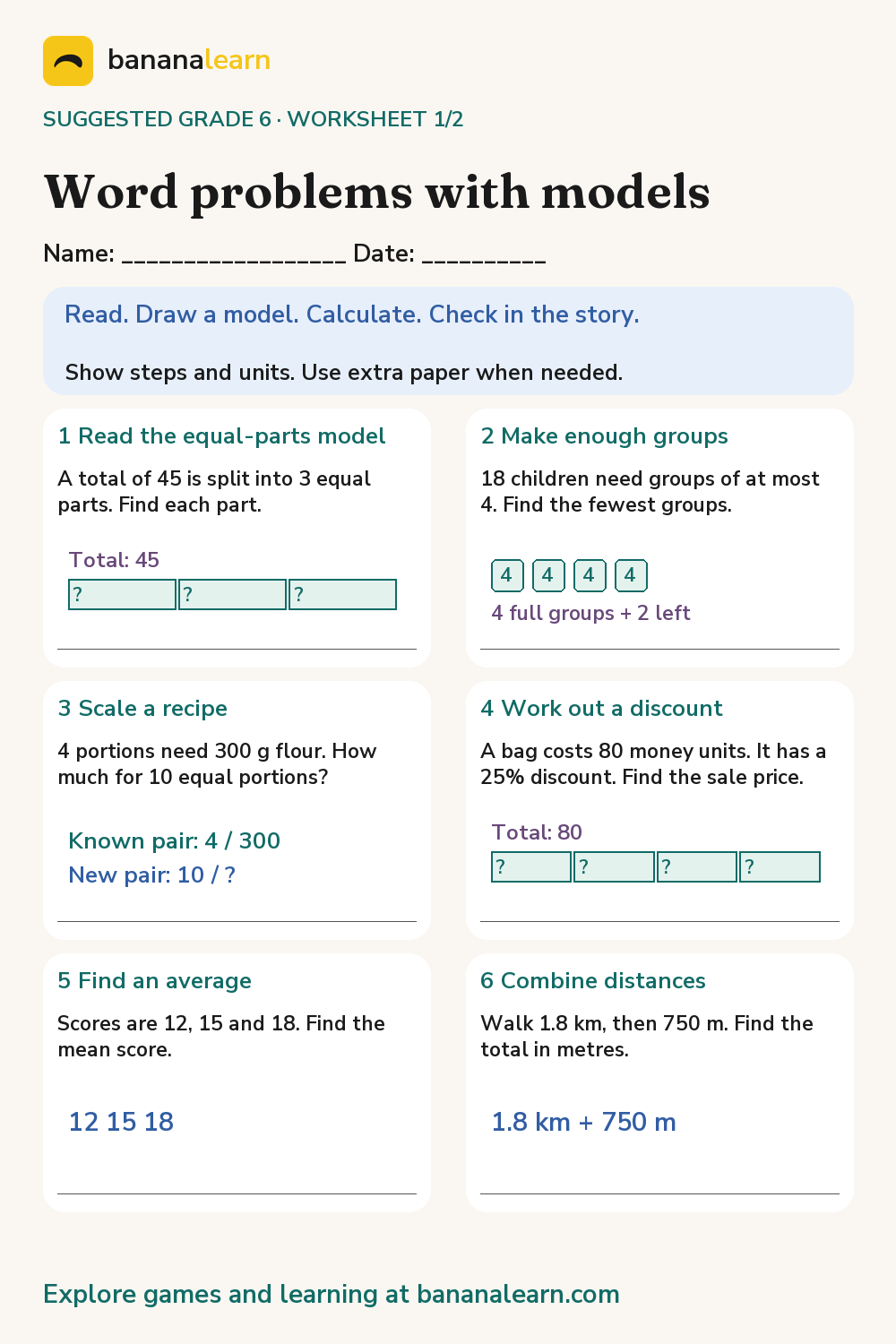
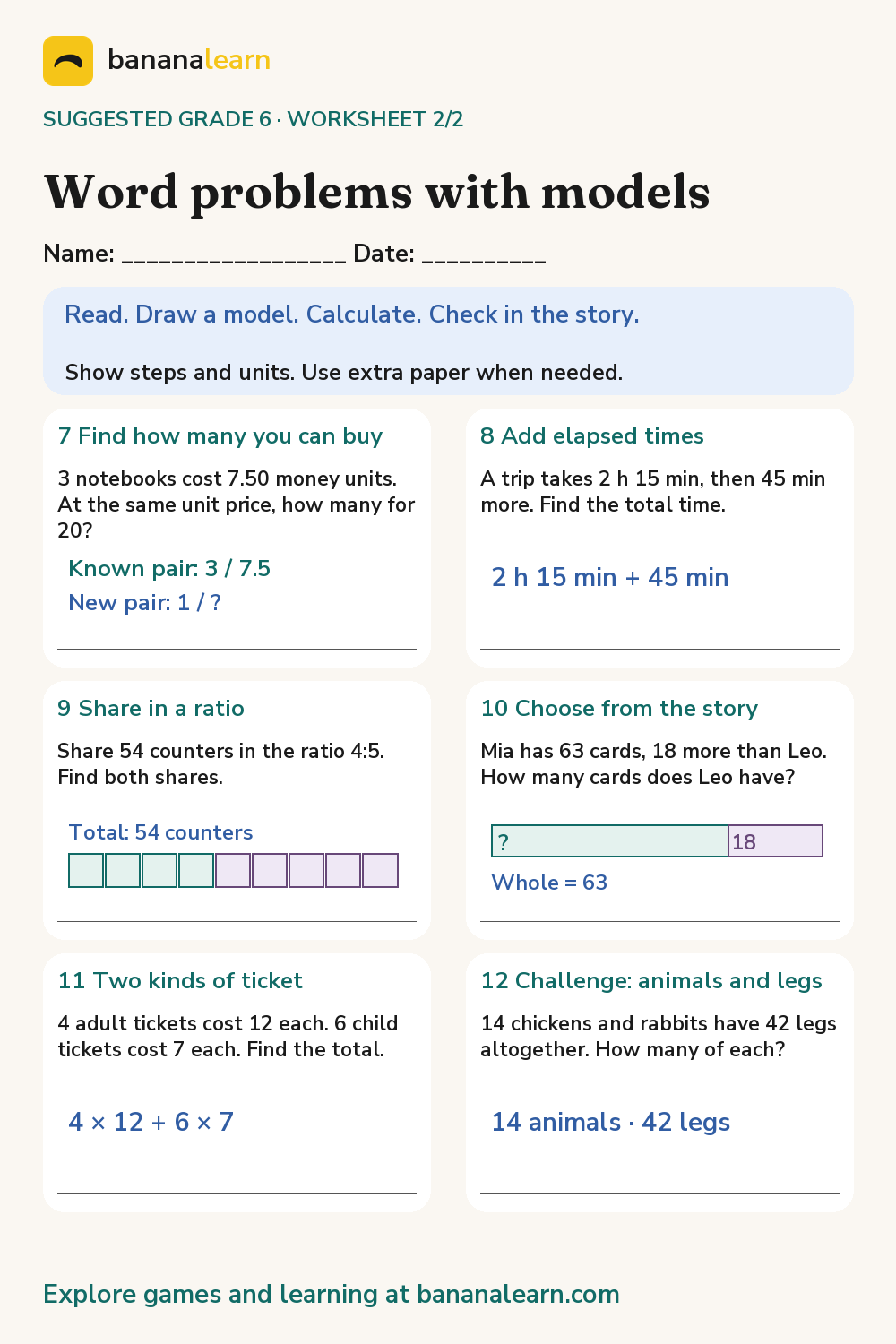
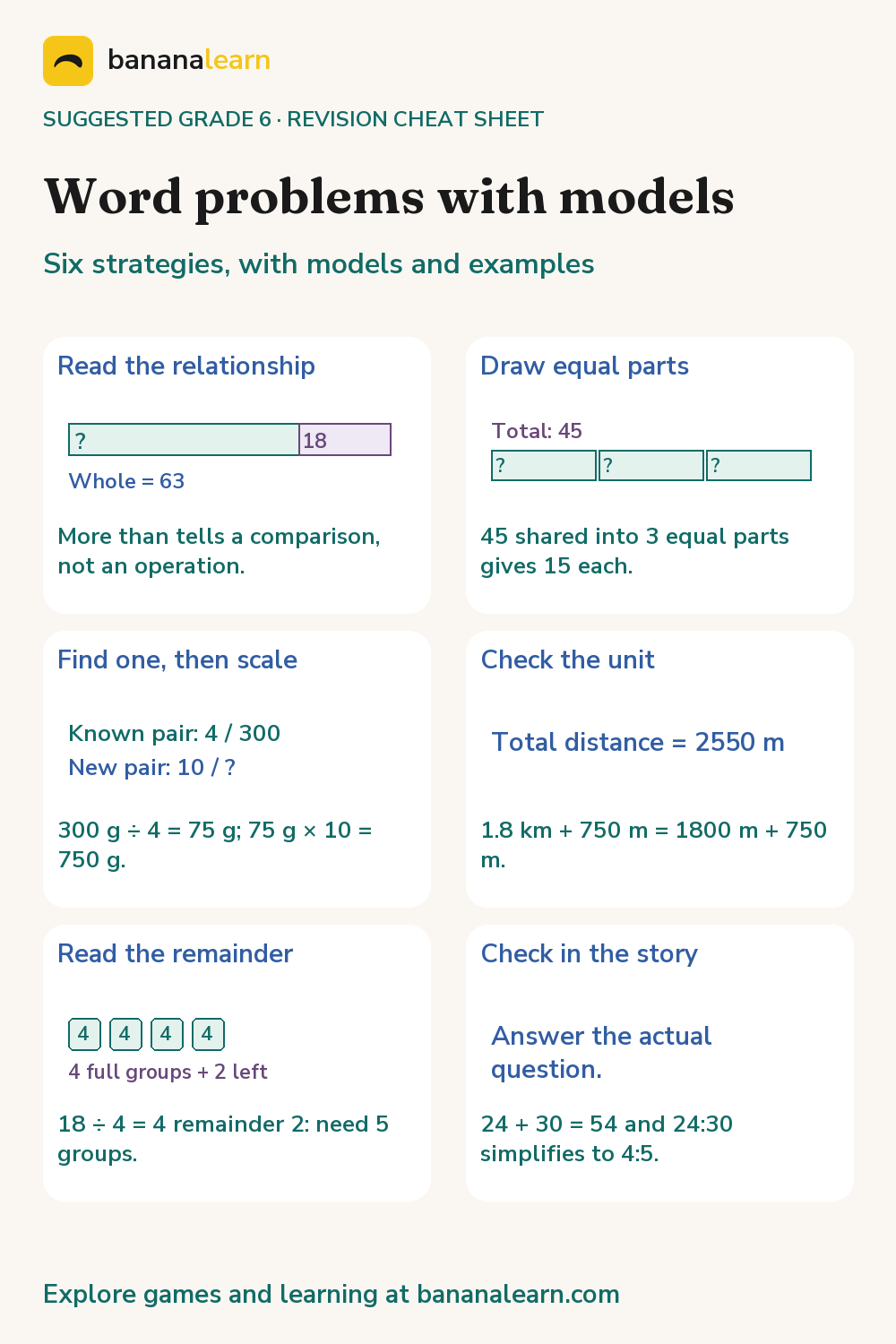
Download the complete image pack
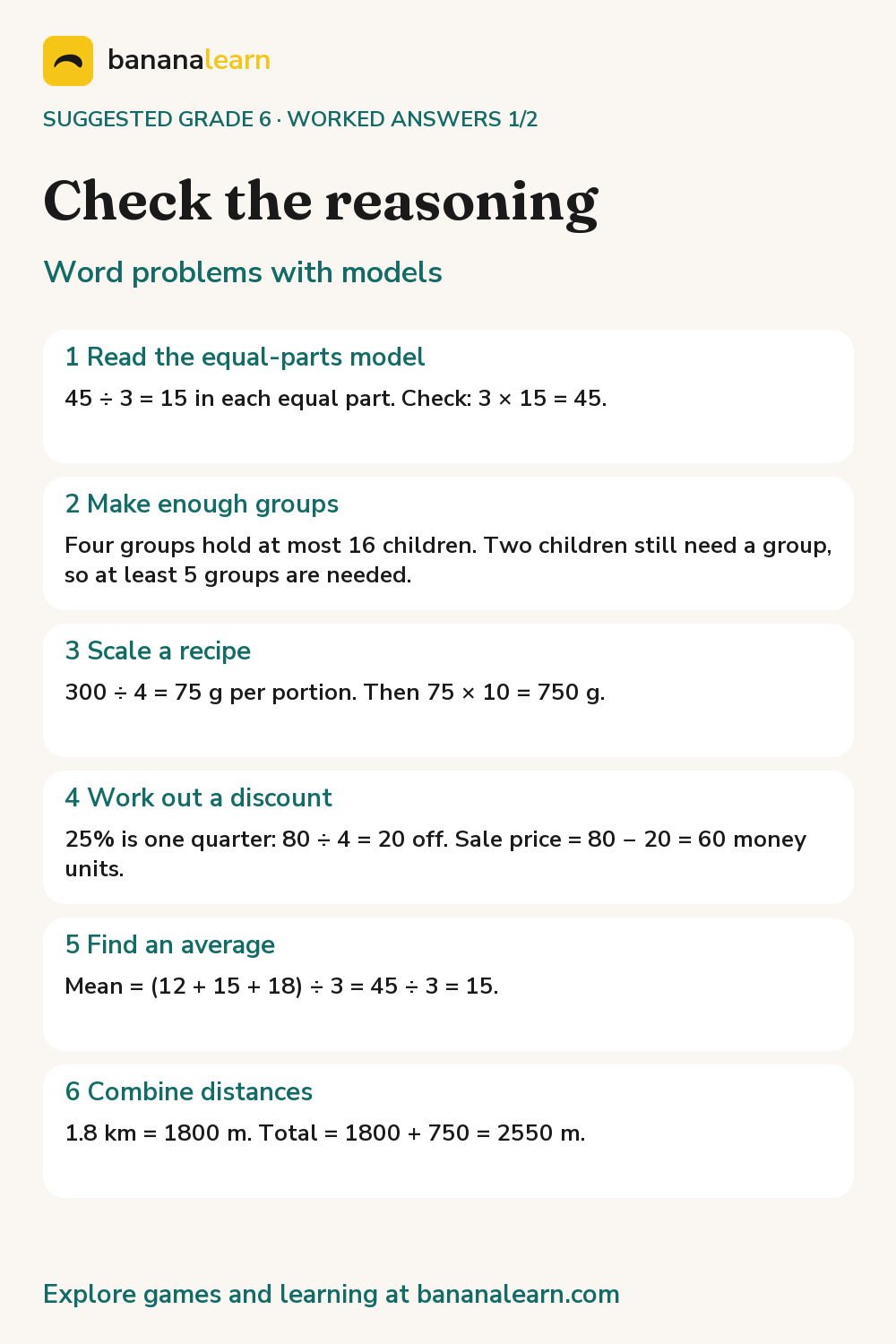
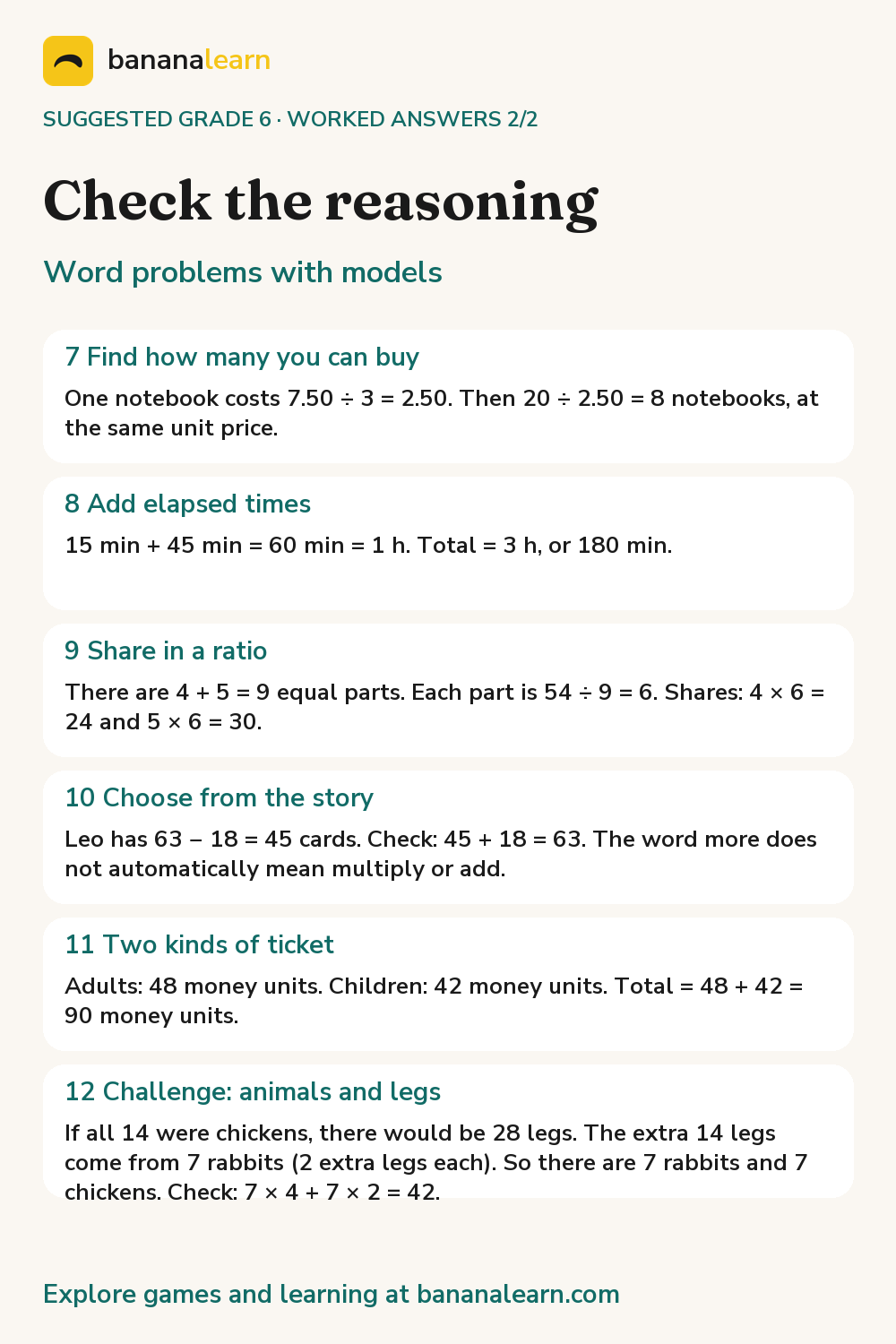
Worked answer sheets: Answers 1 · Answers 2
Open the 12 additional questions and worked solutions
Open each question after you have attempted it. Refer to the matching worksheet diagram where indicated.
1. Read the equal-parts model
A total of 45 is split into 3 equal parts. Find each part.
Model: total 45, split into 3 equal parts.
Show worked solution
45 ÷ 3 = 15 in each equal part. Check: 3 × 15 = 45.
2. Make enough groups
18 children need groups of at most 4. Find the fewest groups.
Model: arrange 18 items in groups of 4.
Show worked solution
Four groups hold at most 16 children. Two children still need a group, so at least 5 groups are needed.
3. Scale a recipe
4 portions need 300 g flour. How much for 10 equal portions?
Table: 4 corresponds to 300; find the matching amount for 10.
Show worked solution
300 ÷ 4 = 75 g per portion. Then 75 × 10 = 750 g.
4. Work out a discount
A bag costs 80 money units. It has a 25% discount. Find the sale price.
Model: total 80, split into 4 equal parts.
Show worked solution
25% is one quarter: 80 ÷ 4 = 20 off. Sale price = 80 − 20 = 60 money units.
5. Find an average
Scores are 12, 15 and 18. Find the mean score.
Shown model: 12 15 18.
Show worked solution
Mean = (12 + 15 + 18) ÷ 3 = 45 ÷ 3 = 15.
6. Combine distances
Walk 1.8 km, then 750 m. Find the total in metres.
Shown model: 1.8 km + 750 m.
Show worked solution
1.8 km = 1800 m. Total = 1800 + 750 = 2550 m.
7. Find how many you can buy
3 notebooks cost 7.50 money units. At the same unit price, how many for 20?
Table: 3 corresponds to 7.5; find the matching amount for 1.
Show worked solution
One notebook costs 7.50 ÷ 3 = 2.50. Then 20 ÷ 2.50 = 8 notebooks, at the same unit price.
8. Add elapsed times
A trip takes 2 h 15 min, then 45 min more. Find the total time.
Shown model: 135; 45.
Show worked solution
15 min + 45 min = 60 min = 1 h. Total = 3 h, or 180 min.
9. Share in a ratio
Share 54 counters in the ratio 4:5. Find both shares.
Model: 4 equal parts of one colour and 5 equal parts of another, total 54.
Show worked solution
There are 4 + 5 = 9 equal parts. Each part is 54 ÷ 9 = 6. Shares: 4 × 6 = 24 and 5 × 6 = 30.
10. Choose from the story
Mia has 63 cards, 18 more than Leo. How many cards does Leo have?
Model: the whole is 63, made up of an unknown part and 18 more.
Show worked solution
Leo has 63 − 18 = 45 cards. Check: 45 + 18 = 63. The word more does not automatically mean multiply or add.
11. Two kinds of ticket
4 adult tickets cost 12 each. 6 child tickets cost 7 each. Find the total.
Shown model: 4 × 12 + 6 × 7.
Show worked solution
Adults: 48 money units. Children: 42 money units. Total = 48 + 42 = 90 money units.
12. Challenge: animals and legs
14 chickens and rabbits have 42 legs altogether. How many of each?
Shown model: 14 animals · 42 legs.
Show worked solution
If all 14 were chickens, there would be 28 legs. The extra 14 legs come from 7 rabbits (2 extra legs each). So there are 7 rabbits and 7 chickens. Check: 7 × 4 + 7 × 2 = 42.
No registration is needed to download. Suggested grades describe readiness and are not a claim of alignment to every curriculum.
Choose related practice
Choose a game for the skill you need
Times Table Blaster practises products for equal-group calculations. Ratio Lab practises sharing and proportional relationships, including the scaling used in the recipe example. Neither replaces reading the story and identifying the unknown.
Practise multiplication facts Try Ratio LabGuest play has level, question and time limits. Sign in to continue or save progress. A game score is not a mastery assessment.
Help a learner explain the method
Help at home: Retell before calculating
Ask your child to retell a story with objects or a quick sketch. Then ask what the answer will measure. Keep the numbers small enough that arithmetic does not hide the structure.
If reading is the obstacle, read the story aloud while they draw. Then offer a similar problem to read independently; avoid turning every story into a keyword hunt.
Keep one example of your child’s own working. If the same confusion returns across fresh questions, share that attempt with their teacher and ask which next step fits their current learning.
5 worked examples with reasoning
1. Five packets hold seven stickers each. Find the total.
- There are five equal groups of seven.
- 5 × 7 = 35.
- There are 35 stickers.
2. Four shelves hold nine books each. Three books are borrowed. How many remain?
- 4 × 9 = 36 books before borrowing.
- 36 − 3 = 33.
- The question asks for books remaining, so 33 is the final answer.
3. Mina has six beads. Jo has four times as many. How many has Jo?
- Draw four equal parts, each worth six.
- 4 × 6 = 24.
- Jo has 24 beads, not ten.
4. An array has three rows of eight dots. Explain 24.
- Count eight dots in each row.
- 8 + 8 + 8 = 24, or 3 × 8 = 24.
- The result counts dots.
5. A pupil multiplies 5 × 4 for “five red balls and four blue balls”. Repair the method.
- The two quantities are different groups being combined, not five equal groups of four.
- Add 5 + 4 = 9.
- There are nine balls in total.
Save the guide or print the practice
Download to save or share
Complete guide with answers (PDF) · Worksheet without answers (PDF) · Worksheet and answer key (PDF)
Try each task before opening its answer. Give an example or reason, not only a label.
14 practice questions with explanations
Try each task before opening its answer. Give an example or reason, not only a label.
Write an answer and your reason before opening the explanation. Check the reasoning as well as the final answer.
- Groups
Six bags contain four apples each. Find the total.
Answer and reasoning
24 apples.
6 × 4 = 24.
- Groups
Eight boxes contain three crayons each. How many crayons altogether?
Answer and reasoning
24 crayons.
8 × 3 = 24.
- Array
There are seven rows of five chairs. How many chairs?
Answer and reasoning
35 chairs.
Multiply rows by chairs per row.
- Compare
Sam has five cards. Lee has twice as many. How many cards does Lee have?
Answer and reasoning
10 cards.
Twice as many means two groups of five.
- Contrast
Sam has five cards. Lee has two more. How many cards does Lee have?
Answer and reasoning
7 cards.
More by two describes addition.
- Two steps
Three packs contain eight stickers each. Four are given away. How many stickers remain?
Answer and reasoning
20 stickers remain.
3 × 8 = 24; 24 − 4 = 20.
- Units
What unit belongs to 4 trays × 6 muffins per tray?
Answer and reasoning
Muffins.
The product counts the objects on the trays.
- Check
Check 6 × 9 using tens.
Answer and reasoning
60 − 6 = 54.
Take one away from each of six groups of ten.
- Equal groups
Can 3, 5 and 7 be described as three equal groups of five without rearranging?
Answer and reasoning
No.
The original groups have different sizes.
- Create
Write a story for 4 × 7.
Answer and reasoning
For example: Four shelves hold seven books each; there are 28 books.
Other equal-group stories are valid.
- Missing factor
Four equal packs contain 28 pens. How many per pack?
Answer and reasoning
7 pens.
28 ÷ 4 = 7; check 4 × 7.
- Reason
Why are 4 × 6 and 6 × 4 equal but their tray pictures different?
Answer and reasoning
They have the same total with different groupings.
The factors can be exchanged without changing the product.
- Select
Five cups and six plates: how many items altogether?
Answer and reasoning
11 items.
Combine two amounts with addition.
- Zero
Three empty trays each contain zero muffins. How many muffins altogether?
Answer and reasoning
0 muffins.
3 × 0 = 0.
Use the ideas without looking at the notes
Draw one equal-group story, one “times as many” story and one addition story. Explain the relationship before calculating. Check the answer’s unit.
Common questions
Should I multiply whenever a story says altogether?
No. Altogether can ask for a sum or a product. Look for the relationship.
Why draw groups?
The model shows the two factors and what the answer counts.
Can I reverse the factors?
The product stays the same, but explain the original story’s quantities.
What if the groups are unequal?
Use addition or explain a valid regrouping before multiplying.
How do I check a two-step problem?
Label the meaning and unit of each intermediate result, then reread the question.
Connect your learning
Ask about guided Maths learning if your child needs help explaining these ideas.
About this guide
Original explanations, examples, diagrams and practice by BananaLearn. The grade label indicates the intended learning level; this is not an official textbook extract or exam paper.