1. Solve the readers puzzle.
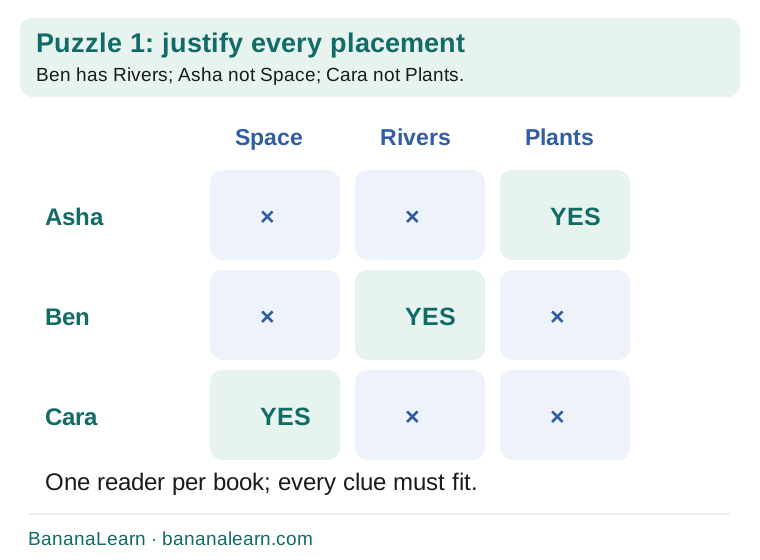
- Place Ben–Rivers. Asha and Cara must take Space and Plants.
- Asha cannot take Space, so Asha–Plants and Cara–Space.
- All three clues hold and no alternative remains.
Maths · Suggested Classes 5–8
A puzzle can have a neat-looking answer and still lack enough clues. These three challenges ask you to show what must be true—and notice when more than one solution survives.
Start here
World Logic Day is 14 January 2027. Try three original constraint puzzles, including one deliberately underdetermined case, with worked explanations and a puzzle-making record.
Original BananaLearn guide · 7 November 2026
On a narrow screen, swipe the diagram or open it full size.
UNESCO’s World Logic Day is observed on 14 January, so the 2027 date is 14 January 2027. This independent activity supplies original puzzles rather than an official programme or theme.
Allow about 25–40 minutes. Use paper grids or list possible assignments. A correct solution satisfies every clue; a unique solution also requires showing that no other assignment survives.
Asha, Ben and Cara each borrow one different book: Space, Rivers and Plants. Asha does not borrow Space. Ben borrows Rivers. Cara does not borrow Plants. Who borrows each book?
Make a three-by-three grid and mark Ben–Rivers first. A used book cannot be assigned to someone else. Apply each negative clue to eliminate possibilities before filling the remaining squares.
Ben has Rivers, leaving Space and Plants for Asha and Cara. Asha cannot have Space, so Asha has Plants and Cara has Space. Cara’s not-Plants clue is consistent with the result.
For this small puzzle, the Ben clue and Asha clue already determine the assignment. The extra Cara clue checks consistency but is redundant. Redundant does not mean false; it means the clue is not needed for uniqueness here.
On a narrow screen, swipe the diagram or open it full size.
Art, Coding and Music each have one different starting slot: 9 am,10 am and 11 am. Coding starts later than Art. Music starts at 10 am. Determine the timetable.
Music occupies the middle slot. The other two slots are 9 and 11, and the order clue forces Art to 9 and Coding to 11. The words later than compare order; they do not mean immediately after in every puzzle.
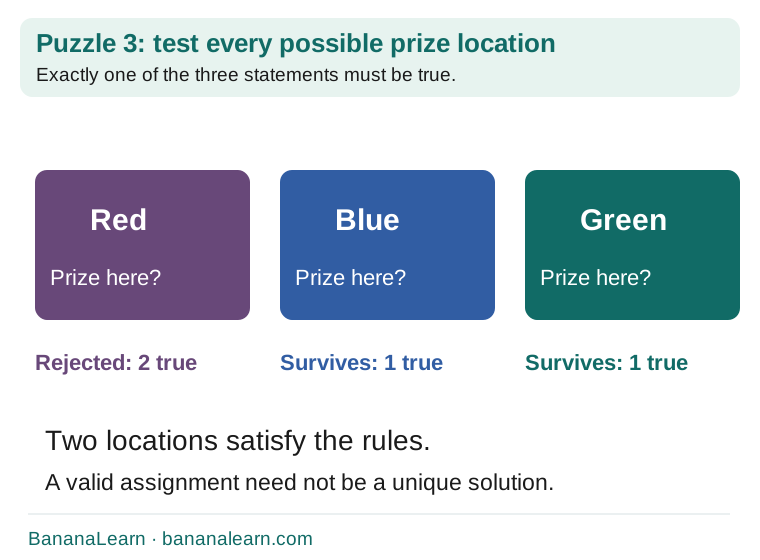
There are Red, Blue and Green boxes, exactly one of which contains a prize. Red’s statement says “The prize is in Blue.” Blue’s says “The prize is not in Blue.” Green’s says “The prize is in Red.” Exactly one statement is true. Can you locate the prize uniquely?
Test each possible location rather than trusting the colour of a box or assuming every puzzle has one answer. Count the true statements in each case.
If the prize is in Red, the truth counts are false,true,true: two true statements, so reject it. If it is in Blue, the counts are true,false,false: one true, so keep it. If it is in Green, they are false,true,false: one true, so keep it.
Both Blue and Green satisfy the clues. There is no unique location. Adding the clue “The prize is not in Green” would make Blue unique. The important answer is the surviving possibilities and the reasoning, not a forced guess.
Choose a small set of items and slots. Write an intended assignment, then supply clues. List all possible assignments or test them systematically to check uniqueness. Give the puzzle to a reader without revealing your answer.
If two answers survive, add a discriminating clue. If none survives, a clue may contradict another. Do not fix either problem by simply declaring your intended answer correct.
For every filled grid square, write the clue or elimination that justifies it. For the box puzzle, use a table of candidate location and truth count. A completed grid without explanations hides lucky guesses.
For parent support, ask “which clue rules that out?” rather than giving the next placement. An extension can ask which clues are redundant or how removing a clue changes the number of solutions.
See the reasoning
Try, explain, check
Try each task before opening its explanation. These are original BananaLearn questions, not official exam or past-paper questions. Where several answers can work, the explanation gives the criteria.
14 January 2027
It is UNESCO’s annual 14 January observance.
Ben
The clue states it directly.
Asha
Ben uses Rivers and Asha cannot have Space.
Cara does not have Plants
The same unique solution follows without it.
10 am
It is explicitly fixed.
11 am
Music uses 10 and Coding must be later than Art.
No
It specifies an order unless a clue adds adjacency.
2
Blue’s and Green’s statements are true.
Blue and Green
Each gives exactly one true statement.
The prize is not in Green
It removes the other surviving location.
The clues may be inconsistent
Check for a contradiction or a mistaken interpretation.
No
You must exclude the alternatives too.
Copy these headings and fill them for one worked task, then for a fresh attempt. Use your own evidence rather than copying the model answer.
Explore BananaLearn’s games, learning features and one-to-one tutoring. Maths is our priority; English and Science tutoring are also available. Bring a recent example of schoolwork when checking teaching fit.
Original BananaLearn explanations, examples, illustrations and practice. Source facts checked 7 November 2026. Suggested levels are learning guides, not a claim that every board or textbook uses the same sequence.
Event timing is calendar-backed. Search demand is a forecast unless a separately measured trend is stated. No official event theme, school programme or affiliation is implied.
How we prepare guides · Report a correction
Share the complete guide: https://bananalearn.com/learn/world-logic-day-2027-grid-puzzles.html