Learning · Suggested ages 10–14 · family or classroom activity
World Braille Day 2027: Six-Dot Patterns & Access Activity
Six positions, each either raised or unraised: how many different patterns can you make? For World Braille Day, investigate the mathematics—and ask who can actually read the information you share.
Original BananaLearn guide · 7 November 2026
On a phone, swipe across the illustration to read every label.
When is World Braille Day 2027?
World Braille Day is observed on 4 January each year, so the 2027 observance falls on 4 January 2027. The United Nations established the annual day to recognise Braille and access to communication. This guide prepares an independent learning activity; it is not an official UN event pack.
As of 7 November 2026, this page does not announce an official 2027 theme. Use the source links to check future announcements before adding a theme to a school display. The date is confirmed by the annual observance; increased search interest is a forecast, not a measured trend or a promise that this topic will attract traffic.
What Braille is, and what this activity teaches
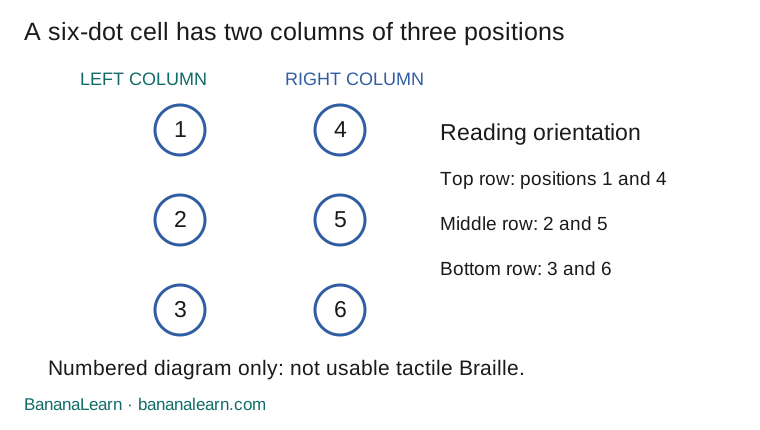
Braille represents written information using patterns of raised dots read through touch. It is used by blind and partially sighted readers. A basic six-dot cell has two columns with three positions in each. In reading orientation, the left column is numbered 1, 2, 3 from top to bottom; the right is 4, 5, 6.
Here you will name dot positions, organise possible patterns and improve an everyday classroom message. The generic patterns in the maths task are not presented as letters, words or a complete Braille code. Reading and writing real Braille requires the appropriate code, conventions and instruction. Ordinary printed dots are a visual diagram, not accessible tactile text.
Materials, preparation and a 35-minute plan
Use paper, a pencil, six large circles arranged in two columns and two marks for each position: filled for selected, empty for unselected. Learners can say dot numbers aloud or use a large-print record. Optional removable raised markers can demonstrate positions if suitable for the group; these oversized models are not standard reading Braille. Avoid small loose objects around younger children.
Spend 5 minutes on the purpose and dot order, 10 on the pattern investigation, 5 on explaining the count, 10 on the access redesign and 5 sharing a checkable improvement. Choose a fictional notice rather than collecting a pupil’s disability or personal information. Invite learners to choose a visual, verbal or supported tactile way to participate; do not make eye-covering or simulated blindness part of the activity.
On a phone, swipe across the illustration to read every label.
Round 1: make the same pattern from precise instructions
One learner describes “dots 1 and 4 selected; all other positions unselected”. A partner marks the cell and reads back the selected positions. Compare with “dots 1 and 2”. Both patterns have two selected dots, but the first occupies the top row and the second the upper two positions in the left column. Position, not just the total, distinguishes a pattern.
Try dots {2,5,6}, then {1,3,4}. In the first pattern the middle row is selected on both sides, plus the bottom-right position. In the second, the top row is selected on both sides, plus bottom-left. If two records disagree, check whether the error is the numbering order or the selected positions. Keep the viewing orientation fixed.
Round 2: count three positions before counting six
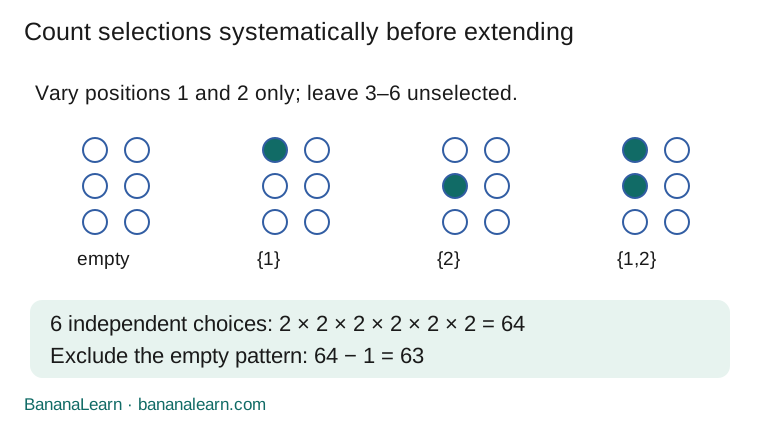
First allow just positions 1 and 2 to vary; leave every other position unselected. The four possibilities are {}, {1}, {2}, {1,2}, where {} denotes the empty selection. Now allow position 3 to vary as well. Each of those four patterns has two versions: without dot 3 or with dot 3. That makes eight patterns for three positions.
Write them systematically: {}, {1}, {2}, {1,2}, {3}, {1,3}, {2,3}, {1,2,3}. A methodical list helps catch duplicates. An empty pattern still counts when the question is “all selections”, just as zero items is one possible count. If a later question excludes the empty pattern, remove exactly one possibility.
Round 3: extend the count to a six-dot cell
Every one of six positions has two possible states. Therefore the number of all possible patterns is 2×2×2×2×2×2=64. If at least one dot must be selected, subtract the one completely empty pattern: 64−1=63. These are mathematical counts of selections, not a claim that all patterns are alphabet letters.
A helpful second route treats each column separately. The left column has 8 possible selections and so does the right. Each left selection can be paired with each right selection: 8×8=64. RNIB describes the six-dot arrangement and 63 non-empty combinations. Actual Braille symbols and meaning depend on code and context, so this counting result is only an introduction to the representation.
Challenge: exactly two selected dots
To choose exactly two of six positions, start by picking a first position in 6 ways and a different second position in 5 ways. That gives 30 ordered choices. But choosing 1 then 4 makes the same pattern as choosing 4 then 1. Each unordered pair has been counted twice, so there are 30÷2=15 patterns.
Check by fixing the smaller dot number: dot 1 pairs with 2,3,4,5,6 (5 patterns); dot 2 pairs with 3,4,5,6 (4); then 3, 2 and 1 further pairs. The total is 5+4+3+2+1=15. The two counting methods provide an independent check without needing combination notation.
Why mirroring can change the message
A vertical mirror exchanges 1↔4, 2↔5 and 3↔6. Thus {1,2} mirrors to {4,5}; it does not stay the same merely because two dots remain selected. In reading orientation, preserving positions matters. Writing with particular Braille tools may involve other conventions; this activity does not teach those production methods.
For a mathematical extension, a pattern unchanged by that vertical mirror must select both positions or neither in each left-right pair. There are three such pairs, each with two choices, so 2×2×2=8 symmetric patterns including the empty one, or 7 excluding it. This is a symmetry investigation, not a rule for deciding whether a pattern is a valid Braille symbol.
Turn awareness into one useful access improvement
Use this fictional notice: “Garden club meets in Room 6 at 3:15 pm on Tuesday. Bring a notebook. Ask the school office about joining.” Imagine it exists only as a photograph with tiny decorative lettering. Identify what a learner needs to find: the activity, place, day, time, preparation and contact route.
Rewrite it as selectable text with a clear heading and a short list. Read it aloud in a recording if that format is useful, while keeping an equivalent text version. A large-print version or professionally prepared Braille may also be appropriate for particular readers. Ask the intended reader which format works rather than assuming one format serves everyone. An awareness activity is not an accessibility audit or certification.
A completed example and a redesign record
A clearer text version is: “Garden club. When: Tuesday, 3:15 pm. Where: Room 6. Bring: a notebook. Joining information: school office.” This keeps the original details and groups them by task. It still needs a real date if there is any ambiguity about which Tuesday; the fictional notice did not supply one, so do not invent it.
Record one actual barrier, one proposed change and a way to check it. For example: barrier—time appears only inside an image; change—put the time in selectable text below the image; check—ask a reviewer to locate it using their preferred reading setup. “Add a picture of Braille” does not address that barrier. Preserve the meaning while changing the format.
Adapt the activity without lowering the thinking
For learners beginning systematic counting, use two or three positions and list every selection before introducing six. For learners ready for an extension, count symmetric patterns or patterns with exactly two selected dots. Let partners explain through speech, a list, a diagram or another suitable format. The aim is an argument another person can check, not fast visual copying.
If a child needs real Braille teaching or accessible course materials, consult their school and a qualified vision-education professional; a dot-pattern game is not a substitute. Keep the celebration centred on communication and participation. End by sharing the improved fictional message and the reasoning behind one format choice, rather than testing whether sighted learners can imitate reading by touch.
One-message access redesign sheet
Copy this record into a notebook. Fill each blank using your own example or the activity above.
On a phone, swipe across a wide table to see every column.
| Record | Write your decision |
|---|---|
| Message and intended reader | Fictional message ___; intended use ___ |
| Information needed | Activity ___; place ___; date/time ___ |
| Observed barrier | What is hard to obtain? ___ |
| Change | Equivalent text / chosen format ___ |
| Check and remaining gaps | Reviewer task ___; result ___; missing detail ___ |
14 questions with explained answers
Try each question first. Open the explanation to check your reasoning. These are original BananaLearn questions, not official exam questions.
What date is World Braille Day 2027?
Check answer and reasoning
4 January 2027
The UN observance is on 4 January each year. No official 2027 theme is asserted here.In the reading-orientation six-dot model, which numbers form the right column?
Check answer and reasoning
4, 5 and 6 from top to bottom
The left column is 1,2,3. The numbering does not run across rows.Which selected positions form the top row?
Check answer and reasoning
{1,4}
Position 1 is top-left and 4 is top-right.Are {1,2} and {1,4} the same pattern because each has two dots?
Check answer and reasoning
No
Their dot counts match, but their positions differ.How many patterns can two independent on/off positions make, including empty?
Check answer and reasoning
4
List {}, {1}, {2} and {1,2}; or calculate 2×2.How many patterns can three positions make, including empty?
Check answer and reasoning
8
Each of the four two-position patterns has two versions depending on the third position.How many six-position patterns are non-empty?
Check answer and reasoning
63
There are 2⁶=64 total selections and exactly one is empty.How many patterns have exactly one selected position?
Check answer and reasoning
6
Choose the selected position in six ways. The remaining five are unselected.How many patterns have exactly two selected positions?
Check answer and reasoning
15
There are 6×5 ordered choices, but each pair is counted twice; divide by 2.What is the vertical mirror of {1,3,5}?
Check answer and reasoning
{2,4,6}
Use 1↔4, 3↔6 and 5↔2, then list the resulting positions in order.How many six-position patterns are unchanged by a vertical mirror, including empty?
Check answer and reasoning
8
Each of the three left-right pairs is either both selected or both unselected: 2³.Does printing an enlarged dot pattern make a notice readable as tactile Braille?
Check answer and reasoning
No
Flat ink is a visual representation. Usable Braille needs the correct raised representation and code conventions.A fictional notice says Tuesday, but gives no date. Should the rewritten version invent one?
Check answer and reasoning
No
Keep the known details and ask for the missing date before publishing a real notice.A time is available only inside a photo. Name one improvement and one check.
Check answer and reasoning
Add the same time as selectable text; ask a reviewer to locate it using their preferred reading setup
The change addresses the observed barrier. It is a useful check, not proof that every access need is solved.
Choose your next learning step
- Extend the accessibility design activity
- Organise outcomes in a sample space
- Check reflection and lines of symmetry
- Explore BananaLearn’s learning games
Explore BananaLearn games, learning resources and tutoring. Maths is our priority; English and Science tutoring are also available. Share your current schoolwork when checking teaching fit.
Sources and scope
Explanations, activities, diagrams and practice are original BananaLearn work. Class labels suggest a learning level; school sequences and current textbook editions can differ. Sources checked 7 November 2026.
- UN General Assembly resolution: 4 January annual observance
- RNIB: Braille and the six-dot arrangement
How we prepare guides · Report a correction
Share the complete guide: https://bananalearn.com/learn/world-braille-day-2027-six-dot-patterns.html