Read the requested quantity
If 5x + 7 = 32, then 5x = 25 and x = 5. If the question asks for 2x, the response is 10.
Underline the requested expression before calculating. The final check is whether the answer responds to that request.
One-to-one online tutoring
A lower SAT Math result can hide very different problems: an unfamiliar concept, a missed condition or a method that takes too long. Start with the pattern in the errors, then choose the practice.
BananaLearn offers one-to-one SAT Math tutoring for the US college-admissions SAT. Support combines mathematical understanding, question interpretation, method choice and timed practice matched to the student’s starting point and intended test date.
On a phone, swipe across the illustration to read every label.
College Board currently specifies 44 Math questions in 70 minutes, divided into two 35-minute modules. The test uses multistage adaptation: performance in the first module influences the second module. Questions include multiple choice and student-produced responses.
Use the official SAT site and Bluebook for the current testing experience. The original examples on this page demonstrate reasoning; they are not official SAT questions or a full-length adaptive simulation.
Preparation should address Algebra, Advanced Math, Problem-Solving and Data Analysis, and Geometry and Trigonometry. The first two include linear and nonlinear relationships; the others require interpreting quantitative information and geometric relationships.
Use a recent official practice result to identify priorities within those domains. A broad domain label alone does not explain whether the student misread a condition, selected the wrong model or made an arithmetic error.
Take an official practice test under appropriate conditions, then review the work as well as the score. Record the skill, chosen method, time pressure and reason for each correction. Keep guesses and interrupted attempts visible in the record.
An untimed correct answer and a rushed incorrect answer suggest a different next step from a question that remains confusing without a time limit. Neither observation alone predicts a future score.
Compare algebraic manipulation, a graph, a table and substitution where appropriate. A shorter method is useful when its assumptions are clear and its output is interpreted correctly.
Technology can support a graph or calculation, but the student still needs to know which equation to enter and what the intersection or root means. Practise the actual permitted test tools using official guidance.
After reviewing a missed question, explain the underlying idea and solve a fresh question with a changed structure or context. Return to the skill later. Copying a solution immediately after reading it gives limited evidence of retention.
Track conditions such as positive values, integer restrictions, units and the exact requested quantity. Finding x when the question asks for 2x can produce a mathematically sound intermediate result and an incorrect response.
Begin by making the reasoning reliable, then practise appropriate timed sets and full official modules. Review where time went: reading, setup, calculation, checking or revisiting an uncertain response.
A 70-minute section average is not a fixed allowance for every question. Allocate time flexibly and practise decisions about returning to a difficult item within the test interface’s rules.
Share the planned test sitting, school commitments and time available for independent practice. Choose a review point before the test so there is time to adjust priorities. Confirm registration and device requirements through College Board.
An illustrative sequence is baseline review, focused skill repair, mixed application and official timed practice. The length of each phase depends on the student; the sequence is not a guaranteed-score package.
Tell us the intended test date, current Math practice result if available, difficult domains and preferred local lesson times. A few described errors are useful even if no practice score is available yet.
Discuss the starting skill, independent practice and progress review. BananaLearn is an independent tutoring provider; registration, official test rules and score reporting are handled by College Board.
If 5x + 7 = 32, then 5x = 25 and x = 5. If the question asks for 2x, the response is 10.
Underline the requested expression before calculating. The final check is whether the answer responds to that request.
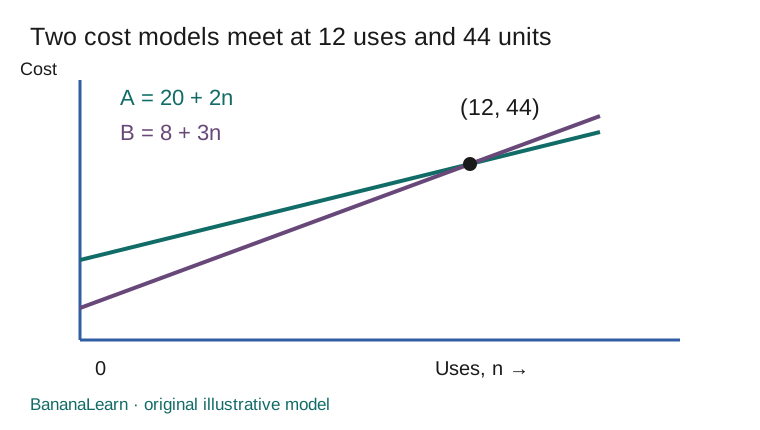
Fictional plan A costs 20 + 2n and plan B costs 8 + 3n. Equality gives n = 12 and a cost of 44. For 10 uses, A = 40 and B = 38; for 15, A = 50 and B = 53.
The crossover is useful only with the stated cost model. Units, fixed charges and the allowed values of n matter.
A value of 80 increases by 25% to 100. Reducing 100 back to 80 is a 20% decrease, because the reference amount is now 100.
The absolute change is 20 in both directions, but the percentage bases differ.
These original questions illustrate reasoning. They are not an official exam paper or a placement score.
8. Add 3 to both sides to get 4x = 24, then divide by 4: x = 6. The requested quantity is x + 2, so the response is 8.
36. Convert 15% to 0.15, then calculate 0.15 × 240 = 36. Alternatively, add 10% (24) and 5% (12).
y = 2x + 5. In y = mx + b, m is the slope and b is the y-intercept.
x = −3 or x = 3. Factorise x² − 9 as (x − 3)(x + 3); either factor can be zero. Both values square to 9.
10, from the square root of 36 + 64.
20%, using the original value 50 as the base.
No. This page concerns the College Board SAT used in US college admissions. Our separate Year 6 SATs guide concerns England’s primary assessments.
The worked examples and quick checks here are original BananaLearn material. Official full-length practice is linked through College Board.
Yes. Tell us the school Maths background and intended test date, then discuss a suitable baseline and learning priorities.
A target can guide preparation, but a result depends on the student and test performance. Discuss a plan and measurable practice evidence rather than a guaranteed outcome.
Original BananaLearn explanations and practice. Official curriculum and assessment information checked 2 November 2026.
Share the student’s class or course, current topic, country/time zone and preferred lesson windows. For an exam course, include the intended assessment date or year. We will discuss teaching priorities and availability.
Review current pricing and confirm the class arrangements before booking. You can also use the trial-lesson checklist to prepare questions.