Maths · Suggested Grade 4–9
National Mathematics Day 2026: Four Explain-and-Try Stations
A good Maths Day station gives a visitor something to discover and explain. Try a growing square, count routes, investigate coins or uncover two different ways to make 1729.
Original explanations and practice by BananaLearn · Published 31 October 2026
On a small screen, swipe across the illustration to read every label.
The date and the purpose of this pack
India celebrates National Mathematics Day on 22 December, honouring Srinivasa Ramanujan’s birth anniversary. A current ICTS–TIFR teacher event also describes preparing hands-on school mathematics activities for the occasion. This page was checked on 31 October 2026. Our stations are original BananaLearn activities, not an official event booking or a prescribed 2026 theme.
The four stations have different entry points. Growing squares and coin combinations suit many upper-primary learners; the cube connection suits learners who understand powers. Use a station to invite explanation, not to rank children by how quickly they know a surprising fact.
Plan a manageable rotation
Prepare squared paper, pencil, number cards and a simple answer flap for each station. Use paper tokens rather than real coins with younger children, and keep small parts supervised. Allow roughly five to eight minutes per station as a planning estimate, then adjust to the group rather than rushing an unfinished explanation.
Each station card should show the question, permitted moves, a starter example and a way to check. Ask the host to give a hint before revealing an answer. A visitor record can contain one drawing and one sentence explaining a discovery, so participation means more than collecting four ticks.
Station 1: build squares from odd-number borders
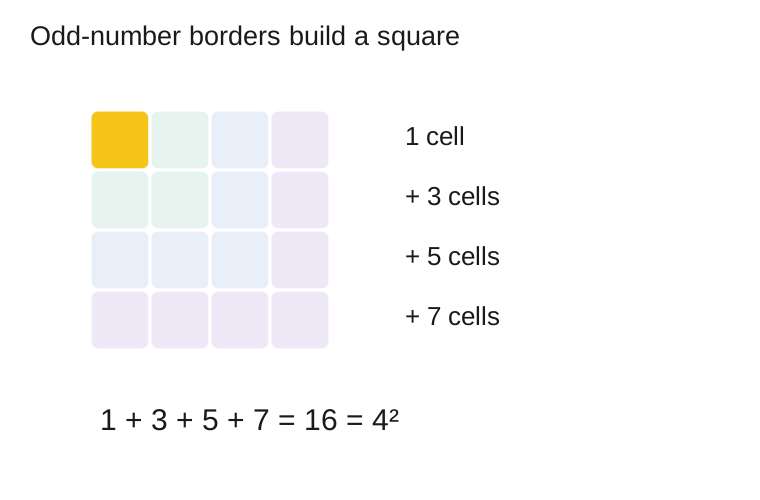
Draw a 1-by-1 square. Add three cells around it to make a 2-by-2 square, then five more to make 3-by-3, then seven to make 4-by-4. The totals are 1, 4, 9 and 16. The added L-shaped border explains 1 + 3 + 5 + 7 = 16.
Challenge: how many new cells make the next square? The answer is 9, making a total of 25. In general, moving from an n-by-n square to an (n+1)-by-(n+1) square adds 2n + 1 cells. Younger learners can count the drawing; older learners can expand (n+1)² − n² to explain the same pattern.
Station 2: make six with one-unit and two-unit tokens
Find combinations of one-unit and two-unit tokens totalling 6. Ignore order: a two-unit token followed by four one-unit tokens is the same combination as placing those one-unit tokens first. Organise by the number of twos: 0, 1, 2 or 3. The matching numbers of ones are 6, 4, 2 and 0, so there are four combinations.
The organising rule proves the list is complete: more than three twos would exceed 6, and for each allowed number of twos the number of ones is fixed. Extend to a total of 10, giving six combinations. If you decide to count different orders instead, announce that it is a different question and use a separate method.
Station 3: count short grid routes
On a 2-by-2 grid of squares, travel from the bottom-left corner to the top-right corner along grid lines. Allow only two east steps and two north steps, with no diagonal or backward move. The six routes can be recorded EENN, ENEN, ENNE, NEEN, NENE and NNEE.
A systematic record prevents drawing the same route twice. For a younger visitor, trace routes in different colours. For an extension, explain why choosing the two north positions among four moves gives six possibilities. Do not say there are only two routes because the destination is two squares away in each direction.
Station 4: investigate 1729 with cubes
Compute 1³ + 12³ = 1 + 1,728 = 1,729 and 9³ + 10³ = 729 + 1,000 = 1,729. These are two different pairs of positive cubes with the same sum, a famous connection with Ramanujan. The reversal 12³ + 1³ is the same pair and does not count as a third way.
Finding two pairs does not by itself prove that 1,729 is the smallest number with this property. To investigate that extra claim, list cubes from 1³ to 12³, generate unordered pairs and look for repeated sums. A computer or organised table can help, but the visitor should first explain the two equalities and what different ways means.
Help visitors explain rather than memorise
Use hints that reveal structure: what changes around the square, how can we order the coin list, which letter sequences have already been counted, and why does swapping two cubes not create a new pair? Let the visitor try a smaller case when the original task is too hard.
Finish with one changed question and an explanation. The linked target-number game can extend expression-building after the stations; it is a different activity, not proof that playing automatically improves a score. Parents and teachers can save the record sheet in the page or share the guide with the station hosts.
A station visitor record
Copy the record into a notebook or use it to organise your own answer. Blank spaces are for your work.
| Station | My drawing or organised list | What I discovered | A changed question |
|---|---|---|---|
| Growing squares | ___ | ___ | ___ |
| Coin combinations | ___ | ___ | ___ |
| Grid routes | ___ | ___ | ___ |
| 1729 and cubes | ___ | ___ | ___ |
10 questions with explained answers
Try the questions before opening the answers. Explain the reason, then try a changed example to check your understanding.
When is National Mathematics Day in India?
Show answer and explanation
22 December
It honours Srinivasa Ramanujan’s birth anniversary.Complete 1 + 3 + 5 + 7.
Show answer and explanation
16
The four odd-number borders make a 4-by-4 square.How many cells turn a 4-by-4 square into 5-by-5?
Show answer and explanation
9
25 − 16 = 9.How many unordered combinations of 1s and 2s total 6?
Show answer and explanation
4
Use 0, 1, 2 or 3 two-unit tokens.How many such combinations total 10?
Show answer and explanation
6
The number of twos can be 0 through 5.How many north/east routes cross a 2-by-2 square grid?
Show answer and explanation
6
Choose the two north positions among four moves or list all six sequences.Is NNEE a different route from EENN?
Show answer and explanation
Yes
Their ordered step sequences differ.Find 9³ + 10³.
Show answer and explanation
1,729
729 + 1,000 = 1,729.Does swapping 1³ and 12³ create another unordered pair?
Show answer and explanation
No
Addition order changes, but the pair does not.Does finding two cube pairs alone prove smallestness?
Show answer and explanation
No
A smallestness claim needs checking all relevant smaller possibilities.
Keep the ideas connected
- Explain a growing pattern
- Review powers and roots
- Count outcomes systematically
- Explore target-number expressions
For help with a school-learning difficulty, bring one attempted question to a discussion about tutoring and curriculum fit. Maths is our priority; English and Science tutoring are also available.
Sources, scope and sharing
The examples, diagrams and practice are original BananaLearn work. Grade labels suggest a learning level; teaching sequences and school requirements can differ. Official sources below support the stated facts and resource links. These activities are independent resources, not official exam questions or endorsed campaign materials.
- ICTS–TIFR: Mathematics Day activity preparation
- Mathematical research reference: taxicab-number definition
How we prepare learning guides · Report a correction
Share this guide: https://bananalearn.com/learn/national-mathematics-day-2026-school-activities.html