1. Evaluate log₅(1/125).
- 125=5³, so 1/125=5⁻³.
- The required exponent is −3.
- Check: 5⁻³=1/125, a positive allowed argument.
Maths · Algebra / Precalculus · suggested level; school sequences vary
“How many times do I multiply by 3 to reach 81?” The answer is an exponent. A logarithm gives that question a compact name.
Start here
log_b(a)=c means b^c=a. For real logarithms, b>0, b≠1 and a>0. Rules follow from the laws of exponents.
Original BananaLearn guide · 7 November 2026
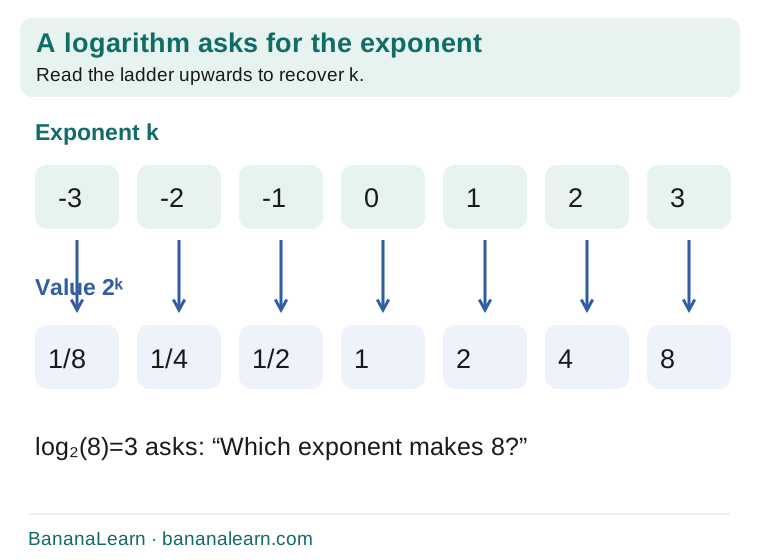
On a narrow screen, swipe the diagram or open it full size.
In log₃81=4, 3 is the base, 81 is the argument and 4 is the exponent needed to reach it. Read the equation back as 3⁴=81. The logarithm is not “81 divided by 3”.
The base must be positive and different from 1. Real logarithms accept positive arguments. Zero and negative arguments are not allowed in this real-number lesson.
Since b⁰=1, log_b(1)=0. Since 2⁻³=1/8, log₂(1/8)=−3. A negative logarithm value is possible even though its argument must be positive.
For bases greater than 1, arguments between 0 and 1 produce negative logarithms. For bases between 0 and 1, the graph decreases; do not apply every increasing-base intuition to that case.
If A=bᵐ and B=bⁿ with positive A and B, then AB=bᵐ⁺ⁿ. Thus log_b(AB)=log_b(A)+log_b(B). The product inside becomes addition of exponents outside.
For base 2, 8×4=32, and log₂32=5=3+2. Both logarithms must use the same base. This rule does not say log_b(A+B)=log_b(A)+log_b(B).
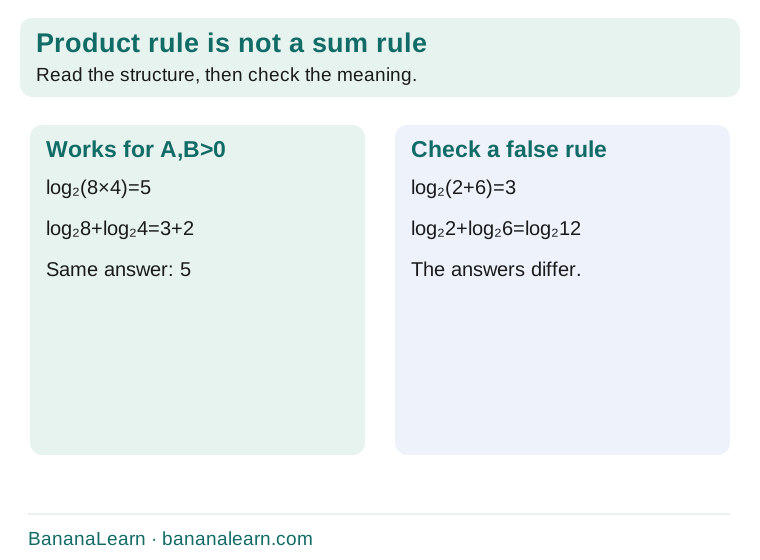
On a narrow screen, swipe the diagram or open it full size.
Division subtracts exponents, so log_b(A/B)=log_b(A)−log_b(B), for positive A and B. Also log_b(Aᵏ)=k log_b(A) for positive A and real k. These conditions protect the real logarithms used in the equality.
For example log₃(81/3)=4−1=3. With log₂(8²), the answer is 2×3=6. Do not drop brackets when only part of an expression is raised to a power.
A common logarithm uses base 10 and is often written log. A natural logarithm uses base e and is written ln. Check the notation in your course or calculator rather than assuming an omitted base in every context.
Change of base gives log_b(a)=ln(a)/ln(b). This is a ratio of two logs, not ln(a/b). When an exact power is visible, exact evaluation is clearer than a rounded calculator answer.
For log₂(x−1)=3, convert to x−1=2³=8, giving x=9. Check x−1>0: it is 8. For an equation with several logarithms, write the domain conditions before combining them.
Algebra may generate values that violate those conditions. A candidate root is not an answer until every original logarithm is defined. A numerical check should use the original equation.
For b>1, y=log_b(x) increases, passes through (1,0) and (b,1), and approaches the vertical line x=0 without reaching it. Its real domain is x>0 and range is all real numbers.
The exponential y=bˣ has the coordinates reversed. Reflecting across y=x connects the two graphs. Different scales can distort the picture, so label axes and use the same unit scale when illustrating reflection.
A logarithm helps solve for an exponent, compare multiplicative scales and represent wide ranges. It is not automatically appropriate for an additive pattern. For this introductory guide, focus on interpreting the exponent before memorising laws.
Keep a record with four entries: base and domain; equivalent exponential equation; calculated value; substitution check. If a rule seems uncertain, test it with simple powers that you can verify independently.
See the reasoning
Try, explain, check
Try each task before opening its explanation. These are original BananaLearn questions, not official exam or past-paper questions. Where several answers can work, the explanation gives the criteria.
5
2⁵=32.
0
4⁰=1.
−2
3⁻²=1/9.
No
A positive base raised to a real power is never zero.
No
Base 1 is excluded.
log₅A+log₅B
Multiplication adds the exponents.
2
4−2=2, also log₂(16/4)=log₂4.
6
1000²=10⁶.
24
x+1=25 and the argument is positive.
x>3
Its argument must be strictly positive.
No
For example log₂(1/2)=−1.
ln(11)/ln(7)
The denominator records the base; it is not ln(11/7).
Copy these headings and fill them for one worked task, then for a fresh attempt. Use your own evidence rather than copying the model answer.
Explore BananaLearn’s games, learning features and one-to-one tutoring. Maths is our priority; English and Science tutoring are also available. Bring a recent example of schoolwork when checking teaching fit.
Original BananaLearn explanations, examples, illustrations and practice. Source facts checked 7 November 2026. Suggested levels are learning guides, not a claim that every board or textbook uses the same sequence.
How we prepare guides · Report a correction
Share the complete guide: https://bananalearn.com/learn/logarithms-explained-exponents-and-laws.html