
Start with the key idea
For positive integer powers, aⁿ represents n factors of a. Multiplying powers with the same base adds exponents; dividing subtracts exponents when the denominator is nonzero; raising a power to a power multiplies exponents. Zero and negative powers extend these patterns for nonzero bases. Read the base and operation before choosing a law.
1. Identify the base and what the exponent counts
In 5³, the base is 5 and the positive integer exponent 3 counts three factors: 5 × 5 × 5 = 125. It does not mean 5 × 3. This expanded form is the simplest way to check a new rule.
The base can itself be an expression. In (x + 1)², the base is the whole bracket x + 1, so the expansion is (x + 1)(x + 1). Do not remove brackets before identifying the object being raised to a power.
A power describes an operation, not a size guarantee. For example, (1/2)³ = 1/8, which is smaller than 1/2. A larger exponent need not produce a larger value when the base is between zero and one.
2. Same-base products join factors
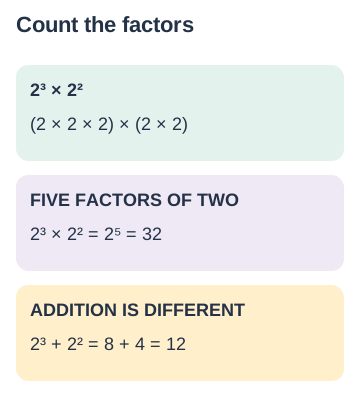
For positive integer m and n, aᵐ × aⁿ = aᵐ⁺ⁿ because the first power contributes m factors of a and the second contributes n more. Thus 2³ × 2² = 2⁵. The bases must match for this particular rule.
In 2³ × 3², the bases differ and the exponents differ, so neither a same-base rule nor a common-exponent rule directly combines the expression into one of these simple powers. Calculate 8 × 9 = 72 or retain a useful factorised form.
Addition does not join factors. 2³ + 2² = 8 + 4 = 12. You may factor out 2² to write 2²(2 + 1), but adding the exponents would change the value. Look at the operation sign before reaching for a law.
3. Division cancels matching factors
For a nonzero base, aᵐ ÷ aⁿ = aᵐ⁻ⁿ when the powers are defined. With positive integers and m greater than n, expand and cancel: 7⁵ ÷ 7² leaves three factors of 7, so the result is 7³.
The nonzero condition matters because division by zero is undefined. Do not apply a cancellation rule to a fraction with a zero denominator. For a symbolic fraction, record restrictions before simplifying; a shortened expression can hide them.
If m equals n and a is nonzero, the quotient equals 1. This motivates a⁰ = 1. In this school treatment, 0⁰ is not assigned a value by that rule: the reasoning used a nonzero denominator.
4. A power of a power repeats groups
For integer powers where the expressions are defined, (aᵐ)ⁿ = aᵐⁿ. For example, (3²)³ = 3² × 3² × 3², which contains six factors of 3. The exponents multiply because three groups each contain two factors.
A product raised to a positive integer power distributes over its factors: (ab)ⁿ = aⁿbⁿ. For example, (2 × 5)³ = 2³ × 5³. A quotient behaves similarly when its denominator is nonzero: (a/b)ⁿ = aⁿ/bⁿ.
A power does not generally distribute over addition. (2 + 3)² = 25, while 2² + 3² = 13. Expand (x + 1)(x + 1) to see the cross terms. Confusing addition with multiplication is a common source of wrong simplifications.
5. A negative exponent means a reciprocal
For a nonzero base and positive integer n, a⁻ⁿ = 1/aⁿ. It does not mean a negative answer. For example, 2⁻³ = 1/8. The exponent records how the multiplication pattern extends backwards.
A fractional base reverses when taking a reciprocal: (2/3)⁻² = (3/2)² = 9/4. Keep the whole fraction inside brackets so the exponent applies to numerator and denominator together.
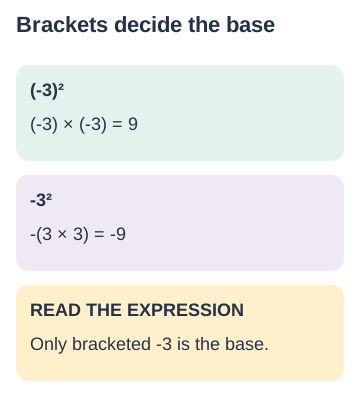
Compare (-3)² and -3². The first has base -3 and equals 9. In the second, the exponent applies to 3 before the leading minus, giving -9. With an odd integer exponent, (-3)³ = -27. The sign comes from multiplication and brackets, not from guessing that every power is positive.
6. Connect rational powers with roots
For a positive base a and positive integer n, a^(1/n) means the positive nth root of a. For example, 16^(1/2) = 4 and 27^(1/3) = 3. More generally, for a positive base, a^(m/n) = (the nth root of a)^m.
Therefore 27^(2/3) = 3² = 9 and 16^(-1/2) = 1/4. In these examples, taking the root first keeps the arithmetic simple. State the positive-base condition when using the rational-power rules in this introductory treatment.
Negative bases with fractional exponents require more care in real-number mathematics. This guide does not extend every rational-power identity blindly to them. Stay with the stated positive-base examples unless the task explicitly defines a valid odd-root interpretation.
7. Use a short checking routine
First mark the complete base and the operation between powers. Then state any nonzero or positive-base condition. Apply one matching law at a time, and write a result with positive exponents when requested.
For a numerical problem, compare with direct arithmetic on a small example. For a symbolic expression, testing a permitted number can reveal an error but does not prove an identity for every value. The algebraic reasoning supplies the general justification.
Keep excluded values even if a factor cancels. For x⁵/x², write x³ with x ≠ 0. The simplified expression x³ exists at zero, but the original quotient does not. Correct simplification preserves the original domain.
6 worked examples with reasoning
1. Simplify 3⁴ × 3⁻².
- The bases match and are nonzero.
- Add the exponents: 4 + (-2) = 2.
- The result is 3² = 9.
2. Simplify (2³)² ÷ 2⁴.
- Multiply exponents inside the power of a power: (2³)² = 2⁶.
- Subtract exponents in the quotient: 2⁶ ÷ 2⁴ = 2².
- The value is 4; directly, 64 ÷ 16 = 4.
3. Write (3/5)⁻² with positive exponents and evaluate.
- Take the reciprocal of the whole nonzero fraction.
- (3/5)⁻² = (5/3)².
- The value is 25/9.
4. Compare (-2)⁴ and -2⁴.
- In (-2)⁴, the base is -2 and four negative factors give 16.
- In -2⁴, calculate 2⁴ first, then apply the minus.
- The second value is -16.
5. Evaluate 64^(2/3).
- Use the positive cube root of 64, which is 4.
- Square the root: 4² = 16.
- Check with (64^(1/3))²; the positive base satisfies the stated rule.
6. Simplify x⁷/x³ and state the restriction.
- The original denominator x³ must not be zero, so x ≠ 0.
- Subtract exponents: 7 − 3 = 4.
- The result is x⁴, retaining x ≠ 0.
Save the guide or print the practice
Download to save or share
Complete guide with answers (PDF) · Worksheet without answers (PDF) · Worksheet and answer key (PDF)
Try each task before opening its answer. Give an example or reason, not only a label.
16 practice questions with explanations
Try each task before opening its answer. Give an example or reason, not only a label.
Write an answer and your reason before opening the explanation. Check the reasoning as well as the final answer.
- Meaning
Expand 4³ and evaluate.
Answer and reasoning
4 × 4 × 4 = 64.
The exponent counts factors, not a multiplier of the base.
- Product
Simplify 5² × 5³.
Answer and reasoning
5⁵ = 3,125.
Same-base multiplication adds exponents.
- Quotient
Simplify 2⁷ ÷ 2⁴.
Answer and reasoning
2³ = 8.
Cancel four of the seven factors of two.
- Nested
Simplify (3²)².
Answer and reasoning
3⁴ = 81.
Two groups of two factors make four factors.
- Zero
Find 11⁰.
Answer and reasoning
1.
The base is nonzero.
- Negative
Find 4⁻².
Answer and reasoning
1/16.
Take the reciprocal of 4².
- Fraction
Find (2/5)⁻².
Answer and reasoning
25/4.
Invert the fraction and square: (5/2)².
- Sign
Find (-5)² and -5².
Answer and reasoning
25 and -25 respectively.
The brackets change whether the minus is part of the base.
- Odd
Find (-2)³.
Answer and reasoning
-8.
Three negative factors give a negative product.
- Addition
Does 3² + 3² equal 3⁴?
Answer and reasoning
No. It equals 18, while 3⁴ = 81.
The product rule does not apply to addition.
- Root
Find 81^(1/2).
Answer and reasoning
9.
This denotes the positive square root.
- Rational
Find 8^(2/3).
Answer and reasoning
4.
The cube root is 2, and 2² = 4.
- Rational
Find 25^(-1/2).
Answer and reasoning
1/5.
Take the reciprocal of the positive square root of 25.
- Restriction
Simplify y⁶/y² and state the excluded value.
Answer and reasoning
y⁴, with y ≠ 0.
The original denominator is zero at y = 0.
- Different bases
Evaluate 2² × 3² using a common exponent.
Answer and reasoning
(2 × 3)² = 36.
A product raised to the same integer power can be combined this way.
- Check
Is (1/2)⁴ greater than (1/2)²?
Answer and reasoning
No: 1/16 is less than 1/4.
For a base between zero and one, larger positive integer powers are smaller.
Use the ideas without looking at the notes
For each law, write one valid example, its condition and a tempting invalid example. Include addition versus multiplication, a negative exponent versus a negative base, and a cancelled denominator that still excludes zero.
Common questions
Do exponents always add?
Only in the relevant same-base multiplication rule. Quotients subtract exponents; powers of powers multiply them.
Does a negative exponent make the answer negative?
No. It indicates a reciprocal for a nonzero base. The sign depends on the base and exponent.
Is every number to the power zero equal to one?
Every nonzero base has zeroth power one. The rule used here does not assign a value to 0⁰.
Why do brackets change a negative-base answer?
They show whether the minus sign belongs to the base being raised to the power.
Can I ignore a denominator restriction after cancellation?
No. The simplified expression must retain the original excluded values.
Connect your learning
Ask about guided Maths learning if your child needs help explaining these ideas.
About this guide
Original explanations, examples, diagrams and practice by BananaLearn. The grade label indicates the intended learning level; this is not an official textbook extract or exam paper.