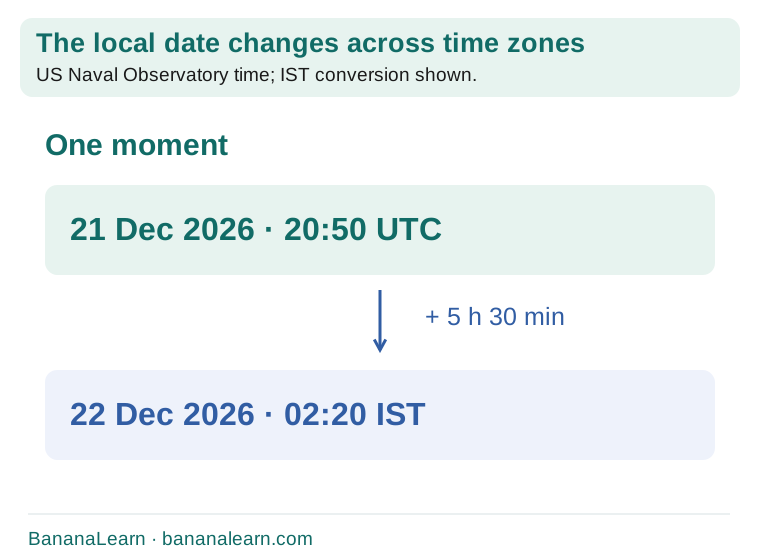
1. Convert 21 December 20:50 UTC to IST.
- Add 5 hours to reach 22 December 01:50.
- Add 30 minutes to reach 02:20.
- The time-zone conversion crosses midnight, so the local date changes.
Science · Suggested Classes 5–8
The same solstice happens on 21 December in UTC and 22 December in India. It is one event; the clock and calendar labels differ by location.
Start here
The December 2026 solstice occurs at 20:50 UTC on 21 December, according to the US Naval Observatory table. That is 02:20 IST on 22 December.
Original BananaLearn guide · 7 November 2026
On a narrow screen, swipe the diagram or open it full size.
The US Naval Observatory’s 2026 seasons table gives the December solstice at 20:50 with timezone offset zero on 21 December. This guide expresses that minute as 20:50 UTC. Adding India’s 5 hours 30 minutes gives 02:20 IST on 22 December.
A solstice is one global astronomical moment, not a different event in each country. The local date depends on the time zone. Use the official source below before adding a city-specific clock time.
Around this point, the Northern Hemisphere is tilted away from the Sun and the Southern Hemisphere towards it. It corresponds to the northern winter and southern summer solstice.
“Shortest day” means the least daylight in the relevant seasonal sense, not a civil day shorter than 24 hours. Near polar regions, the sunrise/sunset pattern needs additional explanation.
Daylight depends strongly on latitude and season. Temperature also depends on heat storage, weather, altitude and other conditions. The solstice need not be the coldest or hottest local day.
Nor is the earliest sunset necessarily on the solstice date. A daylight-duration investigation asks a different question from finding a single sunrise or sunset extreme.
On a narrow screen, swipe the diagram or open it full size.
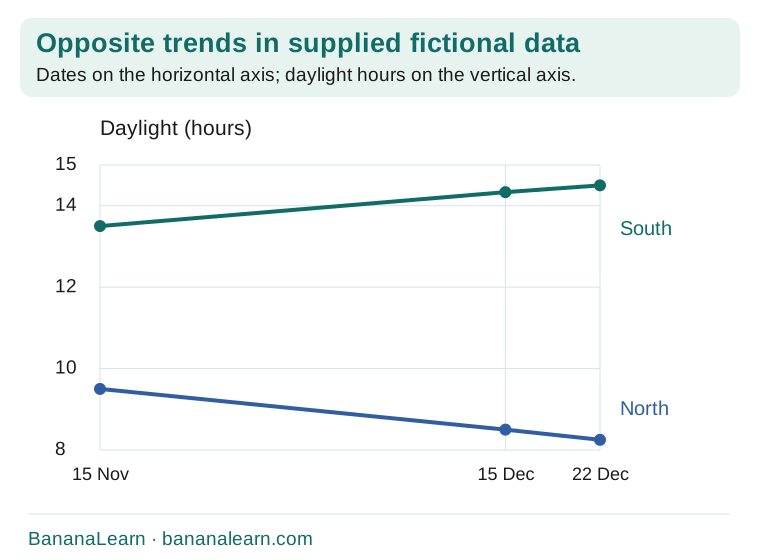
For this maths task only, Northern Town has sunrise/sunset pairs: 15 November 07:00–16:30; 15 December 07:30–16:00; 22 December 07:40–15:55. Southern Town has 05:45–19:15, 05:25–19:45 and 05:20–19:50 on the same dates.
These are invented practice records illustrating opposite seasonal tendencies, not observed readings or astronomical predictions for named towns. Calculate daylight by subtracting sunrise from sunset on each date.
Northern Town’s last record is 15:55−07:40=8 hours 15 minutes. Southern Town’s last record is 19:50−05:20=14 hours 30 minutes. Keep hours and minutes separate before converting to decimal hours.
8 hours 15 minutes is 8.25 hours, not 8.15. Fifteen minutes is one quarter of an hour. The distinction matters when placing values on a graph with decimal-hour units.
Use dates on the horizontal axis and daylight duration in hours on the vertical axis. Northern values are 9.5,8.5,8.25; southern values are 13.5,14⅓,14.5. State that the data are fictional.
A shared vertical scale makes the durations comparable. The intervals between dates are unequal, so position the dates proportionally on a true time axis or label an equally spaced display as separate recorded dates rather than a rate graph.
If a family wants a real extension, use a reputable local sunrise/sunset source and record its place, time zone and definitions. Do not look at the Sun to time an observation.
Compare like with like: changing town or source halfway through a record can create a false trend. Cloudiness changes what you see in the sky but does not by itself redefine the astronomical sunrise calculation.
For the supplied data, say that Northern Town’s recorded daylight decreases while Southern Town’s increases over the selected dates. Connect that fictional comparison with the tilt model, without presenting the values as measurements.
A parent can ask which parts are official facts, which are calculations and which are invented practice data. Keeping those categories distinct is part of the lesson, not a detail to hide in a footnote.
See the reasoning
Try, explain, check
Try each task before opening its explanation. These are original BananaLearn questions, not official exam or past-paper questions. Where several answers can work, the explanation gives the criteria.
21 December 2026
The official table gives 20:50 at offset zero.
22 December, 02:20 IST
Add 5 h 30 min.
No
They are different local labels for one moment.
Southern Hemisphere
It is tilted towards the Sun.
No
It refers to daylight duration.
8.25 h
15/60=0.25.
9 h 30 min
16:30−07:00.
14 h 20 min
19:45−05:25.
No
They are explicitly invented practice data.
No
Temperature depends on more than daylight on one date.
Place, dates, source and time zone
These make the measurements comparable.
No
Their horizontal distances should reflect elapsed time.
Copy these headings and fill them for one worked task, then for a fresh attempt. Use your own evidence rather than copying the model answer.
Explore BananaLearn’s games, learning features and one-to-one tutoring. Maths is our priority; English and Science tutoring are also available. Bring a recent example of schoolwork when checking teaching fit.
Original BananaLearn explanations, examples, illustrations and practice. Source facts checked 7 November 2026. Suggested levels are learning guides, not a claim that every board or textbook uses the same sequence.
Event timing is calendar-backed. Search demand is a forecast unless a separately measured trend is stated. No official event theme, school programme or affiliation is implied.
How we prepare guides · Report a correction
Share the complete guide: https://bananalearn.com/learn/december-solstice-2026-daylight-activity.html