
Start with the key idea
A conversion changes the unit used to describe a quantity, not the quantity itself. Use the known relationship, such as 1 m = 100 cm. Multiply when expressing the same quantity in smaller units, and divide when expressing it in larger units. Keep length, mass and capacity relationships separate.
1. Keep the quantity separate from its label
Measure the same desk in metres and centimetres. The desk has one length, but the number of units differs. A centimetre is smaller than a metre, so more centimetres are needed to cover the same length. This gives a check before calculating.

A conversion is not an instruction to make the physical quantity larger or smaller. Multiplying the numerical value by 100 while changing metres to centimetres describes the same length. Multiplying by 100 without changing the unit would describe a length one hundred times as large.
Write the unit at every meaningful step. “2.4 × 100 = 240” shows arithmetic; “2.4 m = 240 cm” shows the quantity relationship. The second statement tells the reader what the numbers measure.
2. Choose the correct relationship
For length, use 1 cm = 10 mm, 1 m = 100 cm and 1 km = 1,000 m. For mass, 1 kg = 1,000 g. For capacity, 1 L = 1,000 mL. Read the unit symbols carefully: m means metre, while mL means millilitre.
The number of zeros is not a universal rule. Metres to centimetres uses 100, while kilometres to metres uses 1,000. Start with a true unit equality, then scale it. Do not choose a multiplier simply because both words sound metric.
You cannot convert kilograms directly into metres: they measure different kinds of quantities. Nor can you generally turn litres into kilograms without information about the material and its density. At this level, keep conversion within one stated quantity type.
3. Express a quantity in smaller units
Convert 3.6 m into centimetres by using 1 m = 100 cm. Three metres gives 300 cm and 0.6 m gives 60 cm, so the total is 360 cm. Multiplication by 100 records both parts at once.
For 2.075 kg, multiply by 1,000 to get 2,075 g. You can check this as 2 kg plus 75 g. The zero after the decimal point matters: 2.75 kg would instead be 2,750 g.
Avoid the explanation “just move the dot”. The place values change because multiplication changes how many of the new units are counted. A place-value chart can help track each digit, but the unit relationship explains why the shift is required.
4. Express a quantity in larger units
Convert 750 mL into litres by dividing by 1,000: 750 mL = 0.75 L. The answer is below one litre because 750 is less than 1,000. This estimate would catch the incorrect answer 7.5 L.
For 3,450 m, divide by 1,000 to get 3.45 km. Another valid form is 3 km 450 m. The mixed-unit and decimal forms describe the same distance, but the decimal part must be interpreted using the larger unit.
A zero whole-number part is useful: write 0.75 L rather than leaving only .75 L. Keep enough decimal places to preserve the stated exact measurement; do not round unless the question asks for an approximation.
5. Convert mixed measurements before calculating
A length of 2 m 35 cm equals 200 cm + 35 cm = 235 cm. It is also 2.35 m. It is not 2.035 m: 35 centimetres is thirty-five hundredths of a metre.
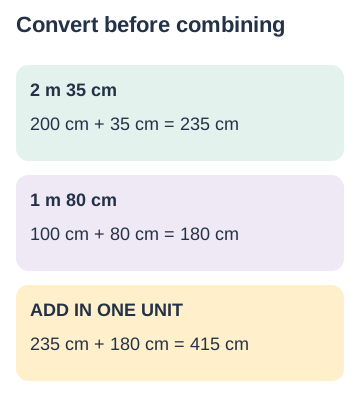
To add 2 m 35 cm and 1 m 80 cm, first use one unit: 235 cm + 180 cm = 415 cm. Convert back if requested: 4 m 15 cm or 4.15 m. The centimetre parts add to 115 cm, so a metre must be regrouped in the mixed-unit method.
The same principle supports subtraction and comparison. Compare 1.2 L and 950 mL as 1,200 mL and 950 mL. The first is greater by 250 mL. Comparing only the written numbers 1.2 and 950 ignores their units.
6. Check the direction and the kind of unit
After a conversion, ask three questions: Is this the same kind of quantity? Did I use the right relationship? Does the number become larger when the unit becomes smaller? These checks catch different errors and work with unfamiliar numbers.
A two-step conversion can be useful. Since 1 m = 100 cm and 1 cm = 10 mm, 1 m = 1,000 mm. Therefore 0.42 m = 420 mm. Keep track of both steps rather than stopping at 42 mm after only converting to centimetres.
Area and volume need different factors. A square metre contains 10,000 square centimetres, not 100, because both dimensions change. A cubic metre contains 1,000,000 cubic centimetres. These are extensions: do not reuse a length multiplier blindly for squared or cubed units.
For practice, use a new measured or invented quantity, predict whether the numerical value should rise or fall, then calculate. Ask the learner to reverse the conversion. Returning to the starting value is a useful arithmetic check, though the original unit relationship must also be correct.
5 worked examples with reasoning
1. Convert 4.08 m to centimetres.
- Use 1 m = 100 cm.
- 4.08 × 100 = 408, so 4.08 m = 408 cm.
- Four metres is already 400 cm; the extra 0.08 m is 8 cm.
2. Convert 6,250 g to kilograms.
- Use 1 kg = 1,000 g.
- 6,250 ÷ 1,000 = 6.25 kg.
- The answer lies between 6 kg and 7 kg, matching the original mass.
3. A bottle holds 1.5 L. A child pours out 350 mL. How much remains?
- Convert the starting capacity: 1.5 L = 1,500 mL.
- Subtract 350 mL: 1,500 − 350 = 1,150 mL.
- That is 1.15 L. This assumes the bottle initially contained 1.5 L and no other liquid was lost.
4. Subtract 85 cm from 2 m 10 cm.
- Convert 2 m 10 cm to 210 cm.
- 210 − 85 = 125 cm.
- Write 1 m 25 cm or 1.25 m if requested.
5. A learner writes 3.2 kg = 320 g. Diagnose the error.
- One kilogram contains 1,000 grams, not 100.
- 3.2 × 1,000 = 3,200 g.
- Since 3.2 kg is more than 3 kg, it must exceed 3,000 g.
Save the guide or print the practice
Download to save or share
Complete guide with answers (PDF) · Worksheet without answers (PDF) · Worksheet and answer key (PDF)
Try each task before opening its answer. Give an example or reason, not only a label.
16 practice questions with explanations
Try each task before opening its answer. Give an example or reason, not only a label.
Write an answer and your reason before opening the explanation. Check the reasoning as well as the final answer.
- Length
Convert 3.7 m to centimetres.
Answer and reasoning
370 cm.
Multiply by 100 because each metre contains 100 centimetres.
- Length
Convert 45 cm to millimetres.
Answer and reasoning
450 mm.
Each centimetre contains 10 millimetres.
- Length
Convert 2.05 km to metres.
Answer and reasoning
2,050 m.
Multiply by 1,000; the decimal part is 50 m.
- Mass
Convert 4.025 kg to grams.
Answer and reasoning
4,025 g.
Four kilograms plus 25 grams gives the same mass.
- Capacity
Convert 650 mL to litres.
Answer and reasoning
0.65 L.
Divide by 1,000; the amount is below one litre.
- Mass
Convert 8,400 g to kilograms.
Answer and reasoning
8.4 kg.
Divide by 1,000.
- Mixed
Write 3 m 8 cm in centimetres.
Answer and reasoning
308 cm.
Three metres gives 300 cm; add the remaining 8 cm.
- Mixed
Write 3 m 8 cm in metres.
Answer and reasoning
3.08 m.
Eight centimetres is eight hundredths of a metre.
- Compare
Which is greater: 1.4 L or 1,250 mL, and by how much?
Answer and reasoning
1.4 L is greater by 150 mL.
1.4 L = 1,400 mL; subtract 1,250 mL.
- Add
Add 2 kg 400 g and 850 g.
Answer and reasoning
3 kg 250 g, or 3.25 kg.
2,400 + 850 = 3,250 g.
- Subtract
Subtract 75 cm from 1.2 m.
Answer and reasoning
45 cm.
1.2 m = 120 cm; 120 − 75 = 45.
- Two steps
Convert 0.36 m to millimetres.
Answer and reasoning
360 mm.
One metre contains 1,000 millimetres.
- Error
Why is 900 mL = 9 L unreasonable?
Answer and reasoning
900 mL is below 1,000 mL, so it must be below one litre.
The correct conversion is 0.9 L.
- Quantity
Can 5 kg be converted directly to centimetres?
Answer and reasoning
No.
Mass and length are different quantities.
- Extension
Is 1 m² equal to 100 cm²?
Answer and reasoning
No; it is 10,000 cm².
A 1 m by 1 m square is 100 cm by 100 cm.
- Create
Write and reverse a conversion between litres and millilitres.
Answer and reasoning
For example, 2.3 L = 2,300 mL, and 2,300 mL = 2.3 L.
Use the same factor of 1,000 in opposite directions.
Use the ideas without looking at the notes
Make a short reference card with five unit equalities. Cover it, convert one length, one mass and one capacity, then check the direction and reverse each conversion. Include one mixed-unit value with a zero, such as 2 m 6 cm.
Common questions
Do I always multiply by 1,000?
No. Use the specific relationship: metres to centimetres uses 100, while kilograms to grams uses 1,000.
Does the object change size when I convert units?
No. Only the number and unit used to describe the quantity change.
Why is 2 m 6 cm not 2.6 m?
Six centimetres is 0.06 m. The correct decimal form is 2.06 m.
Can I compare measurements before converting?
You can reason mentally if you understand the units, but writing a common unit makes the numerical comparison clear.
Do area units use the same factor as length?
No. Both dimensions change for area, so the length factor is squared.
Connect your learning
Ask about guided Maths learning if your child needs help explaining these ideas.
About this guide
Original explanations, examples, diagrams and practice by BananaLearn. The grade label indicates the intended learning level; this is not an official textbook extract or exam paper.