English · Suggested Class 8
Second Conditional: Class 8 Meaning, Examples & Practice
If I owned a flying bicycle, I would skip the traffic. I am not telling you about yesterday’s bicycle. A past verb form can describe an imagined situation now.
Original BananaLearn guide · 2 November 2026
On a phone, swipe across the illustration to read every label.
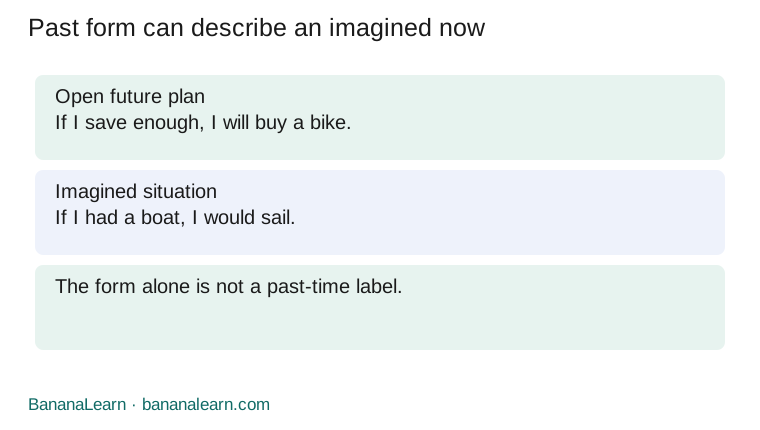
The meaning comes before the pattern
The second conditional imagines a present or future situation the speaker treats as unreal, unlikely or remote: If our classroom had a garden, we would grow herbs. The sentence does not claim that the classroom had a garden in the past. It presents a different possible situation and its imagined result.
This is a way of framing a situation, not a mathematical probability label. Two speakers can choose different conditionals because they see a possibility differently. Understand the context before replacing every past-form verb with a past-time interpretation.
Build the usual classroom pattern
The usual pattern is if plus past simple, followed by would plus the base verb: If I knew the answer, I would explain it. The if-clause gives the imagined condition and the main clause gives its consequence. Would explain is not would explained.
When the if-clause comes first, use a comma in standard classroom punctuation. If it comes second, a comma is usually unnecessary: I would explain it if I knew the answer. Reordering the two clauses does not reverse their causal roles or change their basic meaning.
Use were for an imagined be situation
In formal hypothetical sentences, were is commonly used with all subjects: If I were the captain, I would change the field. If she were here, she would know what to do. Informal speech sometimes uses was with singular subjects, but were is a reliable school-writing choice for this unreal meaning.
If I were you is a familiar advice pattern: If I were you, I would ask the teacher which step is missing. It does not claim that one person can literally become another. Avoid mixing the imaginary condition with a claim that you know the child’s circumstances better than they do; a suggestion still needs to fit the situation.
On a phone, swipe across the illustration to read every label.

Compare a possible plan with a remote idea
If it rains tomorrow, we will practise indoors presents rain as an open future possibility. If it rained every day for a month, we would need a new outdoor schedule imagines a more remote situation in this context. The past form in the second sentence does not turn tomorrow into yesterday.
Similarly, If I save enough, I will buy a bicycle presents a possible plan. If I had a million pounds, I would build a cycling park imagines a different financial situation. Do not use the conditional form as evidence of someone’s actual wealth or plans; these are language examples.
Negatives and questions
A negative condition can use did not plus the base verb: If our bus did not stop here, we would walk farther. A negative result uses would not plus base verb: If I lived nearby, I would not need the bus. Keep the auxiliary and base form together instead of writing didn’t stopped.
A question can ask about the result: What would you do if you found a lost notebook? The word order is would you do, not you would do, in the main question. The if-clause remains if you found; it is not written as if did you find.
Could and might change the result meaning
Could plus base verb can express an imagined ability or possibility: If we had a larger table, we could spread out the map. Might can make the result less certain: If we changed the route, we might arrive earlier. These are useful alternatives, not mistakes for omitting would.
Compare would arrive earlier, which presents that result more firmly within the imaginary condition, with might arrive earlier, which leaves it uncertain. The grammar does not prove that the route is actually quicker. In a real planning task, check evidence about travel time separately.
Repair the common mechanical errors
For an ordinary hypothetical condition, repair If I would know the answer, I would tell you to If I knew the answer, I would tell you. In this pattern, would belongs in the result clause. English has other specialised uses of would in if-clauses, but they are outside this introductory lesson.
Repair If she had more time, she would practised to she would practise. Also distinguish If she had more time from If she had had more time: the latter belongs to a different past-counterfactual pattern. Adding another had changes the time frame and should not be treated as an optional decoration.
Write an original pair of alternatives
Choose a harmless situation, such as a school garden or a longer library opening time. Write one condition and one plausible result. Then change would to might or could and explain the difference. The point is to control the meaning, not to invent the most extravagant fantasy.
Use the table to compare a realistic plan with a remote imagined situation. A learner who can recite if plus past but cannot explain why the sentence is about now needs a timeline and context check. Suggested Class 8 placement is a learning level, not a claim that all boards introduce conditionals at this stage.
Control the meaning of your conditional
Copy this record into a notebook. Fill each blank using your own example or the activity above.
On a phone, swipe across a wide table to see every column.
| Decision | Your version |
|---|---|
| Imagined situation now or later | ___ |
| If-clause with a past form | ___ |
| Result with would / could / might | ___ |
| Why that result word? | ___ |
| Check base verb and punctuation | ___ |
12 questions with explained answers
Try each question first. Open the explanation to check your reasoning. These are original BananaLearn questions, not official exam questions.
Complete: If I ___ (know) the route, I would guide you.
Check answer and reasoning
knew
Use the past form for the imagined condition.Complete: If I were taller, I would ___ (reach) the shelf.
Check answer and reasoning
reach
Would takes the base verb.Choose a formal hypothetical form: If she was / were the captain…
Check answer and reasoning
were
Were is the standard classroom choice for this unreal be condition.Repair: If we didn’t had homework, we would play.
Check answer and reasoning
If we didn’t have homework, we would play.
Didn’t takes the base verb have.Does If I owned a boat necessarily describe the past?
Check answer and reasoning
No.
In a second conditional it can imagine a different present or future.Rewrite with the result first: If I had the book, I would lend it.
Check answer and reasoning
I would lend it if I had the book.
The clauses change order, not roles; a comma is usually unnecessary here.Repair: If I would know, I would help.
Check answer and reasoning
If I knew, I would help.
In the ordinary second-conditional pattern, would marks the result clause.Make a question about the result: you / do / if / you found a key.
Check answer and reasoning
What would you do if you found a key?
The main question inverts would and you.How does might differ from would in an imagined result?
Check answer and reasoning
Might expresses a less certain possible result.
The speaker leaves the outcome open even within the imagined condition.What can could express in If we had a hall, we could rehearse?
Check answer and reasoning
An imagined ability or possibility.
The hall would make rehearsal possible.Choose a possible future plan: If I save enough, I will / would buy a bike.
Check answer and reasoning
will is the expected choice for the open possible-plan meaning.
A remote hypothetical framing would instead use If I saved enough, I would buy a bike.Is the sentence If I had more time, I would practise grammatically a past-perfect conditional?
Check answer and reasoning
No.
Had is the simple past of have here; past perfect would need had plus a participle.
Choose your next learning step
- Compare zero and first conditionals
- Review modal verbs and base forms
- Keep past forms and past time distinct
Explore BananaLearn games, learning resources and tutoring. Maths is our priority; English and Science tutoring are also available. Share your current schoolwork when checking teaching fit.
Sources and scope
Explanations, activities, diagrams and practice are original BananaLearn work. Class labels suggest a learning level; school sequences and current textbook editions can differ. Sources checked 2 November 2026.
How we prepare guides · Report a correction
Share the complete guide: https://bananalearn.com/learn/class-8-second-conditional.html