English · Suggested Grade 7
Zero and First Conditionals: Class 7 Meaning & Practice
“If I finish early, I read” can describe a routine. “If I finish early, I will read” describes a possible future plan. The situation changes the message.
Original explanations and practice by BananaLearn · Published 1 November 2026
On a small screen, swipe across the illustration to read every label.
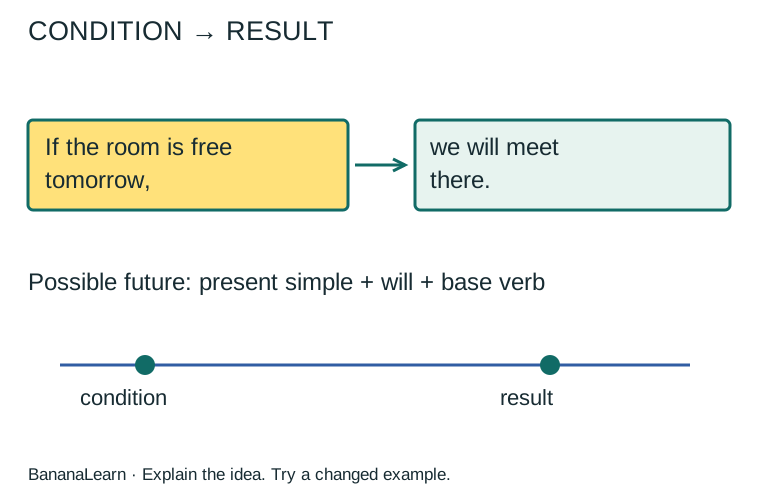
A condition and its result
A conditional sentence connects a condition with a result. In If the timer rings, we stop, the if-clause supplies the condition and we stop gives the result. The terms zero and first are teaching labels for common meaning-and-form patterns, not the only conditional structures English allows.
Start with context. Are you describing what generally happens, or what may happen on a particular future occasion? A sentence without enough context can support more than one form. The practice below states the intended situation so the choice can be explained.
Zero conditional for general rules and routines
A common zero-conditional pattern uses if plus present simple, then present simple: If our club meets on Friday, we use the library. This describes the club’s usual arrangement. You can often replace if with when when the meaning is whenever the condition occurs, though the emphasis can change.
A general statement still needs to be factually true in its context. If water reaches 100°C, it boils requires a suitable pressure qualification in science; grammar does not remove that condition. We use fictional club rules here to avoid pretending a simplified example is an exceptionless law of nature.
First conditional for a real future possibility
A common first-conditional pattern is if plus present simple, then will plus base verb: If the room is free tomorrow, we will meet there. The speaker presents a possible condition and a future consequence. Will does not make the outcome an unconditional guarantee; it remains dependent on the condition.
In this ordinary pattern, do not put will in the if-clause: If the room will be free tomorrow is not the form being practised. English has other uses of will in if-clauses, such as willingness, but they are outside this introductory comparison.
Changing the order and punctuation
If we finish the model, we will test it puts the condition first and uses a comma after that introductory clause. We will test it if we finish the model puts the result first and normally needs no comma before the essential condition. The relationship stays the same.
Keep the subject and verb in both clauses. If finishes early, will read is missing the intended subjects in ordinary full-sentence writing. A good form check follows the meaning check rather than replacing it.
Negatives and alternatives
If it does not rain tomorrow, we will play outside uses does not plus the base verb in the condition. If the bus is late, we will not start without the teacher places the negative in the result. Identify which part is being negated before editing.
A result can also express ability or an instruction: If you finish, you can check your work; If the bell rings, close the boxes. These are valid conditional messages. This guide’s core classification exercise focuses on present/present versus present/will, without labelling every other result pattern wrong.
Worked comparison in a school context
Routine: If our group finishes early, we read quietly. Tomorrow’s possibility: If our group finishes early tomorrow, we will read quietly. The verb forms and time context support different messages. Adding tomorrow without reconsidering the intended meaning can make a habitual explanation misleading.
Edit this future plan: If Tara will bring the ruler, we measure the board tomorrow. In the intended ordinary future-possibility pattern, write If Tara brings the ruler, we will measure the board tomorrow. Do not change it to a statement that Tara definitely brings the ruler every day; that would invent a routine.
Explain the condition, not just the label
Use the record to write one invented rule and one possible future plan. Ask whether the consequence occurs generally or is being predicted for a particular occasion. Then check subject agreement, auxiliary form and comma placement.
Parents can vary one phrase—every Friday versus tomorrow—and ask the learner to explain any change. A correct label without an explanation of the situation is a weaker check than producing two clear messages. Avoid treating if as a signal that every sentence must contain will.
Condition-to-result planner
Copy the record into a notebook or use it to organise your own answer. Blank spaces are for your work.
| Context | Condition | Result | Why this form? |
|---|---|---|---|
| General club rule | If ___ | ___ | ___ |
| Tomorrow’s possibility | If ___ | will ___ | ___ |
| Result first | ___ | if ___ | ___ |
10 questions with explained answers
Try the questions before opening the answers. Explain the reason, then try a changed example to check your understanding.
A routine: If our club meets, we ___ the library. (use)
Show answer and explanation
use
Present/present expresses the stated routine.A future possibility: If the room is free tomorrow, we ___ there. (meet)
Show answer and explanation
will meet
Present in the condition, will plus base verb in the result.Repair the intended future pattern: If she will arrive early, we will begin.
Show answer and explanation
If she arrives early, we will begin.
Use present simple in this ordinary if-clause.Add the boundary: If the timer rings we stop.
Show answer and explanation
If the timer rings, we stop.
The introductory if-clause takes a comma here.Reverse the order: If we finish, we will test it.
Show answer and explanation
We will test it if we finish.
The essential condition at the end normally needs no comma.Complete: If he does not ___, we will call. (arrive)
Show answer and explanation
arrive
After does not, use the base verb.Does a first conditional guarantee the condition will occur?
Show answer and explanation
No
It describes the consequence if the possible condition occurs.Is If you finish, check your work a valid instruction?
Show answer and explanation
Yes
An imperative can form the result clause.Does every conditional result require will?
Show answer and explanation
No
General rules, instructions and other result meanings can use different forms.Explain the difference between a routine and tomorrow’s plan.
Show answer and explanation
A routine describes repeated situations; tomorrow’s plan concerns a particular future possibility.
The intended context guides the form.
Keep the ideas connected
For help with a school-learning difficulty, bring one attempted question to a discussion about tutoring and curriculum fit. Maths is our priority; English and Science tutoring are also available.
Sources, scope and sharing
The examples, diagrams and practice are original BananaLearn work. Grade labels suggest a learning level; teaching sequences and school requirements can differ. Official sources below support the stated facts and resource links. These activities are independent resources, not official exam questions or endorsed campaign materials.
How we prepare learning guides · Report a correction
Share this guide: https://bananalearn.com/learn/class-7-zero-first-conditionals.html