English · Suggested Grade 6
Must, Have To and Should: Class 6 Meaning & Practice
“You mustn’t bring a snack” and “You don’t have to bring a snack” give very different instructions. One forbids it; the other makes it optional.
Original explanations and practice by BananaLearn · Published 1 November 2026
On a small screen, swipe across the illustration to read every label.
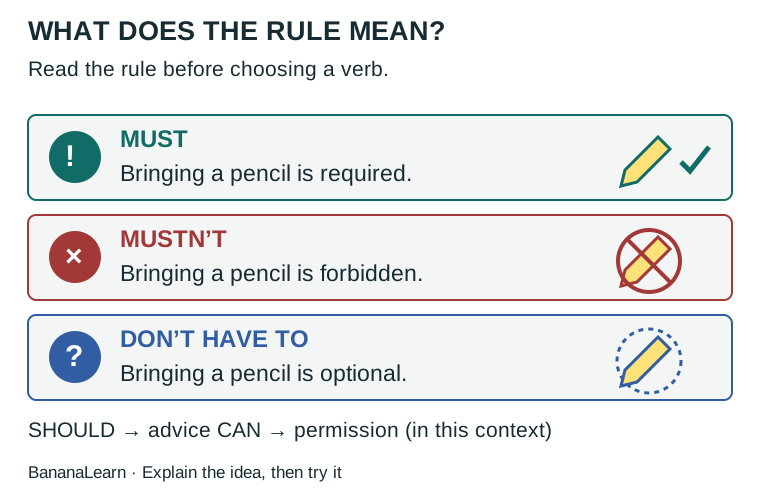
Start with the message, then choose the grammar
We use must and have to for something necessary, should for advice, and can or may for permission in appropriate contexts. The exact strength also depends on the situation and tone. This guide focuses on ordinary instructions and advice, not must used for a deduction such as That must be our bus.
Read the full situation before choosing a word. A missing pencil might call for advice to pack a spare. A rule about protective equipment needs an instruction. An optional museum notebook should not accidentally become a requirement because a writer chose a stronger verb.
Must and have to: a useful distinction, not an absolute rule
Must often expresses a strong requirement or the speaker’s own insistence: I must finish this draft. Have to often reports an external requirement: We have to wear visitor badges at the museum. Both can express rules. A school notice may naturally say Visitors must sign in even though the rule comes from an institution.
Do not mark every positive sentence with one form as wrong if the other also fits. In a question asking you to report the school’s rule, We have to wear badges is a clear choice. In free writing, judge the intended meaning and context. The outside-rule versus personal-insistence distinction is a tendency, not a universal grammar law.
The essential negative contrast
Mustn’t means something is not allowed: You mustn’t cross the barrier. Don’t have to means something is not necessary: You don’t have to buy a souvenir. The second instruction permits buying one if other rules allow it. It does not forbid the purchase.
Worked situation: the museum lends pencils, but visitors may bring their own. Write You don’t have to bring a pencil. Writing You mustn’t bring a pencil would invent a ban. Now change the fact: food is prohibited in the gallery. Write You mustn’t eat in the gallery. The choice follows the rule, not the shape of the sentence.
Should gives advice; it does not create permission
You should check the weather forecast recommends a sensible action. You shouldn’t leave your coat behind advises against a choice. These are generally weaker than a strict instruction. To state permission, use a suitable form such as You can take photographs in this room, provided that is actually the rule.
Advice cannot cancel a prohibition. If a room bans flash photography, You should take a photo does not give permission to use a flash. In schoolwork, separate three questions: Is the action necessary? Is it allowed? Is it a good idea? Different answers may require different verbs.
Build the verb phrase correctly
After must and should, use the base verb: She must wait and He should carry a bottle. Do not write must to wait, should carries or she musts. Negatives are must not and should not, often contracted to mustn’t and shouldn’t. Questions can begin Must I wait? or Should we leave?
Have to changes with the subject and tense: I have to, she has to, yesterday we had to. A question uses do or does: Does she have to wait? The negative is She doesn’t have to wait, with have after does. For a past obligation, We had to queue is the ordinary form; do not invent musted.
Worked edit: a message about a class visit
Draft: Everyone musts bring a notebook. You mustn’t bring money because the visit is free. We should to meet at nine. First remove the unnecessary s: Everyone must bring a notebook, if it truly is required. Next ask whether money is banned or simply unnecessary. For a free visit with optional shopping, write You don’t have to bring money.
Finally remove to after should: We should meet at nine. If nine is the mandatory departure time, stronger wording is clearer: We have to meet at nine. Editing means checking the facts as well as fixing verb forms. A grammatically tidy instruction can still give the wrong rule.
A short practice routine for students and parents
Use the meaning table to sort a few invented messages into required, forbidden, optional, advice and permitted. Ask the learner to explain the message in ordinary language before changing the grammar. Then reverse a meaning: turn a ban into an optional action and name which words must change.
For an independent check, write three original instructions about a fictional library or club. Label them as made-up rules so no one mistakes them for real school policy. Include one optional action and one prohibited action. A successful explanation distinguishes not needed from not allowed, even if the child forgets the grammatical label.
Meaning before wording
Use this reference while checking an explanation or solving a related question.
| Intended message | Useful wording | What the reader understands |
|---|---|---|
| Required | You must / have to wait. | Waiting is necessary. |
| Forbidden | You mustn’t enter. | Entering is not allowed. |
| Optional | You don’t have to join. | Joining is not required. |
| Advice | You should check. | Checking is recommended. |
| Permission | You can sit here. | Sitting here is allowed in this context. |
12 questions with explained answers
Try the questions before opening the answers. Explain the reason, then try a changed example to check your understanding.
The room bans food. Complete: You ___ eat here.
Show answer and explanation
mustn’t
This is a prohibition, not optional advice.Pencils are provided, and personal pencils are allowed. You ___ bring one.
Show answer and explanation
don’t have to
Bringing one is unnecessary, not forbidden.Repair: She musts wait.
Show answer and explanation
She must wait.
Must does not gain s with she.Repair: We should to read the instructions.
Show answer and explanation
We should read the instructions.
Should takes the base verb without to.The school requires badges. Report the rule with have to.
Show answer and explanation
We have to wear badges.
Have to reports a requirement.Use have to with he: He ___ arrive early.
Show answer and explanation
has to
Positive present-tense have changes to has with he.Repair: Does she has to come?
Show answer and explanation
Does she have to come?
After does, use have.Yesterday the bus was late, so we ___ walk. Use have to.
Show answer and explanation
had to
Had to expresses past obligation.Is You don’t have to buy lunch a ban on buying lunch?
Show answer and explanation
No
It says buying lunch is not necessary.Recommend packing a spare pen without making it a rule.
Show answer and explanation
You should pack a spare pen.
Should presents advice. Other clearly labelled advice can also be suitable.Give permission to sit here using can.
Show answer and explanation
You can sit here.
In this stated context, can expresses permission.A draft says You should arrive by nine, but nine is mandatory. Improve it.
Show answer and explanation
You must arrive by nine, or You have to arrive by nine.
Either positive form can express the stated requirement; should may sound merely advisory.
Keep the ideas connected
- Check the subject and verb
- Write instructions in a notice
- Separate a recommendation from its supporting reason
For help with a school-learning difficulty, bring one attempted question to a discussion about tutoring and curriculum fit. Maths is our priority; English and Science tutoring are also available.
Sources, scope and sharing
The examples, diagrams and practice are original BananaLearn work. Grade labels suggest a learning level; teaching sequences and school requirements can differ. Official sources below support the stated facts and resource links. These activities are independent resources, not official exam questions or endorsed campaign materials.
How we prepare learning guides · Report a correction
Share this guide: https://bananalearn.com/learn/class-6-modals-must-have-to-should.html