English · Suggested Grade 6
Present Simple vs Present Continuous: Class 6 Practice
“I read after dinner” describes a habit. “I am reading now” describes an action in progress. The time clue helps—but the intended meaning makes the choice.
Original explanations and practice by BananaLearn · Published 1 November 2026
On a small screen, swipe across the illustration to read every label.
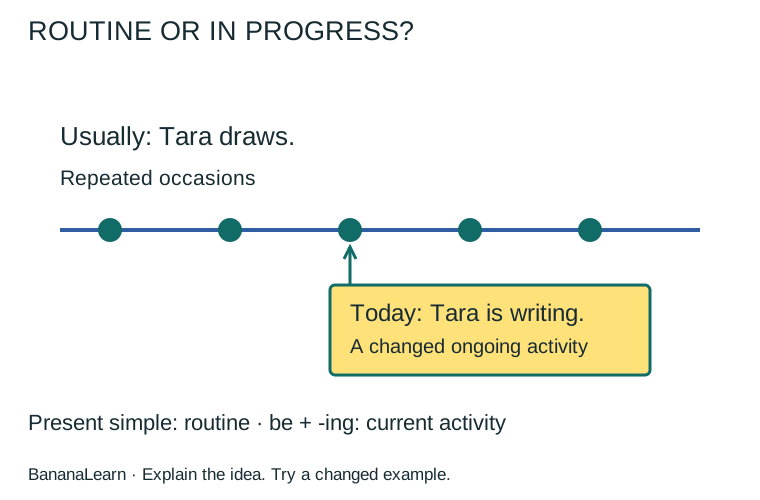
Compare the messages
The present simple commonly describes habits, repeated actions and general states: I walk to school; she knows the answer. The present continuous commonly describes an action in progress or a temporary situation: I am walking home now; she is staying with her aunt this week.
This is a useful core contrast, not a claim that one tense has only one use. Timetables, arrangements and changing situations add other patterns. Start by asking whether the speaker describes a routine, a state or an ongoing situation.
Form the present simple
Use the base verb with I, you, we and they: They play. With he, she and it, many verbs add s or es: She plays; he watches. A negative uses do not or does not plus the base verb: She does not play, not she does not plays.
Questions use Do they play? and Does she play? The verb be is different: I am, she is and they are, with questions such as Is she ready? Do not insert do before ordinary present forms of be.
Form the present continuous
Use am, is or are plus the -ing form: I am drawing, she is drawing, they are drawing. Negatives add not after be, and questions put be before the subject: Are they drawing? Omitting be produces an incomplete form such as They drawing.
Common spelling changes include write → writing and run → running. These are spelling patterns with conditions, not a reason to double every final consonant. When unsure, check the specific verb form rather than applying a blanket rule.
Worked contrast: a club routine and today’s exception
Our fictional art club meets on Fridays. Usually, Tara draws while Ben writes labels. Today Tara is writing the labels because Ben is absent. Meets, draws and writes describe routines. Is writing describes today’s changed activity.
The same person can appear in both patterns without contradiction. Tara usually draws, but she is writing now. A learner who uses the same form everywhere may be ignoring the contrast rather than misunderstanding the story.
Temporary situations and state verbs
We are using the smaller classroom this month describes a temporary arrangement, even when the speaker is not using it at this exact second. We use the smaller classroom every Friday describes a repeated routine. Words such as now and usually are clues, not mechanical switches.
Many state meanings normally use the simple form: I know, she likes, they own. Do not routinely write I am knowing the answer. Some verbs change meaning: I think this is correct expresses an opinion, while I am thinking about the puzzle describes a current mental activity.
Edit questions and negatives
Draft: Does Tara drawing now? She not drawing today. For a current action, write Is Tara drawing now? She is not drawing today. For a routine, write Does Tara draw on Fridays? She does not draw on Mondays. Each pattern needs its own auxiliary structure.
Do not combine both auxiliary systems: Does she is drawing? is not the intended standard question. First select the meaning, then build either do/does plus a base verb or be plus -ing. That order makes editing more reliable.
A brief independent check
Ask a learner to describe one normal school-day habit and one changed activity happening this week. Follow with a negative and a question in each pattern. The aim is to control meaning and form, not to memorise a list of signal words.
Use the record to explain every choice. Accept another tense when a learner supplies a genuinely different valid context, but ask them to name that context. A gap-fill without a clear situation can have more than one grammatical answer; these practice items state the intended meaning.
Meaning and form check
Copy the record into a notebook or use it to organise your own answer. Blank spaces are for your work.
| Situation | Intended meaning | Verb form | Your sentence |
|---|---|---|---|
| Every Friday | Routine | Present simple | ___ |
| Right now | In progress | am/is/are + -ing | ___ |
| This month only | Temporary situation | Often continuous | ___ |
| An ordinary state | Knowing or owning | Usually simple | ___ |
12 questions with explained answers
Try the questions before opening the answers. Explain the reason, then try a changed example to check your understanding.
A habit: She ___ to school every day. (walk)
Show answer and explanation
walks
Third-person singular present simple.Happening now: She ___ to the gate. (walk)
Show answer and explanation
is walking
Be plus -ing expresses the ongoing action.Repair: She does not walks on Fridays.
Show answer and explanation
She does not walk on Fridays.
After does, use the base form.Ask about now: ___ they reading?
Show answer and explanation
Are
The continuous question begins with be.Ask about a habit: ___ he read every evening?
Show answer and explanation
Does
The present simple uses does plus read.Repair: They drawing now.
Show answer and explanation
They are drawing now.
Add the missing form of be.An opinion: I ___ this is right. (think)
Show answer and explanation
think
This meaning is an opinion, not an ongoing thinking activity.Current mental activity: I ___ about the solution. (think)
Show answer and explanation
am thinking
The sentence describes ongoing consideration.Temporary this month: We ___ the small room. (use)
Show answer and explanation
are using
The stated temporary arrangement supports continuous.Routine every week: We ___ the small room. (use)
Show answer and explanation
use
The stated routine supports simple.Repair: Does she is writing now?
Show answer and explanation
Is she writing now?
Do not combine do and be for this continuous question.Form the -ing spelling of write.
Show answer and explanation
writing
Drop the final silent e before -ing here.
Keep the ideas connected
For help with a school-learning difficulty, bring one attempted question to a discussion about tutoring and curriculum fit. Maths is our priority; English and Science tutoring are also available.
Sources, scope and sharing
The examples, diagrams and practice are original BananaLearn work. Grade labels suggest a learning level; teaching sequences and school requirements can differ. Official sources below support the stated facts and resource links. These activities are independent resources, not official exam questions or endorsed campaign materials.
How we prepare learning guides · Report a correction
Share this guide: https://bananalearn.com/learn/class-6-simple-present-present-continuous.html