English · Suggested Class 6
Countable & Uncountable Nouns: Class 6 Examples & Practice
You can count the coins in your pocket, but English usually treats money as uncountable. Grammar follows how a noun is being used, not whether you can measure the thing.
Original BananaLearn guide · 2 November 2026
On a phone, swipe across the illustration to read every label.
The useful distinction: individual items or an amount
A countable noun names items that English can treat as separate units: one notebook, two notebooks; a chair, several chairs. A singular countable noun usually needs a determiner, such as a, the or my. Write I packed a notebook, not I packed notebook.
An uncountable noun is normally treated as a substance, amount or general idea: water, furniture, information, advice. In its usual uncountable meaning it does not take a/an or a regular plural. Write some information or a piece of information. This is a grammar distinction, not a claim that an amount cannot be measured.
A lunchbox makes the pattern visible
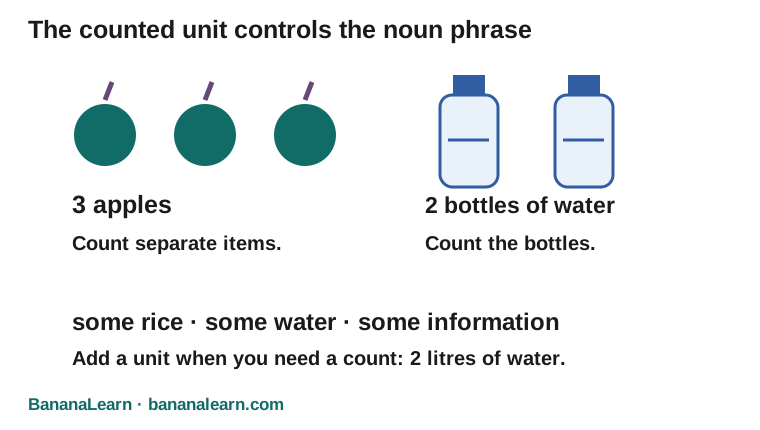
Imagine a lunchbox with three apples, some rice and two bottles of water. Apples and bottles are countable. Rice and water are being used as amounts. A grain of rice or a litre of water adds a unit that can be counted. In two bottles of water, two describes bottles, not a plural word waters.
When checking a sentence, underline the complete noun phrase. In three pieces of toast, the plural ending belongs to pieces. Toast keeps its ordinary uncountable form. This helps a learner avoid writing three toasts in a context where the intended meaning is three slices of toasted bread.
Choose a/an, some and any
Use a/an with one nonspecific countable item: a pencil, an orange. Use some with plural countable nouns and uncountable amounts in many positive statements: some pencils, some juice. A/an depends on the following sound, not simply the letter; countability is a separate decision.
Any is common in negatives and neutral questions: We do not have any glue. Are there any rulers? Some can occur in questions, especially offers and requests: Would you like some juice? Could I have some paper? Therefore the rule questions always use any is too rigid. Learn the purpose of the sentence as well as its punctuation.
On a phone, swipe across the illustration to read every label.
Much, many and a lot of
Use many with plural countable nouns: How many notebooks are missing? Use much with uncountable nouns: How much time is left? A lot of works with both: a lot of notebooks, a lot of time. In ordinary affirmative sentences, a lot of often sounds more natural than much.
Compare There are not many chairs with There is not much space. The plural countable chairs takes are; the uncountable space takes is. To repair How many homework have you got?, use How much homework have you got? or How many assignments have you got? Changing the noun can change the grammar.
A few and a little describe different quantities
A few goes with plural countable nouns: a few questions. A little goes with uncountable nouns: a little patience. Both suggest a small amount that exists. Without a, few questions and little patience often emphasise scarcity, depending on the context.
Worked example: We have a little time, so we can check one answer. Time is uncountable here and the sentence presents the remaining amount as useful. We have little time, so hurry presents that same sort of quantity as insufficient. The article can change the message, not just fill a grammar gap.
School nouns that often cause trouble
In their usual school meanings, homework, equipment, furniture, advice and information are uncountable. Say two tasks, three pieces of equipment, four chairs, two suggestions or three facts. Avoid homeworks, furnitures and advices when writing these ordinary meanings.
Money is normally uncountable, while coins and banknotes are countable. Luggage is normally uncountable, while bags are countable. The noun choice decides whether many or much fits. Do not assume that the plural ending of a word in another language transfers to English.
The same word can change its meaning
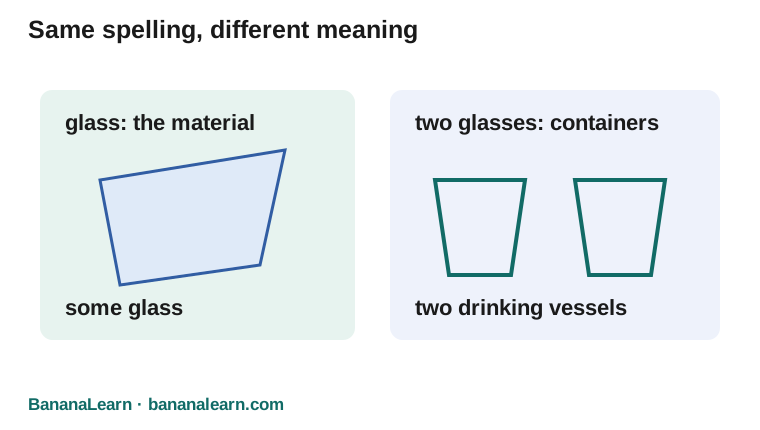
Glass is uncountable when it means the material: The jar is made of glass. A glass is countable when it means a drinking vessel: Put two glasses on the table. Paper as a material is usually uncountable, while a newspaper or a research paper can be a countable text.
Food and drink words can describe portions: two teas may mean two cups of tea in a café. This does not make all uses of tea countable. For a school exercise, read the sentence and its intended meaning before applying the default pattern. A learner dictionary can confirm the countable and uncountable senses of an unfamiliar word.
An editing routine a child can use alone
Read the sentence and identify the meaning of the noun. Ask whether it names separate items or an amount in this sentence. Choose a suitable quantity word, then check whether the verb agrees. Finally read the whole sentence aloud; agreement and natural wording both matter.
For example, There are many furniture in the room has two issues. Furniture is normally uncountable, so write There is a lot of furniture in the room. Alternatively name the separate items: There are many desks in the room. Have the learner explain both repairs; accepting only one memorised replacement hides whether the distinction is understood.
A compact reference for checking your own sentences
Use this reference when checking your own sentences, then explain the choice in a new example.
On a phone, swipe across a wide table to see every column.
| Meaning in this sentence | Examples | Useful forms |
|---|---|---|
| One countable item | a ruler; an idea | a/an, the, my; singular verb |
| Plural countable items | rulers; ideas | many, a few, some, any |
| Uncountable amount | water; information | much, a little, some, any |
| A measured or packed unit | two litres of water | Count the litres, not waters |
| Both groups | books / paper | a lot of books / a lot of paper |
12 questions with explained answers
Try each question first. Open the explanation to check your reasoning. These are original BananaLearn questions, not official exam questions.
Choose: How much / many pencils are in the tray?
Check answer and reasoning
many
Pencils are separate countable items in the plural.Choose: There is a little / a few milk left.
Check answer and reasoning
a little
Milk is an amount in this sentence; a few requires a plural countable noun.Repair: I need an advice.
Check answer and reasoning
I need some advice / a piece of advice.
Advice is normally uncountable. Piece provides a countable unit if one item is intended.Choose: There is / are some equipment in the cupboard.
Check answer and reasoning
is
Equipment is normally uncountable, so its verb is singular.Make three units from the word bread.
Check answer and reasoning
Three slices of bread, for example.
Slices supplies the counted unit. Other plausible units need a clear meaning.Choose: We do not have some / any glue.
Check answer and reasoning
any is the usual neutral choice.
Any is common in negatives. Special contexts can change emphasis, but this exercise uses the ordinary pattern.Is Would you like some water? incorrect because it is a question?
Check answer and reasoning
No.
Some is natural in an offer; questions do not always require any.What does glasses mean in Put two glasses on the table?
Check answer and reasoning
Two drinking vessels.
This countable sense differs from glass as a material.Repair: How many money did you spend?
Check answer and reasoning
How much money did you spend?
Money is uncountable in this ordinary meaning; coins would be countable.Choose: We have a few / a little questions.
Check answer and reasoning
a few
Questions is plural countable.Explain the difference between a little time and little time.
Check answer and reasoning
A little presents some available time; little stresses that there is not much.
Both use the uncountable noun time. The article changes the usual emphasis.Repair both errors: There are many homework today.
Check answer and reasoning
There is a lot of homework today.
Homework is ordinarily uncountable, so use singular is and an amount expression. There are many assignments today is another valid repair.
Choose your next learning step
- Check the verb after the noun phrase
- Practise articles with examples
- Try a wider grammar revision set
- Help a child edit a complete sentence
Explore BananaLearn games, learning resources and tutoring. Maths is our priority; English and Science tutoring are also available. Share your current schoolwork when checking teaching fit.
Sources and scope
Explanations, activities, diagrams and practice are original BananaLearn work. Class labels suggest a learning level; school sequences and current textbook editions can differ. Sources checked 2 November 2026.
- British Council: countable and uncountable noun patterns
- British Council: nouns whose meanings change
How we prepare guides · Report a correction
Share the complete guide: https://bananalearn.com/learn/class-6-countable-uncountable-nouns.html