Maths · Suggested Grade 4
Class 4 Two-Digit Multiplication: Area Model & Practice
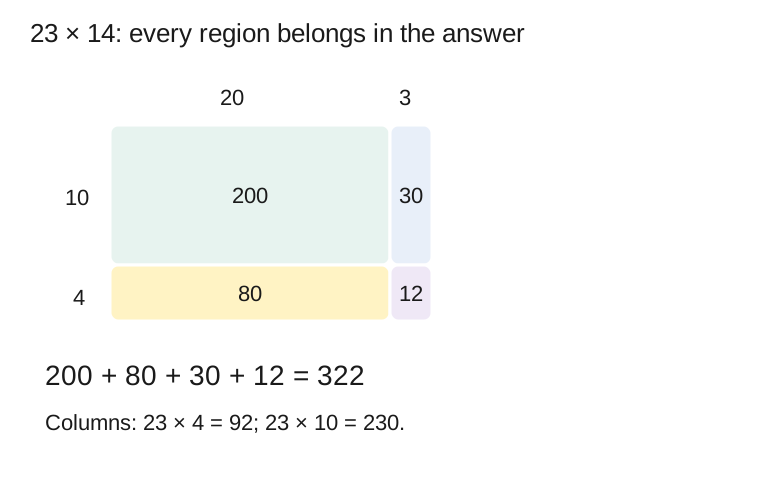
A 23-by-14 rectangle can explain every line of 23 × 14. Split the sides into tens and ones, and the four smaller rectangles show where the answer comes from.
Original explanations and practice by BananaLearn · Published 31 October 2026
On a small screen, swipe across the illustration to read every label.
What you need before multiplying two-digit numbers
You should be able to partition 23 into 20 + 3, multiply a one-digit number by a multiple of ten, and add several numbers. If 6 × 4 is still difficult, use equal groups or an array while you work; understanding the method should not depend on recalling every fact instantly.
The area model represents multiplication as rows by columns. The lengths can be whole-number counts rather than centimetres. When you draw a physical rectangle, area units are square units; when you use the diagram to explain 23 groups of 14 objects, the final unit is objects. Keep the context attached to the answer.
Split both factors, then account for every region
Partition 23 as 20 + 3 and 14 as 10 + 4. Draw one line across each direction, making four rectangles. Label the outside edges before calculating inside: 20 × 10, 20 × 4, 3 × 10 and 3 × 4. These are 200, 80, 30 and 12. Add them: 200 + 80 + 30 + 12 = 322.
Every small cell belongs to exactly one region, so the partial products neither overlap nor leave a gap. This is the distributive property applied twice: (20 + 3)(10 + 4). A drawing that labels only 20 × 10 and 3 × 4 misses the two cross regions and cannot represent the full product.
Worked example: connect the picture to column multiplication
The column method groups the same regions differently. First 23 × 4 = 92, combining 80 and 12. Then 23 × 10 = 230, combining 200 and 30. Finally 92 + 230 = 322. The second row stands for ten groups, which explains its place-value position.
Write 230 as a complete number while learning. Later a placeholder zero can be used, but explain what it represents. Saying move the row over without mentioning tens can hide the meaning. Compare the two methods side by side and point to the regions included in each row.
Worked example: regroup without losing place value
For 36 × 27, split 36 into 30 + 6 and 27 into 20 + 7. The four products are 600, 210, 120 and 42. Their sum is 972. In the shorter method, 36 × 7 = 252 and 36 × 20 = 720. Adding those two partial products also gives 972.
The carry in 6 × 7 = 42 records four tens and two ones; it is not an extra digit to attach at the end. If a child gets 36 × 7 wrong, return to 30 × 7 + 6 × 7 before repeating the whole calculation. Fixing that small step is more useful than copying the finished answer.
Worked example: a word problem and an estimate
A school orders 18 boxes containing 24 pencils each. The product is 24 × 18. Use 24 × 10 + 24 × 8 = 240 + 192 = 432 pencils. The question asks for all pencils, so the answer is not 42 boxes or 432 boxes.
Estimate with 20 × 20 = 400, then check that 432 is plausible. An estimate cannot prove the exact answer: 422 would also be near 400. Combine estimation with checking the partial products or using a second method. You can also calculate 24 × (20 − 2) = 480 − 48 = 432 as an extension.
Common mistakes and how to investigate them
If 23 × 14 becomes 212, ask which regions were counted: 200 + 12 omits 80 and 30. If it becomes 115, inspect whether the second row used 23 × 1 instead of 23 × 10. If a result is ten times too large, check which factor was treated as tens twice.
Do not judge a method by the neatness of its rectangle. A roughly drawn diagram with correct partitions and labels can show good reasoning. Ask the learner to explain one region aloud, then change just one factor. That checks whether the model is understood rather than remembered as a picture.
A short practice routine for students and parents
Begin with an example without regrouping, such as 12 × 13. Move to 23 × 14, then a product such as 36 × 27 with larger partial sums. Finish with a word problem in which the learner identifies the groups and the number in each group before multiplying.
Use the table below as a reusable planning record. Complete the estimate before the exact answer, then compare the result with it. A parent can ask which partial product represents the tens row. If the explanation is clear, let the child choose the area or column method for the next problem.
Copy this calculation record
Copy the record into a notebook or use it to organise your own answer. Blank spaces are for your work.
| Product | Estimate | Partial products | Exact answer and unit | Check |
|---|---|---|---|---|
| 23 × 14 | ___ | ___ | ___ | ___ |
| 36 × 27 | ___ | ___ | ___ | ___ |
| Your own problem | ___ | ___ | ___ | ___ |
10 questions with explained answers
Try the questions before opening the answers. Explain the reason, then try a changed example to check your understanding.
Find 12 × 13.
Show answer and explanation
156
120 + 36 = 156; the area parts are 100, 30, 20 and 6.Find 21 × 14.
Show answer and explanation
294
210 + 84 = 294.Find 32 × 15.
Show answer and explanation
480
320 + 160 = 480.Find 24 × 23.
Show answer and explanation
552
480 + 72 = 552.Find 16 × 18.
Show answer and explanation
288
160 + 128 = 288.Find 45 × 12.
Show answer and explanation
540
450 + 90 = 540.What does the second row represent in 23 × 14?
Show answer and explanation
23 × 10 = 230
The 1 in 14 is one ten, not one unit.A learner adds only 200 and 12 for 23 × 14. What is missing?
Show answer and explanation
80 and 30
The cross regions 20 × 4 and 3 × 10 also belong to the rectangle.There are 17 bags with 22 marbles each. How many marbles?
Show answer and explanation
374 marbles
22 × 10 + 22 × 7 = 220 + 154.Use 25 × (20 − 1) to find 25 × 19.
Show answer and explanation
475
500 − 25 = 475; this is another distributive split.
Keep the ideas connected
- Start with equal rows and columns
- Choose multiplication from the story
- Connect multiplication to division
- Explore a target-number expression game
For help with a school-learning difficulty, bring one attempted question to a discussion about tutoring and curriculum fit. Maths is our priority; English and Science tutoring are also available.
Sources, scope and sharing
The examples, diagrams and practice are original BananaLearn work. Grade labels suggest a learning level; teaching sequences and school requirements can differ. Official sources below support the stated facts and resource links. These activities are independent resources, not official exam questions or endorsed campaign materials.
How we prepare learning guides · Report a correction
Share this guide: https://bananalearn.com/learn/class-4-two-digit-multiplication-area-model.html