1. Compare hydrogen-ion activity at pH 2 and pH 5.
- The pH difference is 3.
- Each unit corresponds to a factor of 10, so 10³=1000.
- The pH 2 sample has 1000 times the hydrogen-ion activity; no general hazard ratio is inferred.
Science · Suggested Class 10 · school sequences vary
A move from pH 5 to pH 3 is not “two times more acidic”. The scale counts powers of ten, and the conditions matter.
Start here
For ordinary dilute aqueous solutions near 25°C, pH below 7 is acidic, 7 neutral and above 7 basic. Each pH unit represents a tenfold change in hydrogen-ion activity.
Original BananaLearn guide · 7 November 2026

On a narrow screen, swipe the diagram or open it full size.
pH describes hydrogen-ion activity on a logarithmic scale. In introductory dilute-solution calculations, activity is often approximated using concentration relative to the standard concentration. Lower pH means greater hydrogen-ion activity.
pH has no units. It does not by itself tell you a liquid’s complete composition, hazard or biological effect. This is an educational interpretation guide, not a test of whether something is safe to drink or touch.
Near 25°C, neutral water has pH about 7. Acidic aqueous solutions have pH below 7; basic ones have pH above 7. Neutral means hydrogen-ion and hydroxide-ion activities are equal in the appropriate chemical description.
The neutral pH changes with temperature. Therefore “pH 7 is neutral at every temperature” is too broad. Introductory questions should state or assume the usual near-room-temperature conditions.
Moving down by one pH unit multiplies hydrogen-ion activity by 10. A pH 3 solution has 100 times the hydrogen-ion activity of a pH 5 solution under the same scale definition.
This comparison is about hydrogen-ion activity, not a blanket statement that every chemical effect or hazard becomes 100 times larger. Name the quantity being compared.
On a narrow screen, swipe the diagram or open it full size.
For a dilute solution where the concentration approximation is appropriate, pH≈−log₁₀[H⁺] when [H⁺] is inserted numerically in mol/L relative to the standard state. If [H⁺]=10⁻⁴ mol/L, the approximate pH is 4.
A positive small concentration can give a positive pH because the negative exponent becomes positive after the leading minus sign. The activity-based definition is more general than this classroom approximation.
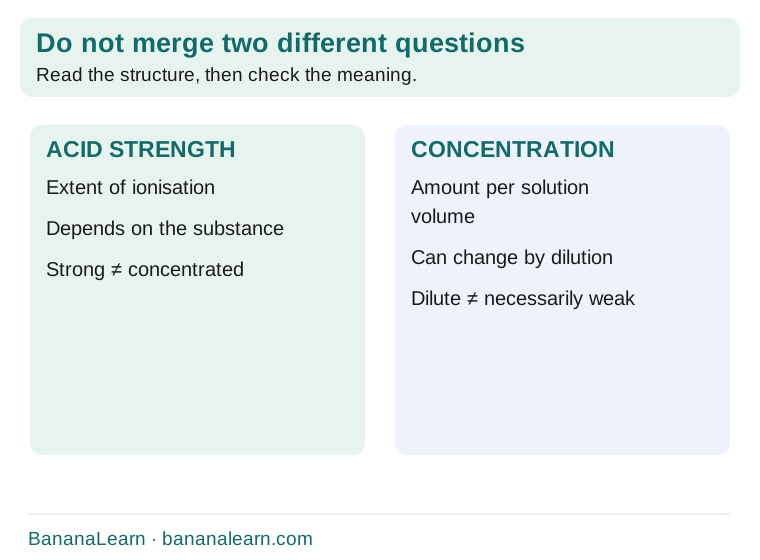
A strong acid ionises extensively in water; a weak acid ionises only partially under the relevant conditions. Concentration describes how much solute is present per amount of solution. A strong acid can be dilute and a weak acid concentrated.
Comparing two pH values alone does not fully classify their acid strength. A solution with a lower pH has greater hydrogen-ion activity, but concentration and chemical identity also affect the interpretation.
Adding water to an ordinary acidic solution generally lowers its hydrogen-ion activity and raises its pH towards the neutral value. A tenfold dilution of a sufficiently acidic strong-acid solution gives an approximate increase of one pH unit.
That simple one-unit rule fails near neutral conditions where water’s contribution matters, and weak-acid equilibria need separate treatment. Dilution does not turn an acid into a base merely by continuing a linear arithmetic pattern.
Litmus distinguishes broad acidic/basic behaviour but does not measure an exact pH. Universal-indicator charts or pH paper estimate a range; a calibrated meter can provide a more precise measurement under appropriate conditions.
Use supplied results for this lesson. Do not taste substances, mix cleaning products or perform unknown-solution tests at home. A paper exercise can develop the interpretation without a chemical handling task.
If a fictional sample reads pH 4, classify it as acidic under the stated near-room-temperature conditions and compare it numerically with another sample. Do not identify it as a particular drink, acid or hazard from that number alone.
A useful record includes the temperature assumption, measurement method, pH value, what comparison is supported and what remains unknown. The familiar 0–14 scale covers many classroom examples, but pH can fall outside that interval in other conditions.
See the reasoning
Try, explain, check
Try each task before opening its explanation. These are original BananaLearn questions, not official exam or past-paper questions. Where several answers can work, the explanation gives the criteria.
Acidic
It is below the neutral value near 7.
Basic
It is above the neutral value near 7.
No
It is a logarithm of a dimensionless activity ratio.
pH 4 is 10 times greater
A lower pH by one unit gives a tenfold increase.
pH 3 is 1000 times greater
The difference is three units.
3
Use the stated dilute-solution approximation.
No
Strength concerns ionisation; concentration concerns amount per solution quantity.
No
It provides a broad classification.
No
Neutral pH depends on temperature.
No
Near-neutral equilibria invalidate that shortcut.
No
Different compositions can have the same pH.
No
Values outside it occur beyond many introductory conditions.
Copy these headings and fill them for one worked task, then for a fresh attempt. Use your own evidence rather than copying the model answer.
Explore BananaLearn’s games, learning features and one-to-one tutoring. Maths is our priority; English and Science tutoring are also available. Bring a recent example of schoolwork when checking teaching fit.
Original BananaLearn explanations, examples, illustrations and practice. Source facts checked 7 November 2026. Suggested levels are learning guides, not a claim that every board or textbook uses the same sequence.
How we prepare guides · Report a correction
Share the complete guide: https://bananalearn.com/learn/class-10-ph-scale-acids-bases.html