Before you start
Solve a linear equation in one variable, multiply signed numbers and substitute a value. A solution to a pair must satisfy both equations at the same time. These original examples support Class 10 revision but are not reproduced textbook exercises.
Need a starting point? Grade 8 Solving Simultaneous Equations Graphically builds a related prerequisite or visual idea.
What is the elimination method?
Elimination combines two equations so that one variable has coefficient zero. It works because equal quantities remain equal when we add or subtract the same quantities. After eliminating one variable, solve the remaining one-variable equation.
Keep one original equation as well as the combined equation. The combined equation alone usually has many ordered-pair solutions; it is the pair together that identifies the shared solution. Recover the second unknown and check both original statements.
Choose addition or subtraction from the signs
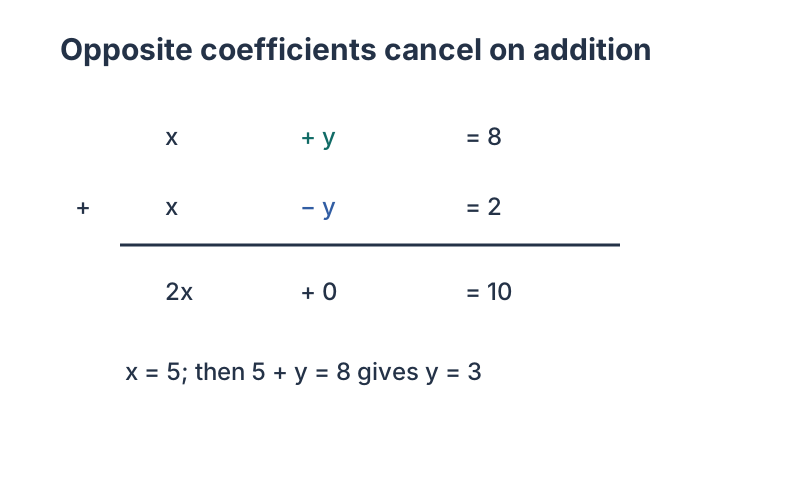
Opposite coefficients, such as +3y and −3y, cancel when added. Equal coefficients, such as +4x and +4x, cancel when subtracted. Write the operation beside the equations before carrying it out.
For subtraction, put the entire second equation in brackets. Subtract every term and the right-hand constant. In (2x + y) − (2x − 3y), the y part becomes y + 3y = 4y, not −2y. This sign change is a common source of errors.
Multiply whole equations to match coefficients
If no coefficients already match, multiply one or both equations by suitable non-zero constants. For 2x + 3y = 13 and 3x − 2y = 0, multiply the first by 2 and the second by 3. Their y coefficients become +6 and −6.
Multiply every term on both sides, including the constant. A reversible multiplication preserves an equation’s solution set. Multiplying only a chosen variable term, or changing the left side but not the right, creates a different equation and can change the answer.
Recover the second unknown and verify
After finding x or y, substitute into whichever original equation gives easier arithmetic. Solve for the other unknown. State the pair with labels: x = 2, y = 3, or (2, 3) when the variable order is clear.
Check each original equation independently. A pair can satisfy the transformed equation while failing one original if an earlier operation was incorrect. A successful two-equation check catches many arithmetic and sign mistakes.
What if both variables disappear?
If elimination gives a contradiction such as 0 = 5, no ordered pair satisfies the equations. Their graphs are distinct parallel lines. If it gives an identity such as 0 = 0, the equations may represent the same line and have infinitely many common solutions.
An identity does not mean x = 0 and y = 0. Retain an original equation to describe the family of solutions. These conclusions assume the ordinary linear-pair setting; inspect the actual equations rather than treating every cancellation as a unique answer.
Turn a word problem into a pair
Name the unknowns with units, translate each independent fact, then eliminate. If x is the price of a notebook and y the price of a pen, 2x + y = 70 means two notebooks and one pen cost ₹70.
After solving, interpret the result in context. A negative length or a fractional count may show that the proposed model does not fit the physical question. Not every real algebraic solution is a feasible answer to a word problem.
See the relationships
Read the labels and explanation together. These diagrams illustrate the examples stated in their captions; the practice questions give their own values.

Worked examples, step by step
Example 1: Solve x + y = 8 and x − y = 2.
- Add the equations: 2x = 10, so x = 5.
- Use x + y = 8: 5 + y = 8, giving y = 3.
- Check: 5 + 3 = 8 and 5 − 3 = 2.
Example 2: Solve 3x + 2y = 16 and 3x − y = 7.
- Subtract the second equation from the first: 3y = 9.
- So y = 3; substitute into 3x − y = 7 to get 3x = 10.
- x = 10/3. Check: 10 + 6 = 16 and 10 − 3 = 7. Fractional solutions are allowed.
Example 3: Solve 2x + 3y = 13 and 3x − 2y = 0.
- Multiply the first equation by 2: 4x + 6y = 26.
- Multiply the second by 3: 9x − 6y = 0. Add to get 13x = 26, so x = 2.
- Substitute: 4 + 3y = 13 gives y = 3. Check the second: 6 − 6 = 0.
Example 4: Solve x + y = 4 and 2x + 2y = 11.
- Double the first: 2x + 2y = 8.
- Subtract it from the second: 0 = 3.
- That is impossible. The pair has no solution, rather than a value obtained by dividing by zero.
Example 5: Two notebooks and a pen cost ₹70. One notebook and a pen cost ₹45. Find each price.
- Let notebook price be x and pen price be y. Write 2x + y = 70 and x + y = 45.
- Subtract: x = 25. Then y = 45 − 25 = 20.
- A notebook costs ₹25 and a pen ₹20. Check both totals: 50 + 20 = 70 and 25 + 20 = 45.
Common mistakes and how to repair them
Changing only one term during scaling
3(x + 2y = 7) must mean 3x + 6y = 21. The right side also changes.
Forgetting the minus sign before brackets
Subtract all terms of the second equation, including its negative terms and constant. Write an intermediate line if needed.
Stopping after finding one variable
A pair of equations asks for a shared ordered pair. Substitute back and give both values unless the question asks for only one.
Practise before opening the answers
Write your working on paper. Open each answer after making an attempt, then compare the explanation. For construction questions, use the named physical tools.
Solve x + y = 10 and x − y = 4.
Show answer and reasoning
x = 7, y = 3. Addition gives 2x = 14. Substitute x = 7 into the first.
Solve 2x + y = 11 and x − y = 1.
Show answer and reasoning
x = 4, y = 3. Addition gives 3x = 12. Then 4 − y = 1.
Solve 2x + 3y = 16 and 2x − y = 4.
Show answer and reasoning
x = 7/2, y = 3. Subtract to get 4y = 12; then 2x = 7.
Solve 3x + 2y = 18 and x − 2y = 2.
Show answer and reasoning
x = 5, y = 3/2. Add to get 4x = 20. Substitute into x − 2y = 2.
Solve 2x + y = 9 and x + 2y = 9.
Show answer and reasoning
x = 3, y = 3. Double the second and subtract the first: 3y = 9. Then recover x.
Classify x + y = 3 and 2x + 2y = 8.
Show answer and reasoning
No solution. Doubling the first gives right side 6, contradicting the second right side 8.
Classify x − y = 2 and 2x − 2y = 4.
Show answer and reasoning
Infinitely many solutions. The second is exactly twice the first; any pair on x − y = 2 works.
Three tickets and a drink cost ₹170. Two tickets and a drink cost ₹120. Find ticket and drink prices.
Show answer and reasoning
Ticket ₹50; drink ₹20. Subtract the equations to get one ticket at ₹50. Then 100 + drink = 120.
Questions students and parents ask
Is elimination always faster than substitution?
No. If a variable already has coefficient 1, substitution can be short. Elimination is often convenient when equal or opposite coefficients appear or can be created with small multipliers.
Can I multiply an equation by a negative number?
Yes, if the multiplier is non-zero and every term on both sides is multiplied. Keep the signs consistent.
Do I have to eliminate x first?
No. Choose the variable that produces simpler arithmetic. Both choices lead to the same shared solution when performed correctly.
Does 0 = 0 give the answer (0, 0)?
No. It signals that the combined equation adds no new restriction. Use an original equation to describe the possible pairs; (0, 0) may not satisfy it.
A simple way to practise together
Ask the learner to explain the cancellation before doing the arithmetic. Then cover the worked solution and ask them to verify the final pair in both originals. A correct check is part of the method.
Keep learning and practising
For a change of pace, explore our learning games. The games list explains the skills each one practises; not every guide has a matching game level. Return to a fresh question here to check this specific idea.
About this guide
Adapted for independent reading from BananaLearn’s Grade 10 teaching material. We reused our course visual library where it fits and created supporting diagrams for the written explanations. The examples and practice are original learning resources, not official NCERT solutions or reproduced exam questions. School sequences and textbook editions differ.
Need another explanation?
Bring one question your child found difficult to a free 50-minute session. Share their grade, curriculum and time zone so we can discuss the next step.
Request a free session