
Start with the key idea
Pause the argument and find out what the first obstacle is: an unclear task, missing knowledge, a difficult transition or something else. Offer a small, specific starting action and a limited choice. If refusal persists or homework causes significant distress, work with the school rather than escalating pressure.
Start with what happened before the refusal
“I am not doing it” is the end of a sequence. Perhaps the child has just returned from a demanding day, cannot find the sheet, or remembers struggling with yesterday's work. Ask a short question at a calmer moment: “Which part feels hardest to start?” Listen before proposing a reward or consequence.

A refusal does not tell you that the child is lazy, anxious or unable. Avoid deciding the cause from a single evening. Look for patterns in the task, timing and support that was available. Take persistent distress seriously without trying to diagnose it yourself.
If emotions are high, take a pause. A plan made in the middle of an argument is less likely to feel like something you are solving together.
Choose a response to the actual obstacle
| What the child says or shows | A possible first action |
|---|---|
| “I don't know what to do.” | Read the instruction together and identify the requested output. |
| “There is too much.” | List the tasks, choose one small starting piece and clarify priorities with the teacher. |
| “I always get this wrong.” | Start with a supported example and separate the error from the child's identity. |
| “I want to finish what I am playing.” | Agree a predictable transition and an endpoint before the next session. |
| “I cannot do any more today.” | Check basic needs and workload, and discuss repeated difficulty with school. |
These are starting points, not scripts that work for every family. Ask whether your proposed action matches what the child is finding difficult.
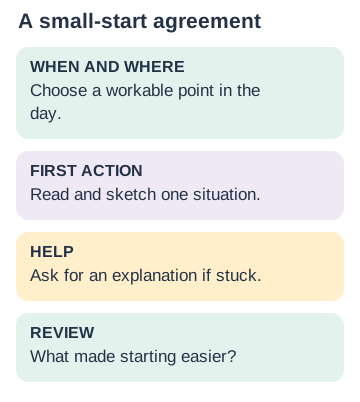
A small start that still leaves the work with the child
Imagine Leo has eight Maths questions and closes the book immediately. His parent asks which question looks confusing. He points to the first word problem and says he does not know which operation to choose.
They agree to read that question and draw the situation before deciding how much to attempt next. The parent says, “Would you like to read it, or shall I read it while you point to the amounts?” That is a choice about how to begin, not a choice between completing everything instantly and losing playtime.
Leo draws four equal groups. The parent asks what the drawing represents and gives him time to choose a calculation. If he is still unsure, they use a different worked example. The goal for this first step is understanding the task, not racing through all eight answers.
If the same barrier returns, they keep an honest work sample and contact the teacher. Requiring the child to repeat an unsupported attempt does not supply the missing explanation.
Make a predictable agreement outside homework time
- Choose when and where you will usually begin, allowing for the real family schedule.
- Describe the first small action: opening the book, reading the instruction or organising materials.
- Offer two workable choices about the process, such as reading aloud or drawing first.
- Agree how the child can ask for help and what a break will look like.
- Review after the attempt: what made starting easier, and what is still difficult?
Keep the agreement short enough to remember. A younger child may prefer three pictures; an older learner may want to write their own plan. A visible timer is optional, and a timer should not be used as a threat.
When the small-start plan is not enough
If the child repeatedly needs you to do most of the task, ask the teacher about the level and intended support. If there is a sudden change in participation, share that change and ask what school has noticed. Persistent distress, pain or difficulties across daily activities need appropriate professional support, not a tougher homework contract.
A useful message is: “We can begin when the first question is explained, but the next similar question still stops him. Could you help us identify the missing step?” Include what you tried and how the child responded.
Use the printable plan below for one task. Do not turn each box into another assignment or a record of bad behaviour. The child's own description of what helped is part of the result.
Further reading: Reading Rockets: family homework support. The examples and printable activities on this page were created by BananaLearn.
Our first-step agreement
Complete this at a calm moment. Use for one task and adjust together after trying it.
A completed example
Task: Maths word problem
What makes starting hard: Choosing what the quantities mean
First small action: Read and draw the situation
Help or break plan: Ask for a similar example if stuck
Opens a separate sheet with the completed example and writing space. Save it as a PDF or print it using your browser. No account is required.
5 worked examples with reasoning
1. A child cannot tell what the question asks.
- Read the instruction together.
- Ask the child to say or point to the required output.
- Then let the child attempt the work, rather than supplying the answer.
2. A child says eight questions feel impossible.
- List the tasks and identify the first manageable action.
- Agree to read and sketch one question.
- Clarify required workload with school if the task remains unrealistic.
3. A child is still playing when homework is announced.
- Discuss a predictable transition at a calm time.
- Agree a clear endpoint for the activity and a first homework action.
- Avoid negotiating an entirely new system during every argument.
4. A parent solves the first question and the child copies it.
- The page may look started, but the child’s understanding is unknown.
- Use a different worked example if teaching is needed.
- Return to a new attempt and record the support.
5. Distress persists despite a smaller starting task.
- Stop escalating the pressure.
- Record the task, timing, support and response.
- Work with the school and seek appropriate professional support when needed.
Save the guide or print the practice
Download to save or share
Complete guide with answers (PDF) · Worksheet without answers (PDF) · Worksheet and answer key (PDF)
These are practice decisions for parents and learners, not an assessment or diagnosis. Compare the suggested response with the explanation and adapt it to the actual task.
14 practice questions with explanations
These are practice decisions for parents and learners, not an assessment or diagnosis. Compare the suggested response with the explanation and adapt it to the actual task.
Write an answer and your reason before opening the explanation. Check the reasoning as well as the final answer.
- Observe
Does “I won’t do it” identify the cause?
Answer and reasoning
No.
Ask what happened before the refusal and look for the first obstacle.
- Choice
Give two process choices for reading a question.
Answer and reasoning
The child reads it, or an adult reads while the child points to the quantities.
Both choices begin the task without choosing the answer.
- Instruction
What is a useful first step when the task is unclear?
Answer and reasoning
Clarify the requested output.
The child needs to know what they are being asked to produce.
- Knowledge
What if the required method is unfamiliar?
Answer and reasoning
Use an explanation or a different worked example.
A demand to try harder does not teach the missing method.
- Transition
When is a predictable starting agreement best discussed?
Answer and reasoning
At a calmer time outside the argument.
This allows the learner to take part.
- Support
Does an adult-completed worksheet show independent work?
Answer and reasoning
No.
Record the help and avoid hiding the difficulty.
- Timer
Must a timer be used?
Answer and reasoning
No.
It is optional and should support the process rather than threaten the child.
- Pattern
What observations can be recorded?
Answer and reasoning
Task, time, obstacle, help offered and response.
These are more specific than a label such as lazy.
- Next step
What if the next similar question still stops the child?
Answer and reasoning
Share the attempt and ask the teacher which step needs teaching.
Repeating unsupported attempts may preserve the obstacle.
- Workload
Should all missed work automatically be doubled tomorrow?
Answer and reasoning
No.
Review the actual workload and school expectations.
- Identity
Is refusal evidence that the child is incapable?
Answer and reasoning
No.
The behaviour alone does not establish ability or cause.
- Review
What should you ask after a small start?
Answer and reasoning
What helped you begin, and what remains difficult?
The answer helps adjust the next attempt.
- Distinguish
Is refusing to start the same as starting willingly but taking hours?
Answer and reasoning
No.
The two patterns may need different observations and support.
- Create
Write a neutral message to the teacher about a recurring obstacle.
Answer and reasoning
For example: We can start after an example, but the next question still needs the same hint. Which step should we practise?
Describe evidence and ask for a specific next step.
Use the ideas without looking at the notes
Use this record for one real task: What happened? What help was offered? What could the learner then do? What new example will we use next? Record support honestly and choose one next step.
Common questions
Should I insist that everything is finished?
Clarify the teacher’s expectations and stopping point. Do not hide a persistent difficulty by completing the assignment yourself.
What if my child refuses every option?
Pause the negotiation, revisit it when calmer and ask about the obstacle. Persistent refusal or distress is a reason to involve the school.
Is this the same as slow homework?
Starting and finishing are different problems. If your child begins willingly but work takes hours, use the task-time log in our slow-homework guide.
Connect your learning
Ask about one-to-one learning support if your child needs help explaining these ideas.
About this guide
Original explanations, examples, diagrams and practice by BananaLearn. The grade label indicates the intended learning level; this is not an official textbook extract or exam paper.