
Start with the key idea
When a child can calculate but struggles with word problems, check the reading, quantities, relationship, calculation and answer sentence separately. Use a small drawing or table, then ask for a fresh related problem with less help.
1. Find where the problem stops making sense
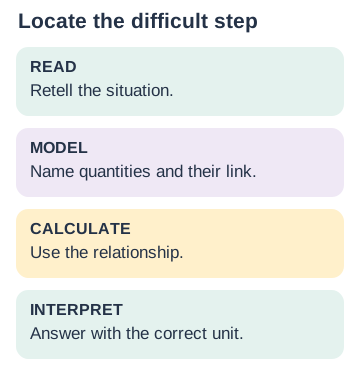
A word problem asks the learner to coordinate several tasks. They must understand the language, identify quantities, recognise their relationship, choose a representation, calculate and interpret the result. A correct multiplication table does not guarantee that all these other steps are secure.
Ask the child to tell the story without calculating. If that is difficult, clarify unfamiliar vocabulary or read it aloud. If the story is clear but the calculation is not, draw the quantities. If the calculation is right but the answer sentence is wrong, focus on interpretation.
Keep the first attempt. Avoid giving several hints in quick succession, because you will lose track of which hint helped. One brief change followed by an explanation gives more useful evidence than finishing the entire worksheet together.
2. Name what every number counts
In “Four bags each contain six marbles”, four counts bags and six counts marbles per bag. The total counts marbles. Draw four labelled bags or write a two-column table before choosing 4 × 6. The units show why multiplication fits.
Now compare “Twenty-four marbles are shared between four bags”. The same numbers can appear in a different relationship. Here the unknown is marbles per bag, so 24 ÷ 4 = 6. Do not choose an operation merely because a familiar pair of numbers appears.
Write the unknown as a question in words: How many marbles are in each bag? If a child draws four marbles instead of four bags, ask what each mark represents. A picture is useful only when it matches the quantities.
3. Replace keyword shortcuts with a relationship
The word more can appear in an addition or subtraction problem. “Dev has 8 stickers and gets 4 more” asks for 8 + 4. “Ria has 12 stickers, which is 4 more than Dev” asks for Dev’s smaller amount: 12 − 4. Read who has which amount.
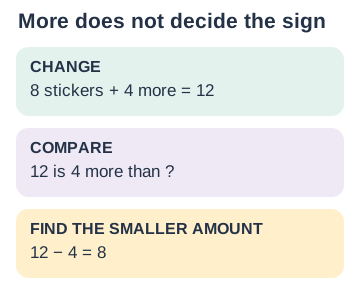
A bar model helps compare the two: Ria’s bar has the same length as Dev’s bar plus a four-sticker part. The complete larger bar is 12. Removing the extra four leaves Dev’s eight. The drawing represents the relationship before the calculation.
Some questions contain numbers that are not needed. “A blue bus has 30 seats and carries 18 passengers; it leaves at 9 o’clock. How many seats are empty?” uses 30 and 18, not 9. Ask what each piece of information contributes.
4. Choose a representation for the problem type
Use equal groups for equal-size collections, a comparison bar for more-than or fewer-than relationships, a number line for changes and a table for repeated quantities. These are options, not a requirement to draw every problem in the same way.
For 3 notebooks costing ₹25 each, a table with notebooks and total cost can show one costs ₹25, two cost ₹50 and three cost ₹75. For a time interval from 2:45 to 3:20, a number line split at 3:00 may be clearer than a cost table.
A learner should eventually explain the link between the representation and the equation. Ask which part of the diagram shows the unknown. If the drawing is decorative or contradicts the story, repair it before proceeding.
5. Check the answer against the situation
Twenty-nine people need vehicles with six available passenger seats each. 29 ÷ 6 = 4 remainder 5 is correct arithmetic. Four vehicles do not carry everyone, so the answer is five vehicles. The meaning of the remainder depends on the question.
If the same calculation concerns complete packs of six stickers, it gives four full packs and five spare stickers. Do not automatically round every remainder up. State what can be split, what must be accommodated and which quantity the question asks for.
Use a rough estimate before or after the calculation. Three ₹25 notebooks should cost less than ₹100 and more than ₹50. ₹7.50 would be implausible. A sensible size check does not prove the answer, but it can expose a misplaced decimal or wrong operation.
6. Make the next attempt small and independent
After explaining one problem, change the numbers while preserving the relationship. Then change the wording while keeping the same structure. This progression helps you see whether the child understood the idea or copied the sentence pattern.
Record the exact help: read aloud, explained vocabulary, drew the first group, suggested the operation, or checked an answer. Use this record when discussing a recurring difficulty with the teacher. It is more informative than “does not understand word problems”.
If reading alone makes the task inaccessible, ask the school how to separate reading support from the Maths objective. If difficulties persist across suitable tasks, share examples with the teacher. This page does not diagnose a learning condition.
5 worked examples with reasoning
1. Four bags hold six marbles each. Find the total.
- Four counts bags; six counts marbles per bag.
- Four equal groups of six give 4 × 6 = 24.
- Answer: 24 marbles.
2. Ria has 12 stickers, 4 more than Dev. Find Dev’s number.
- Ria’s amount is Dev’s amount plus four.
- Subtract the extra four from 12.
- Dev has 8 stickers.
3. A 30-seat bus carries 18 people and leaves at nine. Find empty seats.
- The departure time does not affect the seat count.
- 30 − 18 = 12.
- There are 12 empty seats, assuming each person occupies one seat.
4. 29 people need six-seat vehicles.
- 4 × 6 = 24, leaving five people without seats.
- One more vehicle is needed.
- Five vehicles are required under the stated seating assumption.
5. A child answers three ₹25 notebooks cost ₹7.50.
- Estimate: three amounts near ₹25 should be near ₹75.
- Calculate 3 × 25 = 75.
- Check the unit and explain the decimal error without calling it laziness.
Save the guide or print the practice
Download to save or share
Complete guide with answers (PDF) · Worksheet without answers (PDF) · Worksheet and answer key (PDF)
Try each situation before reading the suggested response. These are learning decisions, not a diagnosis or a score of parenting.
14 practice questions with explanations
Try each situation before reading the suggested response. These are learning decisions, not a diagnosis or a score of parenting.
Write an answer and your reason before opening the explanation. Check the reasoning as well as the final answer.
- Units
In five boxes of eight crayons, what does five count?
Answer and reasoning
Boxes.
Eight counts crayons per box.
- Total
Find the total in five boxes of eight crayons.
Answer and reasoning
40 crayons.
5 × 8 = 40.
- Share
Share 40 crayons equally into five boxes.
Answer and reasoning
8 crayons per box.
40 ÷ 5 = 8.
- Compare
Asha has 15 shells, three more than Ben. How many has Ben?
Answer and reasoning
12 shells.
15 − 3 = 12.
- Change
Ben has 12 shells and finds three more. How many now?
Answer and reasoning
15 shells.
12 + 3 = 15.
- Read
Does more always mean addition?
Answer and reasoning
No.
The relationship and unknown determine the operation.
- Irrelevant
A red box weighs 5 kg and costs ₹200. What matters when finding the mass of two identical boxes?
Answer and reasoning
5 kg per box.
The price is irrelevant to that question.
- Multiply
What is the mass of two such boxes?
Answer and reasoning
10 kg.
2 × 5 kg = 10 kg.
- Remainder
Pack 29 stickers in complete sets of six. How many complete sets?
Answer and reasoning
Four, with five stickers spare.
A partial set is not a complete set.
- Remainder
Why do 29 passengers need five six-seat vehicles?
Answer and reasoning
Four vehicles seat only 24.
Every passenger needs a seat.
- Representation
What should you ask about a child’s drawing?
Answer and reasoning
What does each mark or part represent?
A useful drawing must match the quantities.
- Support
Is a correct answer after suggesting the operation independent?
Answer and reasoning
No.
Record the operation hint.
- Transfer
What is a useful next problem after a worked comparison?
Answer and reasoning
A fresh comparison with new numbers, then different wording.
This checks the relationship rather than copying.
- Record
What should a teacher see?
Answer and reasoning
The task, first attempt and specific help supplied.
These locate the difficult step.
Use the ideas without looking at the notes
Make a one-task record: the question, the learner’s first response, the support offered, what happened next and one fresh follow-up. Use the evidence to choose the next step rather than assigning a label.
Common questions
Should I read the question aloud?
It can help separate reading demand from mathematical reasoning during practice. Follow the school’s rules for assessed work.
Should my child always draw a bar model?
No. Choose a representation that clarifies the relationship; some problems need a different model.
Are keyword lists enough?
No. Words such as more can occur in different relationships.
How many problems should we do?
Use a manageable number that lets the child explain the target idea; stop repeating guesses when teaching is needed.
Connect your learning
Ask about guided Maths learning if your child needs help explaining these ideas.
About this guide
Original explanations, examples, diagrams and practice by BananaLearn. The grade label indicates the intended learning level; this is not an official textbook extract or exam paper.