
Start with the key idea
Choose one school-linked idea, use a clear everyday example, ask the child to explain and finish with a new task. Adapt the level with the teacher: Australian schools and jurisdictions determine their teaching sequence, so these original activities are not a complete year-level curriculum.
1. Ask what the class is learning before choosing practice
Use the current school topic and the child’s work to choose a starting point. The Australian Curriculum provides a national framework, while state and territory arrangements and schools shape implementation. Ask the teacher which representation or method the class is using and what a useful home example would look like.
Do not infer a precise skill level from a year label alone. A learner may be confident with whole-number addition but still need support connecting decimal notation with money. Another may calculate accurately but struggle to describe the units in a measurement problem.
Choose one visible outcome, such as explaining why $3.40 + $2.50 is $5.90 or measuring a length from the ruler’s zero mark. A small, specific target makes feedback clearer than a general instruction to get better at maths.
2. Use money to connect place value and calculation
For $3.40 + $2.50, combine three dollars and two dollars to make five dollars, then forty cents and fifty cents to make ninety cents. The total is $5.90. Write the decimal calculation alongside the explanation so the notation is connected to value.

Next try a price that crosses a dollar boundary: $3.70 + $2.60 = $6.30. Seventy cents plus sixty cents is one dollar thirty cents; that extra dollar joins the five dollars. Ask the learner to explain the regrouping rather than only copying aligned digits.
Keep the example clear about what is being calculated. A displayed price addition task is not a lesson about tax, discounts or banking. If using a real receipt, remove personal details and choose a simple relevant line. Everyday context should clarify the mathematics rather than bury it under unnecessary information.
3. Make measurement something the learner checks
Choose a safe object such as a book and an appropriate ruler. Estimate its length, line up one end with zero, read the scale and record the unit. If the object starts at a different mark, subtract the start reading from the end reading rather than reporting the end number alone.
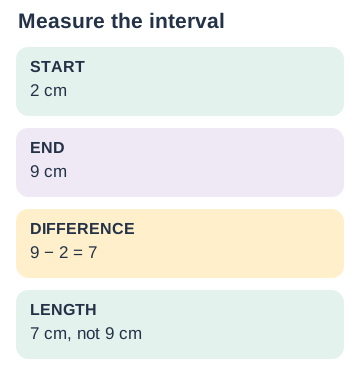
For example, a strip runs from 2 cm to 9 cm on the scale. Its length is 9 − 2 = 7 cm. This is a useful check that the child understands measurement as an interval, not merely reading the number nearest the far end.
Compare the estimate with the measurement without treating an imperfect estimate as failure. Ask whether the estimate was plausible and what reference could improve it. Keep units consistent: 1 metre is 100 centimetres, so 1.2 metres is 120 centimetres.
4. Use equal groups and arrays for multiplication
Place twelve counters in three equal rows of four. Ask what each number counts: three rows, four counters in each row and twelve altogether. Rotate the arrangement to see four rows of three. The total remains twelve, even though the row description changes.
Then change the question: how many groups of four can be made from twenty counters? Five groups, because 5 × 4 = 20. The same relationship can be described through multiplication or division, but the unknown quantity differs.
Use counters large enough to be safe for the child, or draw dots instead. The model should match the story. If a learner simply counts every dot, ask whether the equal rows offer another way to find the total; do not force speed before the grouping is understood.
5. Keep a short routine with a real stopping point
A useful session has an attempt, a conversation, a small teaching response and a fresh check. For instance, calculate two prices, explain the cents, model one regrouping if necessary and try a new pair. The example is a structure, not a prescribed daily duration.
Let the child choose between two suitable contexts when that helps participation: measuring a book or a table edge, or comparing two imaginary prices. The choice should not hide the mathematical aim. Keep the numbers at a level where the learner can engage with the target idea.
If the child is guessing repeatedly, stop adding similar questions and teach the missing step. If the task is easy, ask for a reason or a new representation rather than simply increasing the number of items. Share persistent patterns with the teacher using the original work and the support given.
6. Notice independent reasoning, not just completion
Record one example of what the child could explain and one next question. “Added the cents across one dollar after a reminder” is more useful than “finished a page”. Return to the idea later with different values to see what is now independent.
Avoid using a home routine as a high-stakes assessment. These activities cannot establish a curriculum level, diagnose a difficulty or guarantee school results. Use the teacher’s guidance for formal expectations and support needs.
A routine should fit the family’s actual week and leave room for other activities. If a planned session is missed, continue at the next workable opportunity. The quality of the explanation and the fit of the task matter more than preserving a perfect streak.
Our everyday maths record
Use the record for money, measurement or equal groups. Keep real receipts free of personal details and do not turn a short home activity into a formal level judgement.
Current school idea: ____________________
Context and quantities with units: ____________________
Learner’s first method: ____________________
A drawing or explanation of why it works: ____________________
Fresh example and any support used: ____________________
One useful next question: ____________________
Save the full guide to keep this record with the explanations. The separate worksheet contains the practice and decision questions; use its answer version to check your reasoning.
5 worked examples with reasoning
1. Add $3.40 and $2.50.
- Combine dollars: 3 + 2 = 5.
- Combine cents: 40 + 50 = 90.
- The total is $5.90.
2. Add $3.70 and $2.60.
- The dollars total five.
- 130 cents equals one dollar thirty cents.
- The total is $6.30.
3. Measure a strip from the 2 cm mark to the 9 cm mark.
- Identify the start and end readings.
- Subtract 9 − 2.
- The strip is 7 cm long.
4. Arrange twelve counters as three rows of four.
- Count three equal rows.
- Each row contains four counters.
- 3 × 4 = 12, and the rotated array also shows 4 × 3 = 12.
5. A child finishes all questions after copying a model.
- Record that support was used.
- Choose one new suitable task.
- Ask for an independent explanation before deciding the idea is secure.
Save the guide or print the practice
Download to save or share
Complete guide with answers (PDF) · Worksheet without answers (PDF) · Worksheet and answer key (PDF)
Try each original maths activity and explain the units or method. The parent decision questions help you adapt the routine; this is not a formal year-level assessment.
14 practice questions with explanations
Try each original maths activity and explain the units or method. The parent decision questions help you adapt the routine; this is not a formal year-level assessment.
Write an answer and your reason before opening the explanation. Check the reasoning as well as the final answer.
- Money
Add $2.30 and $1.40.
Answer and reasoning
$3.70.
Two plus one dollars and thirty plus forty cents.
- Money
Add $4.80 and $1.50.
Answer and reasoning
$6.30.
130 cents contributes one extra dollar.
- Change
An item costs $3.60 and is paid for with $5. What is the change?
Answer and reasoning
$1.40.
5.00 − 3.60 = 1.40.
- Measure
A strip runs from 3 cm to 11 cm. Find its length.
Answer and reasoning
8 cm.
Subtract the start reading from the end reading.
- Units
Convert 1.2 m to cm.
Answer and reasoning
120 cm.
One metre is one hundred centimetres.
- Array
Four rows contain five counters each. How many counters?
Answer and reasoning
20.
4 × 5 = 20.
- Groups
How many groups of four can be made from twenty counters?
Answer and reasoning
Five.
20 ÷ 4 = 5.
- Meaning
In three rows of four, what does the three count?
Answer and reasoning
Rows.
The unit attached to each number matters.
- Estimate
Is $2.10 + $3.20 likely to be close to $50?
Answer and reasoning
No.
The amounts are close to two and three dollars, giving about five.
- Check
Why start a ruler at zero when possible?
Answer and reasoning
It makes the reading directly show the length.
Otherwise subtract the starting mark.
- Routine
What follows a taught example?
Answer and reasoning
A fresh suitable task.
It checks whether the idea can be used.
- Level
Can these activities establish a formal year-level result?
Answer and reasoning
No.
They are learning examples, not a standardised assessment.
- School
Who can clarify the current classroom method?
Answer and reasoning
The child’s teacher.
Match home support to actual school learning.
- Review
What is more useful than recording only a completed page?
Answer and reasoning
A specific independent explanation and any support needed.
Completion can hide different levels of understanding.
Use the ideas without looking at the notes
Choose one current school idea. Use a familiar context, ask what each number and unit means, teach only the missing step and check a new example. Record independent reasoning and ask the teacher about persistent difficulty.
Common questions
Are these tasks a full Australian year-level syllabus?
No. They are adaptable original examples. Confirm the current course and expectations with the school.
Must we use money every day?
No. Choose a context that helps the current idea, such as measurement or equal groups.
Should every practice session be timed?
No. Timing is unnecessary when the aim is explaining a concept.
What if the task is too difficult?
Reduce unnecessary demands, teach the missing step and ask the teacher about suitable next examples.
Connect your learning
Ask about one-to-one learning support if your child needs help explaining these ideas.
About this guide
Original explanations, examples, diagrams and practice by BananaLearn. The grade label indicates the intended learning level; this is not an official textbook extract or exam paper.