Learning · Parent guide
Changing Schools: A Learning Handover Checklist for Parents
Two schools can use the same class number and teach fractions in a different order. A useful handover asks what the child can already explain and what the new class is doing next.
Original BananaLearn guide · 2 November 2026
On a phone, swipe across the illustration to read every label.
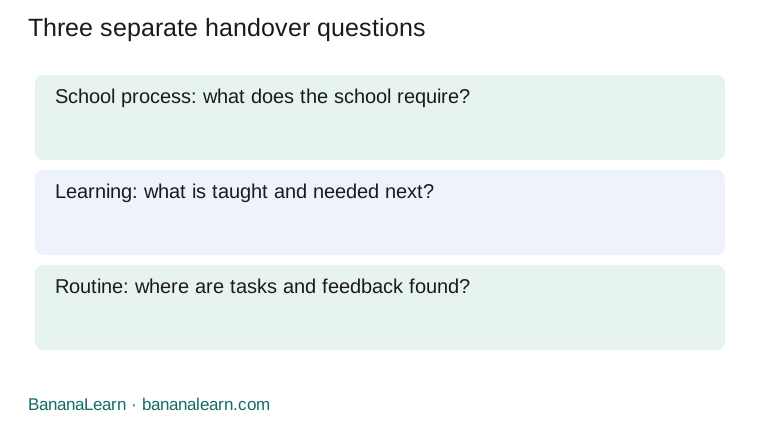
Separate the school process from the learning handover
The new school’s admissions and administrative process determines its required documents and placement decisions. Ask the school directly about those requirements. This guide focuses on the learning information that may help a child settle; it is not an admissions checklist for every country.
A class or year label does not guarantee identical content. Schools can differ in curriculum, textbook edition, language, teaching sequence and assessment. A move between boards or countries makes checking those differences especially useful, but even two local schools may use different sequences.
Collect a small useful learning picture
Choose a recent report, a short description of topics taught and a few representative work samples if the school wants them. Include an independent attempt and, where relevant, the kind of support that helped. A large unfiltered archive may make the important information harder to find.
Ask which information is useful to the receiving teacher and use the school’s agreed private route. Do not turn the child’s complete records into a public shareable document. The blank checklist is reusable; completed personal records should stay with the appropriate adults and school.
Compare sequence before calling something a gap
Ask What has the child been taught? What has the new class already covered? What will it use in the next few lessons? A topic not previously taught is different from a topic taught but not yet secure. Both may need support, but the explanation and expectations differ.
Avoid interpreting unfamiliar vocabulary as proof that the concept is missing. For example, regrouping and borrowing may refer to related written-subtraction ideas in different classroom language. Ask the child to show a method and let the teacher connect terminology rather than forcing a label first.
On a phone, swipe across the illustration to read every label.
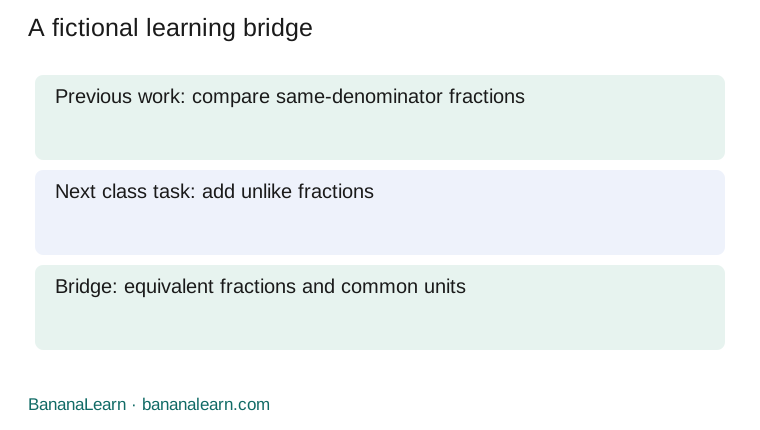
Use an original fictional Maths handover
Suppose a child can compare fractions with the same denominator but has not been taught common denominators. The receiving class is adding unlike fractions. The immediate teaching need is the link between equivalent fractions, common units and addition, rather than repeating every earlier fraction topic.
A work sample could show a same-denominator comparison and one attempted unlike-denominator problem, with a note about help received. The teacher can then choose an entry point. This is a fictional scenario, not a claim about the sequence of every CBSE, ICSE or international class.
Ask about classroom routines as well as content
Find out how assignments are set, how questions are asked, what equipment is normally needed and how the child receives feedback. A learner may understand a topic while being unsure how to submit work or ask for help in a new system.
Keep the questions practical: Where do we find the current task? What should the child do if an instruction is unclear? Which reading or revision routine is used? The answers can prevent routine confusion from being mistaken for a subject-learning problem.
Plan the first fortnight flexibly
During the first few lessons, gather observations instead of assigning a large speculative bridge course. If the teacher identifies a prerequisite, use a focused explanation and a fresh check. Revisit the plan after the child has seen the new classroom methods and materials.
Fortnight is a planning example, not a promised settling-in deadline. Some transitions need more time and different support. Balance the learning work with becoming familiar with classmates, routines and the new environment; this guide does not assess emotional or specialist needs.
Coordinate tutoring with the receiving school
If tutoring is appropriate, share the receiving class’s current topic and a real sample of where the child is stuck. Ask how the tutor will bridge that specific difference and avoid teaching a conflicting shortcut without explanation. A board name alone does not describe the child’s immediate need.
BananaLearn offers Maths, English and Science tutoring, with Maths the priority. Check the exact topic, curriculum and teacher fit. A move to a new country does not automatically establish support for every local examination or syllabus; make the school materials part of the discussion.
Review what changed after the handover
Ask whether the child can find tasks, explain the current idea and attempt a fresh question with appropriate independence. A shorter note with current evidence is more useful than repeatedly forwarding the same old report. Keep teacher questions and agreed actions together.
The checklist below separates administrative questions, learning sequence and everyday routines. Use the school’s decisions for admissions and placement, and use current classroom evidence for teaching support. Do not promise that a single worksheet or tutor can remove every transition difficulty.
A private learning handover
Copy this record into a notebook. Fill each blank using your own example or the activity above.
On a phone, swipe across a wide table to see every column.
| Area | Current information | Question / next step |
|---|---|---|
| School process | ___ | ___ |
| Curriculum / book / language | ___ | ___ |
| Topics taught and current class topic | ___ | ___ |
| Independent sample and help | ___ | ___ |
| Task and feedback routines | ___ | ___ |
| Review point | ___ | ___ |
10 questions with explained answers
Try each question first. Open the explanation to check your reasoning. These are original BananaLearn questions, not official exam questions.
Does the same class number prove the same teaching sequence?
Check answer and reasoning
No.
Curricula, books and school plans may differ.Who confirms required admission documents?
Check answer and reasoning
The receiving school.
This learning checklist is not a universal admissions rule.What is a useful small work sample?
Check answer and reasoning
A representative attempt with the level of help noted.
It helps identify what the child can do independently.How is not yet taught different from taught but insecure?
Check answer and reasoning
The first needs an introduction; the second may need a targeted explanation or practice.
The apparent gap has a different origin.Can unfamiliar vocabulary hide an understood concept?
Check answer and reasoning
Yes.
Ask the child to demonstrate the idea and connect the terms.What prerequisite is missing in the fictional fraction case?
Check answer and reasoning
Common units through equivalent fractions and denominators.
Repeating every earlier fraction topic is not automatically necessary.Name one non-content routine worth checking.
Check answer and reasoning
For example, where tasks are posted or how work is submitted.
Routine uncertainty can affect participation without showing a conceptual gap.Is two weeks a guaranteed adjustment time?
Check answer and reasoning
No.
It is only an example review interval.What should an outside tutor know?
Check answer and reasoning
The receiving school’s current task and the specific point of difficulty.
A board label alone is too broad.Where should completed personal handover records be shared?
Check answer and reasoning
Through the school’s agreed private process.
The reusable blank template does not require public student information.
Choose your next learning step
- Explore the India-to-UAE example separately
- Connect different classroom vocabulary
- Support CBSE learning overseas
- Check curriculum and time-zone fit
Explore BananaLearn games, learning resources and tutoring. Maths is our priority; English and Science tutoring are also available. Share your current schoolwork when checking teaching fit.
Sources and scope
Explanations, activities, diagrams and practice are original BananaLearn work. Class labels suggest a learning level; school sequences and current textbook editions can differ. Sources checked 2 November 2026.
How we prepare guides · Report a correction
Share the complete guide: https://bananalearn.com/learn/changing-schools-learning-handover.html