
Start with the key idea
Connect unfamiliar vocabulary to a quantity, diagram or example before assuming a concept gap. Maths and math name the same subject; spelling differences, number names and local course labels need separate checks. Use the school’s expected notation when completing its tasks.
1. Separate spelling, terminology and understanding
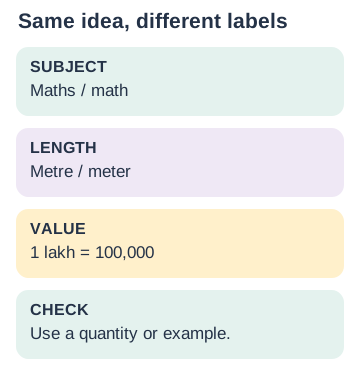
Maths is common in British English and many other English varieties; math is common in American English. They refer to the same subject. Similarly, metre and meter can name the same metric unit of length, depending on the English variety used. A different spelling does not change the size of a centimetre.
Some differences involve a word rather than spelling. A problem may ask for the total, sum or amount altogether, but those words must be read in the whole sentence. Do not teach a list of keyword-to-operation shortcuts: “How much more does A have?” can require a comparison rather than addition.
Begin by asking the learner to show what the question means. If they can model it after one word is clarified, vocabulary may have been the immediate obstacle. If the model remains unclear, teach the relationship as well. The two kinds of support can be needed together.
2. Build a small glossary with examples
Use three columns: term on the page, meaning in this task and a worked example. For numerator, write “the number above the fraction bar” and show that 3 is the numerator of 3/5. For denominator, identify 5 and explain that it names five equal parts of the whole in this example.
Include a drawing or unit when it adds meaning. Area is the amount of surface covered, measured in square units; perimeter is the total boundary length, measured in length units. For a 4 cm by 3 cm rectangle, area is 12 square centimetres and perimeter is 14 centimetres.
Keep the glossary connected to real work rather than trying to memorise hundreds of terms at once. After clarifying a term, use it in a fresh problem. A child who can repeat a definition but cannot connect it to a diagram may still need an example.
3. Translate number names without changing the value
Indian and international place-value naming can group and name large numbers differently. One lakh is 100,000, or one hundred thousand. One crore is 10,000,000, or ten million. The quantities are unchanged; the names and comma grouping differ.
For example, 2,50,000 in Indian grouping is 250,000 in international grouping. Both represent two hundred fifty thousand, or two lakh fifty thousand. Compare the digits and place values rather than treating commas as arithmetic operations.
Ask which convention the school expects in a particular task. When moving between books, write the number in words and in a place-value expansion if confusion remains: 250,000 = 200,000 + 50,000. Avoid introducing unfamiliar very large numbers before the learner is ready for the underlying place values.
4. Read instruction words as actions
A task that asks a learner to calculate usually wants a numerical result; a task asking them to explain needs reasoning in addition to an answer. Estimate asks for a sensible approximate result, while compare asks for a relationship. The exact expected response still depends on the question and course.
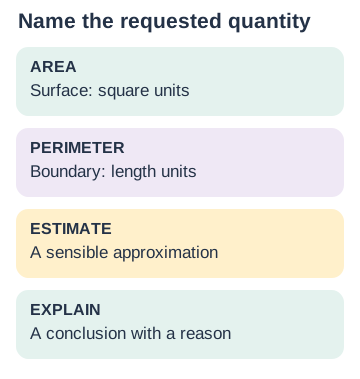
Consider “Estimate 198 + 304.” Rounding to nearby hundreds gives about 200 + 300 = 500. The exact sum is 502, but supplying only the exact answer may miss the requested estimation process. Ask what the instruction asks the learner to show.
For “Explain why 3/4 is greater than 2/3”, a comparison using twelfths gives 9/12 > 8/12. The statement 3/4 > 2/3 is the conclusion; the equal-part comparison is the reason. This distinction is useful across many English varieties and school systems.
5. Treat grade, year and course labels separately
A grade or year label belongs to an education system and school placement process; it is not a mathematical vocabulary translation. Do not assume that Year 6 and Grade 6 always describe identical ages, content or expectations. Ask the receiving school for the actual course and topic list.
The same caution applies to names such as elementary, primary, middle school and lower secondary. These can help describe a broad stage, but they do not establish a learner’s precise syllabus. Use sample work and school documents to identify the immediate learning need.
When enquiring about support, supply the country, school stage, curriculum and current topic. A tutor can then confirm suitability rather than guessing from the word math or maths. This guide explains language connections; it is not an equivalence table for international school admissions.
6. Use a meaning–example–fresh-task routine
When a new word causes difficulty, read it in the sentence, explain it with an example and ask the learner to use it in a different task. Record the term only if it remains useful. Revisit it when it naturally occurs in later work rather than turning every lesson into a vocabulary test.
For example, after showing a rectangle’s perimeter as the boundary, ask for the perimeter of a 5 cm by 2 cm rectangle. The answer is 14 cm. Then ask for its area, 10 square centimetres, so the learner must choose between two quantities rather than repeat one formula automatically.
Respect the language the child already knows. A familiar term can be a bridge to the school’s term. Correct notation where the task requires it, but avoid treating a spelling variety as evidence of weak mathematical thinking. Judge the explanation and the represented quantity.
My vocabulary-to-meaning glossary
Add words only when they matter to current work. A useful glossary connects language to a quantity or relationship rather than listing definitions without examples.
Term on the school task: ____________________
Familiar word or spelling, if helpful: ____________________
Meaning in this sentence: ____________________
Diagram, quantity or worked example: ____________________
A new task using the term: ____________________
School notation or convention to remember: ____________________
Save the full guide to keep this record with the explanations. The separate worksheet contains the practice and decision questions; use its answer version to check your reasoning.
5 worked examples with reasoning
1. Compare metre and meter in a length question.
- Both can name the same metric length unit.
- Show a ruler or a marked length if needed.
- Use the spelling expected in the school’s response.
2. Write 2,50,000 in international grouping.
- Read the value as two lakh fifty thousand.
- This equals two hundred fifty thousand.
- Write 250,000; the quantity has not changed.
3. Estimate 198 + 304.
- Choose nearby hundreds: 200 and 300.
- Add to get about 500.
- The exact total is 502, which is consistent with the estimate.
4. Explain why 3/4 is greater than 2/3.
- Use a common whole divided into twelfths.
- 3/4 = 9/12 and 2/3 = 8/12.
- Nine equal parts exceed eight of the same parts.
5. A 5 cm by 2 cm rectangle has two different measurements.
- Area is 5 × 2 = 10 square centimetres.
- Perimeter is 5 + 2 + 5 + 2 = 14 cm.
- Name the requested quantity before choosing a method.
Save the guide or print the practice
Download to save or share
Complete guide with answers (PDF) · Worksheet without answers (PDF) · Worksheet and answer key (PDF)
Answer each language-and-maths task with the requested quantity or explanation. Keep units visible. You may use the glossary while learning, then try a fresh example without it.
14 practice questions with explanations
Answer each language-and-maths task with the requested quantity or explanation. Keep units visible. You may use the glossary while learning, then try a fresh example without it.
Write an answer and your reason before opening the explanation. Check the reasoning as well as the final answer.
- Name
Do maths and math name different subjects?
Answer and reasoning
No.
They are language variants of the subject name.
- Spelling
Does a meter have a different length from a metre?
Answer and reasoning
No.
The spelling varies, not the metric unit.
- Fraction
Name the numerator of 4/7.
Answer and reasoning
4.
It is above the fraction bar.
- Fraction
What is the denominator of 4/7?
Answer and reasoning
7.
It identifies the equal-part division of the whole here.
- Number
Write one lakh as an international numeral.
Answer and reasoning
100,000.
One lakh is one hundred thousand.
- Number
How many million are in one crore?
Answer and reasoning
Ten million.
One crore is 10,000,000.
- Grouping
Rewrite 3,20,000 in international grouping.
Answer and reasoning
320,000.
The digits retain the same place values.
- Estimate
Estimate 397 + 203 using nearby hundreds.
Answer and reasoning
About 600.
400 + 200 = 600.
- Exact
Find the exact value of 397 + 203.
Answer and reasoning
600.
In this case the estimate and exact value coincide.
- Area
Find the area of a 6 cm by 2 cm rectangle.
Answer and reasoning
12 square centimetres.
Multiply the two side lengths.
- Perimeter
Find the perimeter of a 6 cm by 2 cm rectangle.
Answer and reasoning
16 cm.
6 + 2 + 6 + 2 = 16.
- Compare
Explain whether 1/2 is greater than 2/5.
Answer and reasoning
Yes: 5/10 is greater than 4/10.
Use equal-sized parts of the same whole.
- Instruction
What extra element does explain usually need beyond a final answer?
Answer and reasoning
A reason or method connected to the answer.
Check the actual task for its expected detail.
- Placement
Can Grade 6 be automatically equated with Year 6 everywhere?
Answer and reasoning
No.
Confirm the school system, placement and course.
Use the ideas without looking at the notes
Read the term in context, show its meaning with a quantity or diagram and try a fresh task. Keep number values unchanged when regrouping commas. Confirm school-stage labels separately from mathematical vocabulary.
Common questions
Should a child stop using a familiar spelling?
Use the school’s expected convention in its tasks, while recognising that other standard variants can describe the same idea.
Are keywords enough to select an operation?
No. Read the whole relationship and identify what is unknown.
Is this an international grade-equivalence chart?
No. School placement and curriculum must be checked separately.
How many vocabulary words should we teach at once?
Choose terms that matter to the current task and check their use with examples; there is no fixed required number here.
Connect your learning
Ask about one-to-one learning support if your child needs help explaining these ideas.
About this guide
Original explanations, examples, diagrams and practice by BananaLearn. The grade label indicates the intended learning level; this is not an official textbook extract or exam paper.