1. Solve |2x−3|=7.
- Use 2x−3=7 or 2x−3=−7.
- The solutions are x=5 and x=−2.
- Check: |10−3|=7 and |−4−3|=7.
Maths · Algebra / Precalculus · suggested level; school sequences vary
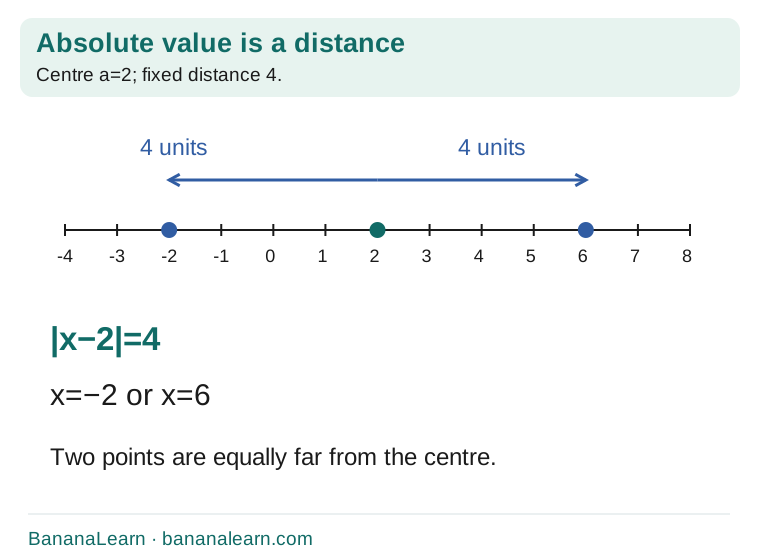
A point 4 units from 2 can be on either side of 2. Distance explains why one absolute-value equation can have two answers.
Start here
|x−a| is the distance between x and a. An equation fixes that distance; an inequality selects points inside or outside a distance boundary.
Original BananaLearn guide · 7 November 2026
On a narrow screen, swipe the diagram or open it full size.
For a real number x, |x| is its non-negative distance from zero. Thus |−7|=7, |7|=7 and |0|=0. Absolute value is not an instruction to remove a negative sign anywhere in a longer expression.
Evaluate the expression inside the bars first. For example |3−8|=|−5|=5, while |3|−|8|=−5. The location of the bars changes the operation.
The expression |x−a| measures distance from a. In |x−2|=4, the points are 4 units to either side of 2: x=−2 and x=6.
For |x+3|, the centre is −3 because x+3=x−(−3). Draw the centre before marking endpoints to avoid the same sign reversal that occurs in vertex form.
For |u|=k, a positive k gives u=k or u=−k. If k=0, the two cases coincide at u=0. If k<0, there is no real solution because distance cannot be negative.
Solve any algebra inside u after choosing the valid cases. Check both answers in the original equation, especially if you first move constants or divide by coefficients.
On a narrow screen, swipe the diagram or open it full size.
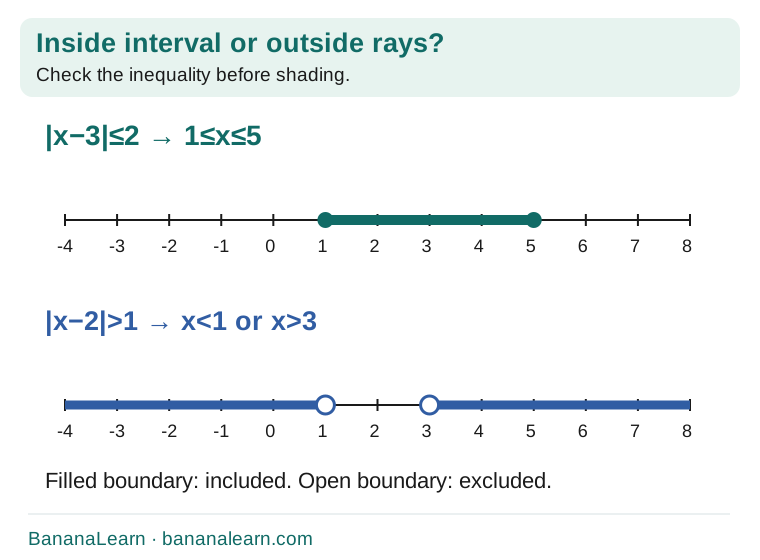
For k>0, |x−a|<k means a−k<x<a+k. The point is closer than k to the centre. Using ≤ includes both endpoints.
For |x−3|≤2, the solution is 1≤x≤5. Test the centre 3, an endpoint 1 and an outside point 0. They explain the filled endpoints and shaded interval.
For k>0, |x−a|>k means x<a−k or x>a+k. There are two separate rays; the word “or” is essential. Using ≥ includes the endpoints.
For |x+1|>3, the centre is −1 and the boundaries are −4 and 2. Solutions lie below −4 or above 2. Values between the boundaries are too close to the centre.
For 2|x−1|+3=11, subtract 3 and divide by 2 to get |x−1|=4. Then x−1=4 or −4, giving x=5 or −3.
Do not split the original equation into x−1=11 and x−1=−11. The outer multiplication and addition are part of the equation and must be undone first.
Every absolute value is ≥0. Thus |x|<0 has no solutions, |x|≥0 has all real solutions and |x|≤0 has only x=0. These boundary cases need reasoning rather than a memorised positive-bound template.
If multiplying or dividing an inequality by a negative number, reverse the inequality sign. Isolating the absolute value first usually makes this easy to see.
Record the centre, distance condition, endpoints, whether boundaries are included and one test point from each region. Give the final answer in words, inequality or interval form as your course requests.
A real-world tolerance can use this model: a length within 0.2 cm of 10 cm satisfies |L−10|≤0.2. State units and the context’s allowed domain. This guide uses simple linear expressions inside the bars; equations with several absolute-value terms need additional case analysis.
See the reasoning
Try, explain, check
Try each task before opening its explanation. These are original BananaLearn questions, not official exam or past-paper questions. Where several answers can work, the explanation gives the criteria.
12
It is a distance from zero.
7
Evaluate inside first.
x=−5 or 5
Both are 5 units from zero.
x=0
Only zero has zero distance.
No real solution
Distance cannot be negative.
x=−2 or 4
Move 3 units either side of 1.
−6≤x≤−2
The centre is −4 and the boundaries are included.
x<1 or x>3
Use the two outside rays.
x=−4 or 4
Divide by 3 before splitting cases.
Yes
All absolute values are non-negative.
7.5≤L≤8.5 cm
The wording includes the boundary tolerance here.
No
For a=3,b=−3, the left side is 0 and the right is 6.
Copy these headings and fill them for one worked task, then for a fresh attempt. Use your own evidence rather than copying the model answer.
Explore BananaLearn’s games, learning features and one-to-one tutoring. Maths is our priority; English and Science tutoring are also available. Bring a recent example of schoolwork when checking teaching fit.
Original BananaLearn explanations, examples, illustrations and practice. Source facts checked 7 November 2026. Suggested levels are learning guides, not a claim that every board or textbook uses the same sequence.
How we prepare guides · Report a correction
Share the complete guide: https://bananalearn.com/learn/absolute-value-equations-inequalities.html