What does it mean?
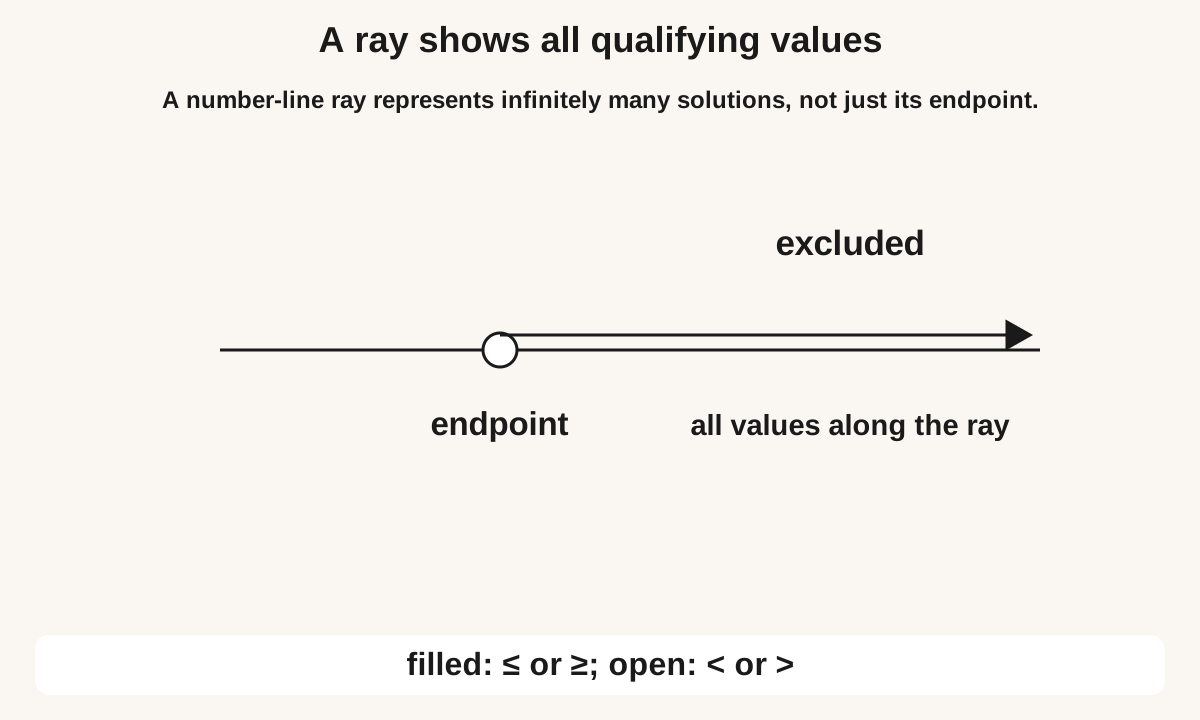
An inequality can describe a whole set of allowed values. Solving 2x + 3 < 11 gives x < 4, so 0, 1 and 3.9 work, but 4 does not. A number-line graph must show both which boundary is used and whether it belongs to the set.
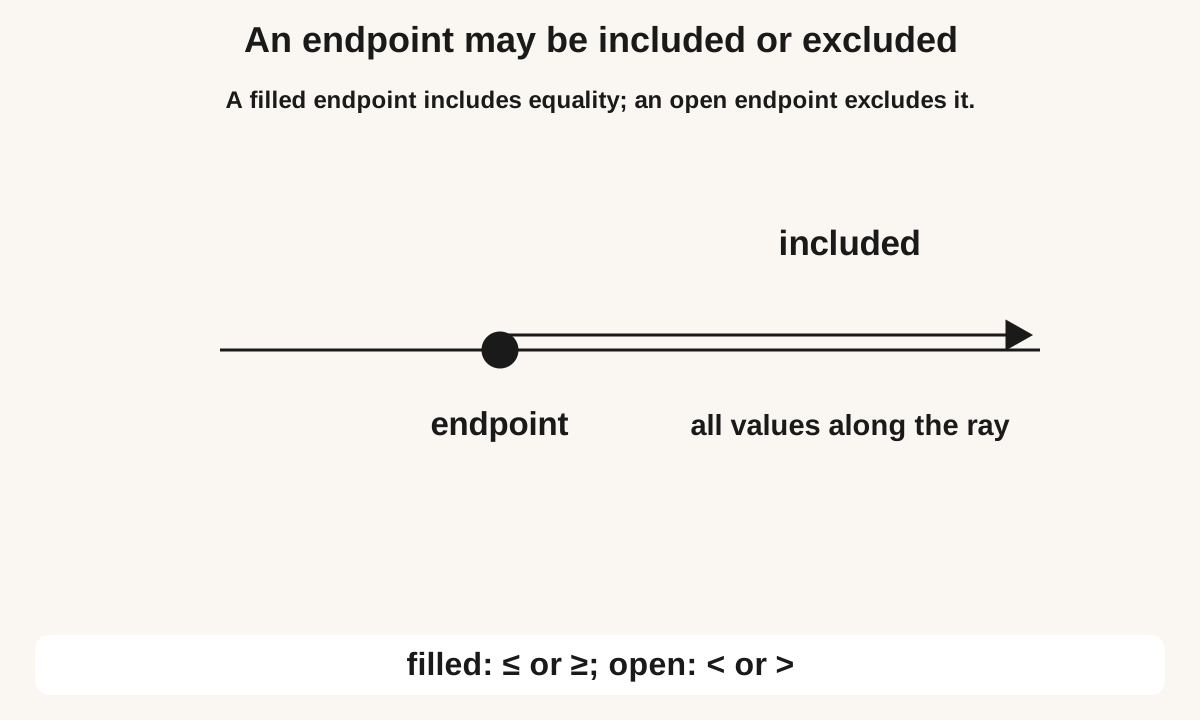
An inequality such as 2x + 3 < 11 is solved with the same inverse steps as an equation, as long as you multiply or divide by a positive number: 2x < 8, so x < 4. Every number less than 4 is a solution. On a number line, an open circle means the endpoint is not included (< or >). A filled circle means it is included (≤ or ≥). If you multiply or divide both sides by a negative number, reverse the inequality sign. Example: −x > 3 becomes x < −3 after multiplying by −1.
Learning goal: Solve and represent one-variable linear inequalities. The grade is a suggested starting point; school sequences vary. Use the first worked example to check readiness, and Grade 8 linear equations: variables on both sides if an earlier idea needs revisiting.
See the idea
Read each diagram with its labels, then follow the worked examples. Practice questions include their own measurements and information.
Enlarge diagram to read the labels
Swipe across the enlarged diagram to read every label.
Enlarge diagram to read the labels
Swipe across the enlarged diagram to read every label.
Choose a method and explain why it works
Use inverse operations on both sides. Adding or subtracting the same value preserves the comparison. Multiplying or dividing by a positive number also preserves it. Multiplying or dividing by a negative reverses the order, so reverse the inequality sign. Test the boundary and one value on the shaded side afterwards.
Notation: x < 4 is all numbers to the left of 4, not including 4. x ≥ −1 includes −1 and everything to the right.
Key rule and when to use it
Adding or subtracting the same quantity preserves an inequality. Multiplying or dividing both sides by a negative number reverses its direction.
Worked examples, step by step
Example 1: Solve 2x + 3 < 11 and describe the graph.
- Subtract 3: 2x < 8. Divide by 2: x < 4.
- Open circle at 4, shade to the left.
- Check a point: x = 0 gives 3 < 11, true. x = 5 gives 13 < 11, false.
Answer: x < 4
Check: The original looks like 2x + 3 = 11 when x = 4, so the boundary is 4 and the inequality is strict.
Example 2: Solve 5 − 3x ≥ 8.
- Subtract 5: −3x ≥ 3. This division is by a negative number.
- Divide by −3 and reverse the sign: x ≤ −1.
- Filled circle at −1, shade to the left. Check x = −1: 5 − 3(−1) = 8, which is allowed by ≥.
Answer: x ≤ −1
Check: Larger x makes −3x smaller, so the solutions are the smaller x values.
Example 3: Tickets cost ₹8 each, and you have at most ₹50. How many whole tickets can you buy?
- Write 8n ≤ 50 with n a non-negative whole number.
- Divide by positive 8: n ≤ 6.25.
- Whole-ticket counts are 0 through 6. Six cost ₹48; seven would cost ₹56 and fail the budget.
Common mistakes and important boundaries
An open circle represents a strict boundary; a filled circle includes the boundary. A context may impose extra limits. If t is elapsed time, t ≥ 0 as well as the inequality you solve. If x counts tickets, only whole-number solutions make sense, even if the algebra permits decimals.
A point to explain
A learner may keep the inequality sign after dividing by a negative, or draw a closed circle for a strict inequality.
Compare an uncertain attempt with the closest worked example. Look at the meaning of each operation, unit and label before repeating the arithmetic.
Solving Linear Inequalities on a Number Line — practice
Work on paper first. Open each answer afterwards and compare the reasoning. Print the questions with or without the separate answer key; no account is required.
Name: ____________________ Date: __________
On a number line, a filled circle at 3 with shading to the right shows which inequality?
Answer and a way to check
x ≥ 3
Filled means 3 is included. Rightward shade means greater.
If you divide both sides of −2x > 6 by −2, which inequality remains?
Answer and a way to check
x < −3
Dividing by a negative reverses the inequality. 6 ÷ −2 is −3.
Solve 4x + 1 ≤ 13.
Answer and a way to check
x ≤ 3
Subtract 1, then divide by 4. Keep the ≤ sign.
Solve 9 − 2x > 1.
Answer and a way to check
x < 4
Subtract 9, then divide by −2 and reverse the sign.
List the integers that satisfy −1 ≤ x < 3.
Answer and a way to check
-1, 0, 1, 2
Include −1. Do not include 3. List the integers strictly between them as well.
Explain why x = 4 is not a solution of 2x + 3 < 11, even though it solves 2x + 3 = 11.
Answer and a way to check
The inequality is strict. At x = 4 both sides are equal, so 11 < 11 is false.
Substitute x = 4 into 2x + 3 < 11. Equal values do not satisfy <.
A student solves −x ≥ 4 by writing x ≥ −4. What is the mistake?
Answer and a way to check
Multiplying by −1 reverses the sign, so x ≤ −4.
Multiply both sides by −1 and reverse ≥ to ≤.
A tank starts with 8 litres and leaks 2 litres per hour. It must stay above 2 litres. Solve 8 − 2t > 2 for t, in hours.
Answer and a way to check
t < 3
Subtract 8, then divide by −2 and reverse the inequality.
Solving Linear Inequalities on a Number Line — answer key
x ≥ 3 Filled means 3 is included. Rightward shade means greater.
x < −3 Dividing by a negative reverses the inequality. 6 ÷ −2 is −3.
x ≤ 3 Subtract 1, then divide by 4. Keep the ≤ sign.
x < 4 Subtract 9, then divide by −2 and reverse the sign.
-1, 0, 1, 2 Include −1. Do not include 3. List the integers strictly between them as well.
The inequality is strict. At x = 4 both sides are equal, so 11 < 11 is false. Substitute x = 4 into 2x + 3 < 11. Equal values do not satisfy <.
Multiplying by −1 reverses the sign, so x ≤ −4. Multiply both sides by −1 and reverse ≥ to ≤.
t < 3 Subtract 8, then divide by −2 and reverse the inequality.
Questions students and parents ask
Does x < 3 always mean the answer is 2?
No. Over the real numbers it includes infinitely many values, such as 2.5 and −10. If x must be a whole-number count, intersect the inequality with that context’s allowed values.
Why does the sign reverse after dividing by a negative?
Multiplication by a negative reverses number-line order. For example 2 < 5 becomes −2 > −5 when both sides are multiplied by −1.
Is this a complete set of textbook exercise solutions?
No. This guide adapts BananaLearn’s own teaching examples and practice. It is not official NCERT material or a promise of the exact chapter sequence in a particular board, country or textbook edition.
What if the examples are still difficult?
Revisit Grade 8 linear equations: variables on both sides. Try the first example with its model, then attempt one fresh question independently. A correct copied answer is not evidence that the method can be used without support.
Help at home
Ask for one working solution and one non-solution after the algebra. This checks that the answer describes a range rather than one boundary number.
Keep one example of the learner’s own working. A repeated difficulty across fresh questions can guide a discussion with their teacher; one short practice sheet does not establish a diagnosis or a full mastery profile.
Connect this idea to the next skill
About this guide
Based on BananaLearn’s Grade 8 course lesson “Inequalities on a Line”. The explanations have been adapted for independent reading; course diagrams are reused where they fit the idea, and missing classroom givens are made explicit in questions.
Need another way to understand it?
Bring one question your child found difficult to a free 50-minute session. Tell us their grade, curriculum and time zone so we can discuss a suitable next step.
Request a free session