Learning · Suggested Classes 5–8
World Television Day 2026: A Media-Literacy Activity for Kids
A cropped screenshot says school is closed tomorrow. It has a logo and hundreds of shares. Before changing your plans, what would you check?
Original BananaLearn guide · 2 November 2026
On a phone, swipe across the illustration to read every label.

Date and purpose of the activity
The United Nations observes World Television Day on 21 November. In 2026 this is Saturday 21 November. The observance recognises the role of television in communication; it does not mean every programme or online video is trustworthy. Check local event listings separately from the annual date.
This independent BananaLearn activity uses an invented school notice, not a real closure announcement. It suits roughly ages 10–14 and takes about 30 minutes. The skill is tracing a claim to usable evidence. It applies to television clips, forwarded videos and screenshots without requiring a child to browse social media or open unfamiliar links.
Prepare the fictional materials
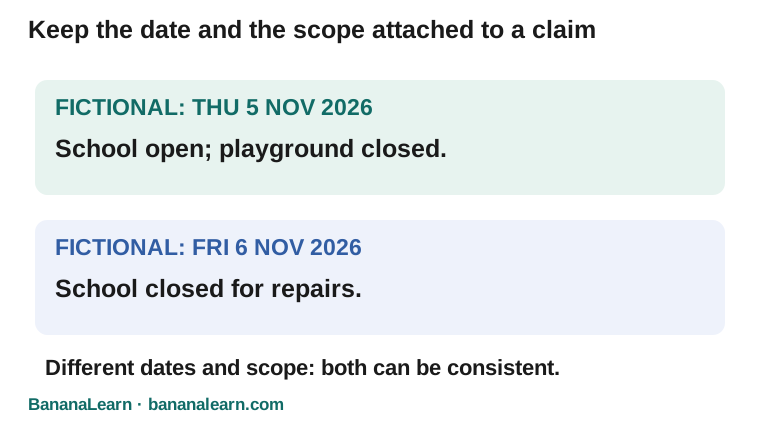
Write three clearly labelled fictional cards. Card A says School closed tomorrow, displays the invented name River School, and has no date or source link. Card B is a full notice reading River School will be closed for repairs on Friday 6 November 2026. Card C says River School remains open on Thursday 5 November 2026; only the playground is closed.
Explain that these are manufactured teaching examples and that none proves an actual school’s status. No school logo is needed. Use paper, a notebook and a timer. An adult reads the cards for younger learners. Do not ask children to enter names, addresses, accounts or their real school’s private messages into a public tool.
Minute 0–5: identify the exact claim
Ask the learner to restate what Card A claims. School closed tomorrow is incomplete because tomorrow depends on when the message was written and seen. It also needs a school identity and the scope of closed. Does it concern the whole school, a year group, the playground or one activity?
A precise checkable version would be River School will be closed to pupils on Friday 6 November 2026. This is still a claim, not established truth. Writing it clearly tells the learner what evidence they need. Do not begin by counting shares: popularity does not answer the date, identity or scope questions.
On a phone, swipe across the illustration to read every label.
Minute 5–12: trace source, date and context
Use three checks: Who issued it? When does it apply? What does the complete message say? A logo in a screenshot is not proof of origin. Cropping can remove a date or qualification, and an old genuine notice can be shared in a misleading new context.
For a real closure decision, an adult would use the school’s usual verified communication channel or an independently known contact route. Do not use a phone number or link supplied only by the suspicious screenshot. The purpose is not to distrust every message; it is to match the importance of the decision with an appropriate source.
Minute 12–20: compare the three cards
If the decision concerns Thursday 5 November, Card B’s Friday repair closure does not establish a Thursday closure. Card C says the school is open on Thursday but the playground is closed. These messages could both be consistent when dates and scope are retained. A cropped version can make them look contradictory.
A careful provisional conclusion is The screenshot alone is insufficient; the full fictional notices distinguish Thursday opening from Friday closure. In a real situation we would confirm through the school’s established channel. Do not teach that missing evidence proves the opposite claim. Unverified means not established by the available evidence.
Separate fact, opinion and persuasion
The school is closed on Friday is a factual claim that can be checked against relevant evidence. This is the worst school schedule is an opinion or judgement. Share this immediately is an instruction designed to prompt action. A single message may contain all three, so label individual statements rather than assigning one label to the whole video.
An advertisement or edited clip can include a true fact while omitting an important condition. For example, A programme offers ten lessons may be true, but it does not establish that every child will master a topic after those lessons. Look for exactly what the evidence supports. Confidence of presentation is not evidence of a learning outcome.
Minute 20–27: write a responsible response
Ask the learner to write a private draft, not send a real message: This screenshot has no date. I would check the full notice through our usual school channel before acting on it. This response explains the uncertainty without accusing a person of lying or forwarding an unsupported claim to more people.
For a class group, assign roles: claim reader, context checker and evidence recorder. Rotate after one example. Avoid rewarding the fastest verdict; reward the explanation of what is known, what remains uncertain and which check would resolve it. Different learners may notice different missing details.
Minute 27–30: complete the checking record
Use the table below to record the exact claim, source, applicable date, missing context, best available evidence and next action. A strong record can finish with Not enough information yet. It should say what would be needed, such as a current full notice from the school’s established channel.
For an easier version, offer two full notices and ask which date each covers. For an extension, ask how a truthful sentence might become misleading when its date is removed. Do not use distressing or politically charged footage as a first exercise. A neutral fictional example is sufficient for practising source and context checks.
A reusable claim-checking record
Copy this record into a notebook. Fill each blank using your own example or the activity above.
On a phone, swipe across a wide table to see every column.
| Check | Record before deciding |
|---|---|
| Exact claim | ___ |
| Who issued it? | ___ |
| Applicable date and scope | ___ |
| Full context available? | ___ |
| Evidence supports… | ___ |
| Uncertain detail / next check | ___ |
10 questions with explained answers
Try each question first. Open the explanation to check your reasoning. These are original BananaLearn questions, not official exam questions.
When is World Television Day observed?
Check answer and reasoning
21 November; in 2026 it is a Saturday.
The United Nations gives the annual date. Event schedules may differ.What is ambiguous in School closed tomorrow?
Check answer and reasoning
The relevant date, school identity and scope of closure.
Tomorrow changes with the date of the message. Closed might refer to only part of the site.Does a logo prove that a screenshot came from a school?
Check answer and reasoning
No.
A logo can be copied and a screenshot can omit its origin. Verify through a known channel.Does a Friday closure notice prove school is closed on Thursday?
Check answer and reasoning
No.
It applies to a different date. Keep the time condition attached to the claim.Can school open and playground closed both be true?
Check answer and reasoning
Yes.
They describe different scopes. The playground is one part of the site.Classify This is the worst timetable.
Check answer and reasoning
An opinion or judgement.
It expresses an evaluation. A supporting argument can be discussed, but it is not a closure notice.Classify Share this with everyone now.
Check answer and reasoning
An instruction or call to action.
It asks for behaviour; it does not provide evidence for the factual claim.What does unverified mean here?
Check answer and reasoning
The available evidence has not established the claim.
It does not automatically mean the claim is false or that its opposite is true.A thousand people shared a clip. What does that establish?
Check answer and reasoning
That it was widely shared, if the count is genuine.
It does not establish whether the clip’s factual claim is accurate or current.What is a safer next step than calling a number shown only on a suspicious screenshot?
Check answer and reasoning
Use the school’s independently known communication channel.
The suspicious material should not provide the only route used to verify itself.
Choose your next learning step
- Practise fact, opinion and inference
- Check what an AI answer helps a child understand
- Build an evidence-based explanation
Explore BananaLearn games, learning resources and tutoring. Maths is our priority; English and Science tutoring are also available. Share your current schoolwork when checking teaching fit.
Sources and scope
Explanations, activities, diagrams and practice are original BananaLearn work. Class labels suggest a learning level; school sequences and current textbook editions can differ. Sources checked 2 November 2026.
How we prepare guides · Report a correction
Share the complete guide: https://bananalearn.com/learn/world-television-day-2026-media-literacy-activity.html